Basic Constructions (Leaving Cert Mathematics): Revision Notes
📚Revision Notes
Basic Constructions
Overview
Geometric constructions involve creating figures or lines using only a compass and straight edge. The basic constructions are fundamental tools for solving complex geometric problems. This note covers constructing angle bisectors, perpendicular bisectors, and perpendicular lines.
Bisector of a Given Angle
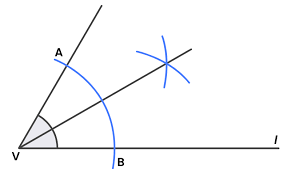
Objective: To divide a given angle into two equal parts.
Method
- Place the compass at the vertex of the angle and draw an arc that intersects both arms of the angle.
- Without changing the compass width, place the compass at one intersection point and draw an arc inside the angle.
- Repeat from the other intersection point.
- Use a straight edge to draw a line from the vertex to the intersection of the two arcs inside the angle. Result: The line divides the angle into two equal parts.
Perpendicular Bisector of a Line Segment
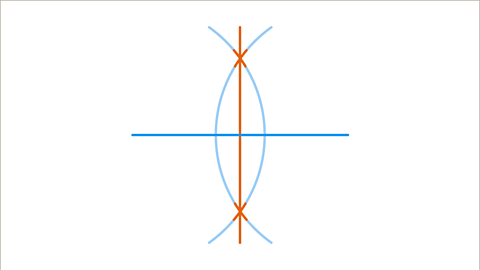
Objective: To create a line perpendicular to a given segment that also bisects it into two equal parts.
Method
- Place the compass at one endpoint of the segment and draw an arc above and below the line. The radius must be more than half the segment length.
- Repeat the process from the other endpoint, keeping the same compass width.
- The two arcs intersect above and below the segment.
- Use a straight edge to draw a line connecting the intersection points of the arcs. Result: The line is the perpendicular bisector of the segment.
Line Perpendicular to a Given Line Passing Through a Point Not on the Line
Objective: To construct a line perpendicular to a given line that passes through a point not on the line.
Method
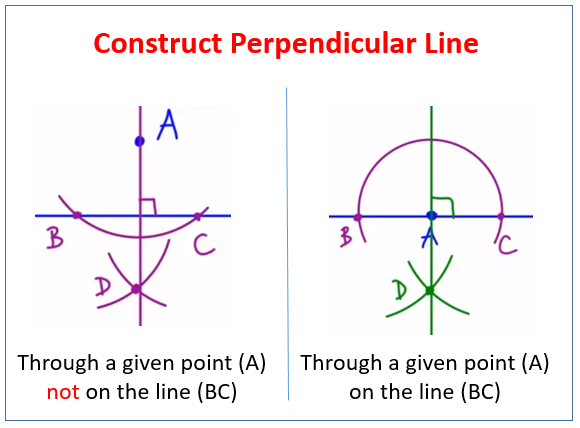
- Place the compass at the given point and draw an arc that intersects the given line at two points.
- Without changing the compass width, place the compass at each intersection point and draw arcs that intersect above or below the line.
- Use a straight edge to draw a line connecting the given point to the intersection of the arcs. Result: The line is perpendicular to the given line and passes through the given point.
Line Perpendicular to a Given Line Passing Through a Point on the Line
Objective: To construct a line perpendicular to a given line that passes through a point on the line.
Method
- Place the compass at the given point and draw an arc that intersects the line on both sides of the point.
- Without changing the compass width, place the compass at each intersection point and draw arcs above or below the line.
- Use a straight edge to draw a line connecting the given point to the intersection of the arcs. Result: The line is perpendicular to the given line and passes through the given point.
Summary
- Angle Bisector: Divides an angle into two equal parts.
- Perpendicular Bisector: Perpendicular line that bisects a segment into two equal parts.
- Perpendicular from a Point Not on a Line: Creates a perpendicular line from a point outside the line.
- Perpendicular from a Point on a Line: Creates a perpendicular line through a point on the line. These basic constructions are vital skills for solving more complex geometric problems.