Enlargements (Leaving Cert Mathematics): Revision Notes
📚Revision Notes
Enlargements
An enlargement is a transformation that changes the size of a shape while keeping its proportions exactly the same. The shape becomes bigger or smaller, but its angles remain unchanged and its sides stay in the same ratio to each other.
Note
Think of enlarging a photograph - the image becomes bigger, but everything in it maintains the same proportional relationships. This is exactly what happens in mathematical enlargements.
Key terminology
Understanding enlargements requires knowing these essential terms:
- Object: The original shape before transformation
- Image: The new shape after the enlargement
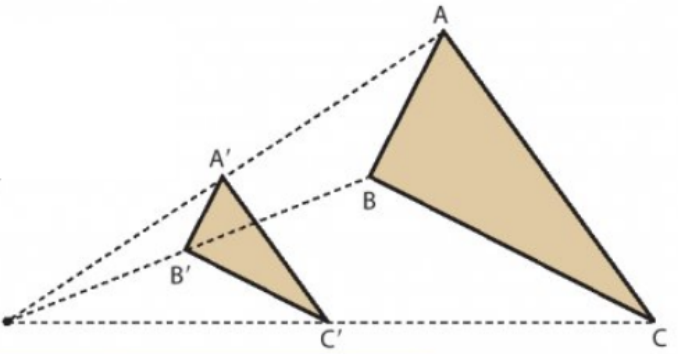
- Centre of enlargement: The fixed point from which the enlargement takes place
- Scale factor: The number that tells us how many times bigger (or smaller) the image is compared to the object
- Rays or guidelines: The straight lines drawn from the centre of enlargement through corresponding points on the object and image
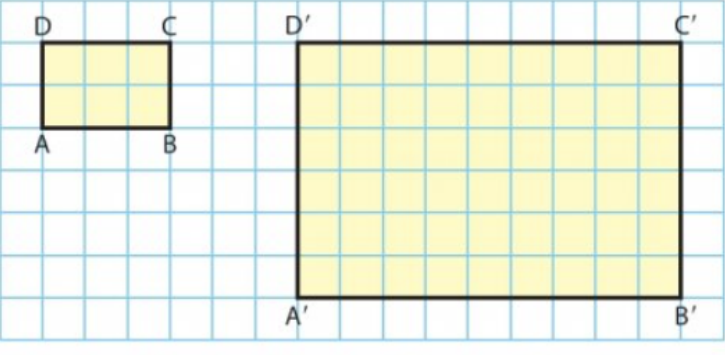
Scale factor
The scale factor is the most important measurement in enlargements. It tells us the relationship between the size of the image and the size of the object.
Important
Scale factor = length of image side ÷ length of corresponding object side
For example, if a side of the object measures 3 cm and the corresponding side of the image measures 9 cm, then: Scale factor =
This means the image is 3 times larger than the object.
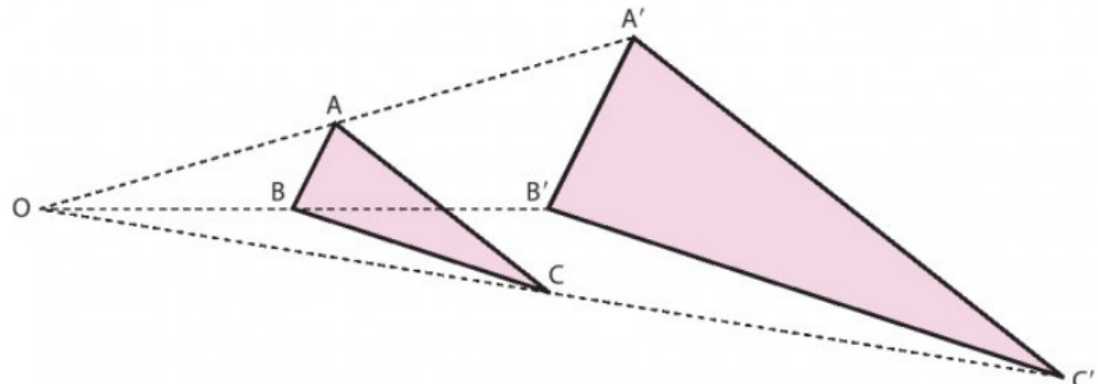
When we know the scale factor (let's call it ), we can find any length in the image:
Drawing enlargements
To construct an enlargement, you need two pieces of information:
- The centre of enlargement
- The scale factor
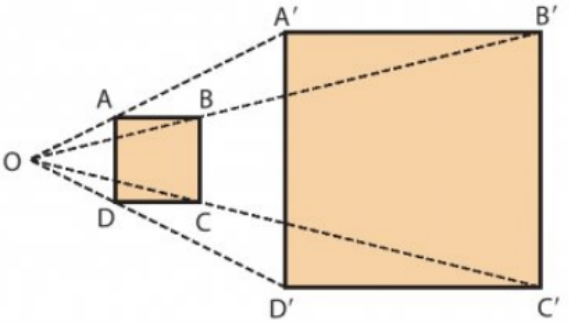
Example
Step-by-Step Construction Method:
- Draw a straight line from the centre of enlargement to each vertex of the object
- Measure the distance from the centre to each vertex
- Multiply this distance by the scale factor
- Mark the new vertex at this calculated distance along the same line
- Join up all the new vertices to complete the image
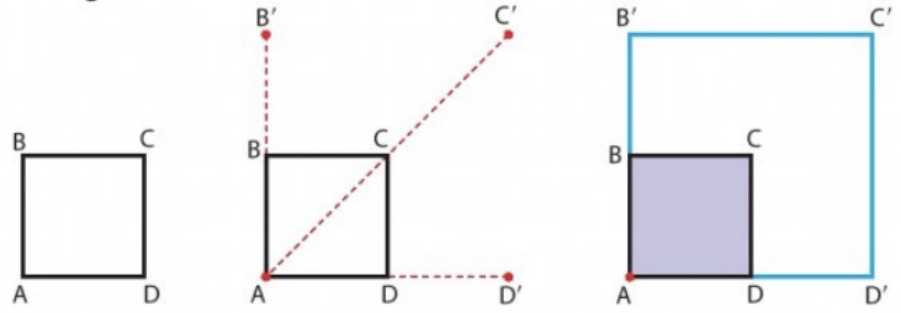
When a vertex is the centre of enlargement
Note
Sometimes one of the vertices of the object acts as the centre of enlargement. When this happens, that particular vertex doesn't move - it stays in exactly the same position in both the object and the image.
For all other vertices, you still follow the same construction method, measuring distances from the fixed vertex and multiplying by the scale factor.
Enlargements with scale factor less than 1
When the scale factor is less than 1 (but still positive), the "enlargement" actually produces a smaller figure. This is sometimes called a reduction.
Important
Scale Factor Rules:
- If , the figure gets bigger (true enlargement)
- If , the figure gets smaller (reduction)
- If , the figure stays the same size
For example, if the scale factor is , then each side of the image will be half the length of the corresponding side in the object.
Finding the centre of enlargement
When you're given both the object and its image, you can find the centre of enlargement using this method:
Example
Finding the Centre of Enlargement:
- Choose any two pairs of corresponding vertices
- Draw a straight line through each pair
- Extend these lines until they meet
- The point where they meet is the centre of enlargement
This method works because all the rays from the centre of enlargement pass through corresponding points on the object and image.
Enlargement and area
There's a special relationship between enlargements and area that's crucial for exam success:
Important
Area Scaling Rule:
When a figure is enlarged by scale factor , the area of the image = area of the object
Notice that the area scales by , not just . This is because area involves two dimensions (length and width), so both get multiplied by the scale factor.
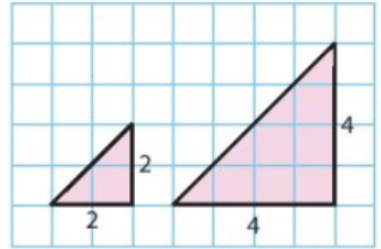
Example
Worked Example: Area Relationship
If a triangle has an area of 12 cm² and is enlarged by scale factor 2, what's the area of the image?
Solution: Area of image = area of object Area of image = cm²
Worked example: Finding scale factor and lengths
Example
Worked Example: Complete Enlargement Analysis
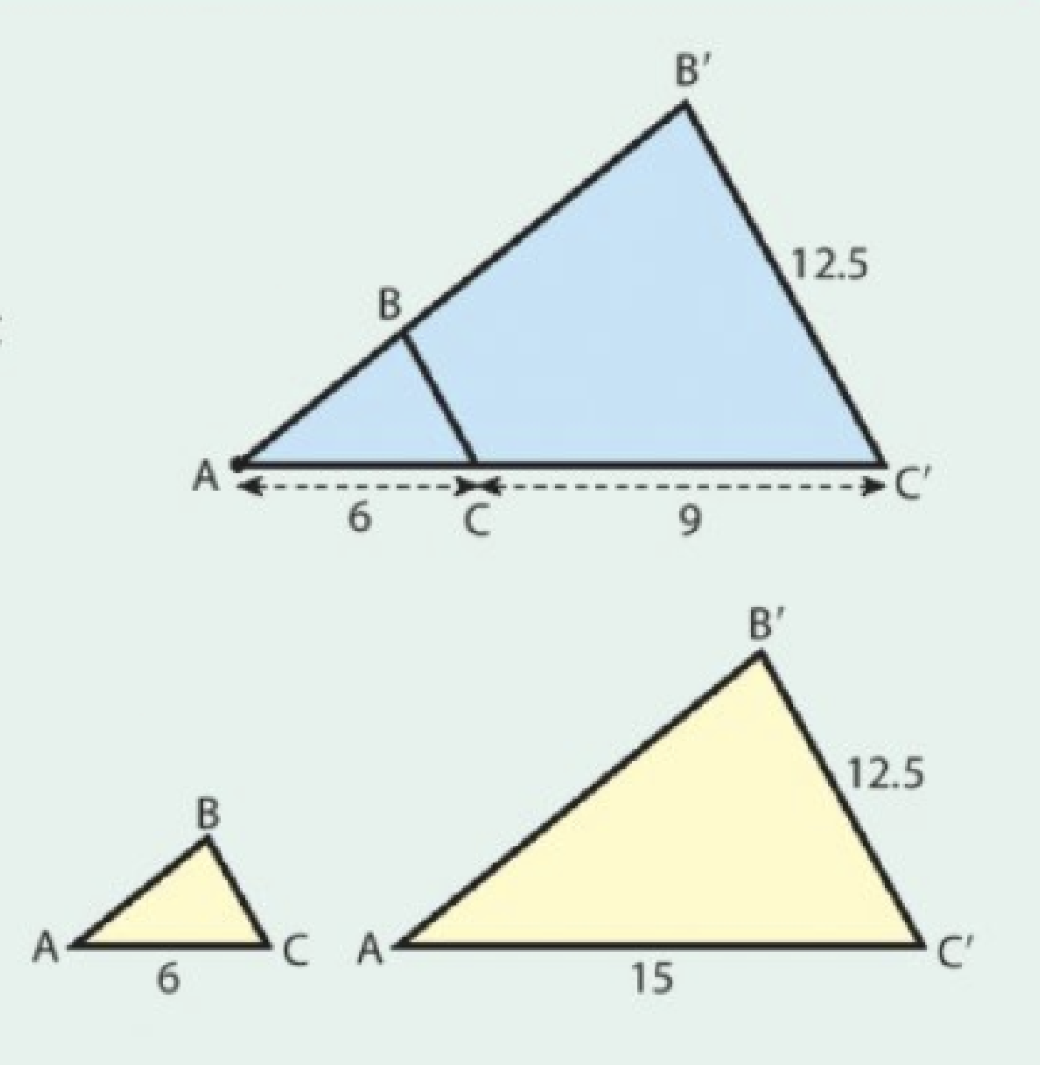
Problem: Triangle ABC is enlarged to triangle A'B'C' with centre of enlargement O. Given |AC| = 6, |CC'| = 9, and |B'C'| = 12.5, find:
- The scale factor
- The length |BC|
- The ratio |AB| : |AB'|
Solution:
(i) Finding the scale factor: First, find |AC'| = |AC| + |CC'| = 6 + 9 = 15
Scale factor = |AC'| ÷ |AC| =
(ii) Finding |BC|: Since scale factor = 2.5, we know |B'C'| = 2.5 × |BC| 12.5 = 2.5 × |BC| |BC| =
(iii) Finding the ratio |AB| : |AB'|: Since |AB'| = 2.5 × |AB|, the ratio is: |AB| : |AB'| = |AB| : 2.5|AB| = 1 : 2.5 = 2 : 5
Worked example: Area problem
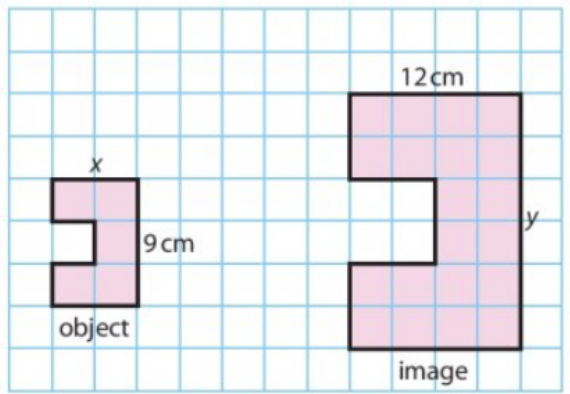
Example
Worked Example: Finding Scale Factor from Areas
Problem: Figure P'Q'R'S' is an enlargement of figure PQRS. If the area of PQRS is 12 cm² and the area of P'Q'R'S' is 48 cm², find the scale factor.
Solution: Let be the scale factor. Area of image = area of object
Therefore, the scale factor is 2.
Inverse enlargements
Note
Sometimes you need to go from the enlarged image back to the original object. This is called an inverse enlargement.
If the original enlargement had scale factor , then the inverse enlargement has scale factor .
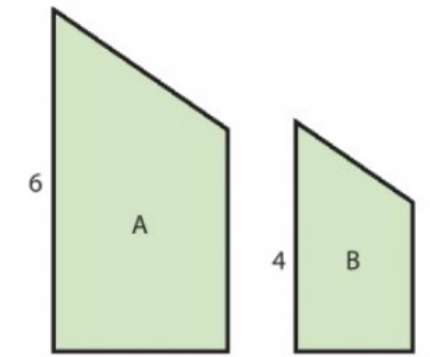
For example, if shape A was enlarged by scale factor to give shape B, then to go from B back to A, you'd use scale factor .
Summary
Key Points to Remember:
- Scale factor = length of image side ÷ length of object side
- Area scales by k², not just k - this is a common exam trap
- Scale factor less than 1 produces a smaller figure (reduction)
- To find the centre of enlargement, join corresponding vertices and extend the lines until they meet
- All measurements (lengths, distances from centre) are multiplied by the scale factor in an enlargement