Rotations (Leaving Cert Mathematics): Revision Notes
📚Revision Notes
Rotations
What is Rotation?
Rotation involves turning a shape around a specific point, called the centre of rotation, by a certain angle, in either a clockwise or anti-clockwise direction.
Key Characteristics of Rotation:
- The image (rotated shape) is the same size as the original but may be in a different orientation.
- The distance from the centre of rotation to any point on the shape remains the same before and after the rotation.
- Angle of rotation: This is typically .
- Direction of rotation: This can be clockwise or anti-clockwise.
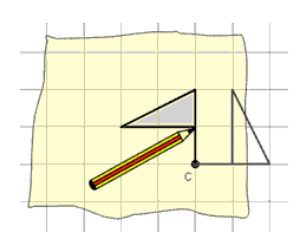
Describing Rotations
When describing a rotation, you must provide the following information:
- Centre of Rotation: This is the fixed point around which the shape is rotated. It is often given as a coordinate, such as () or ().
- Direction of Rotation: This is the degree of rotation, which is usually , or .
- Angle of Rotation: This is the degree of rotation, which is usually , or .
Note
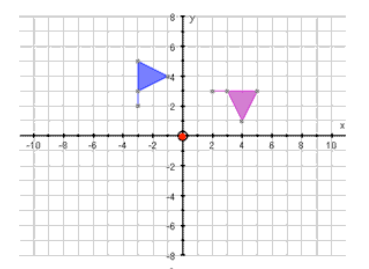
Worked Example 1: Rotating Around the Origin ()
Rotate the blue object to obtain the purple object with the following details:
- Centre of Rotation: () - the origin
- Direction of Rotation: Clockwise
- Angle of Rotation: Steps:
- Locate the centre of rotation at () on the grid.
- Rotate each point of the blue object clockwise around the origin.
- Plot the new points and draw the purple object. Notice: If you wanted to describe the same rotation differently, you could say it was a anti-clockwise rotation since both produce the same result.
Note
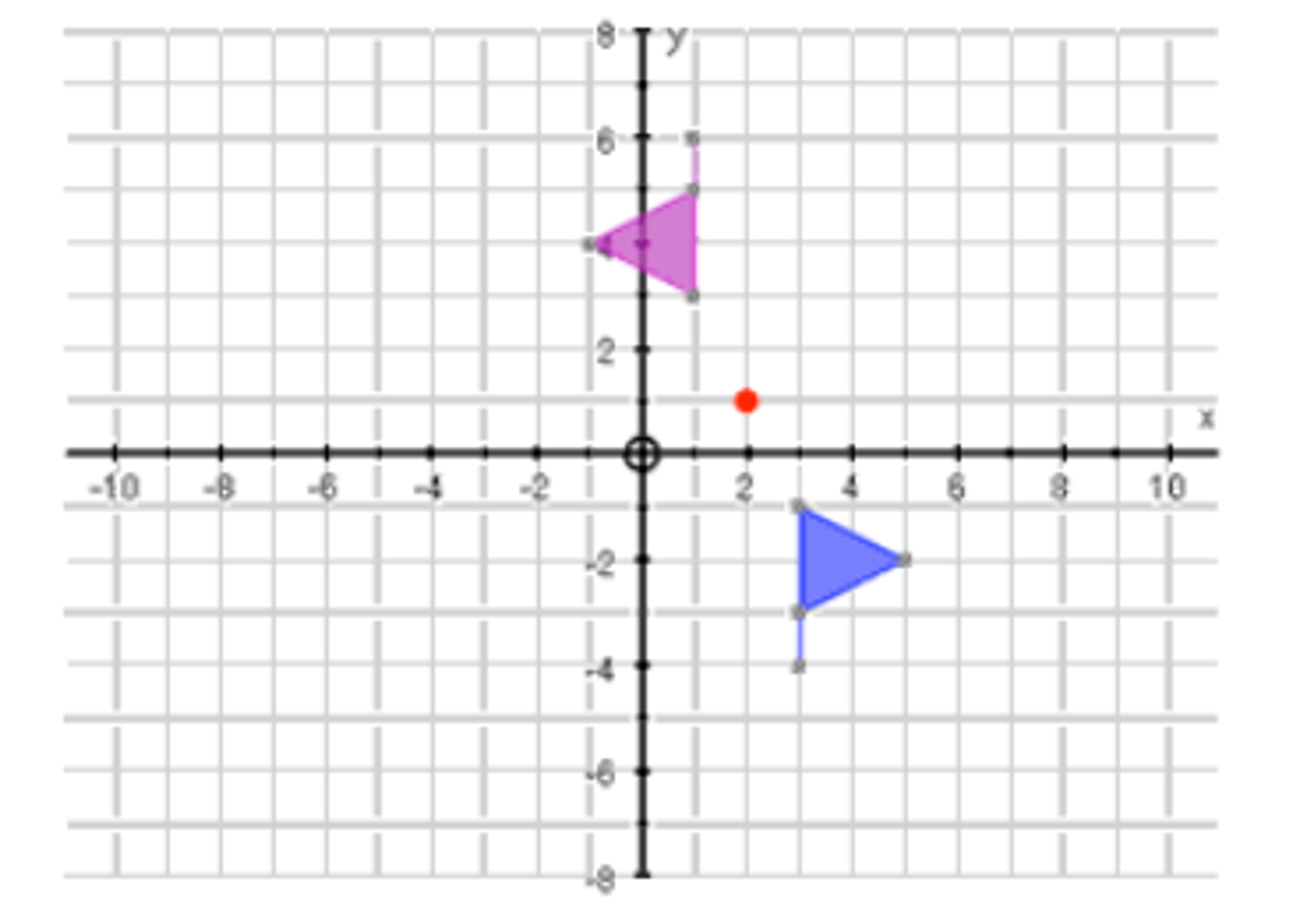
Worked Example 2: Rotating Around a Point ()
Rotate the blue object to obtain the purple object with the following details:
- Centre of Rotation: ()
- Direction of Rotation: Clockwise
- Angle of Rotation: Steps:
- Locate the centre of rotation at () on the grid.
- Rotate each point of the blue object clockwise around ().
- Plot the new points and draw the purple object. Notice: Whenever the angle of rotation is , the direction (clockwise or anti-clockwise) does not matter—the result is the same.