Revision of Angles and Triangles (Leaving Cert Mathematics): Revision Notes
📚Revision Notes
Revision of Angles and Triangles
Types and names of angles
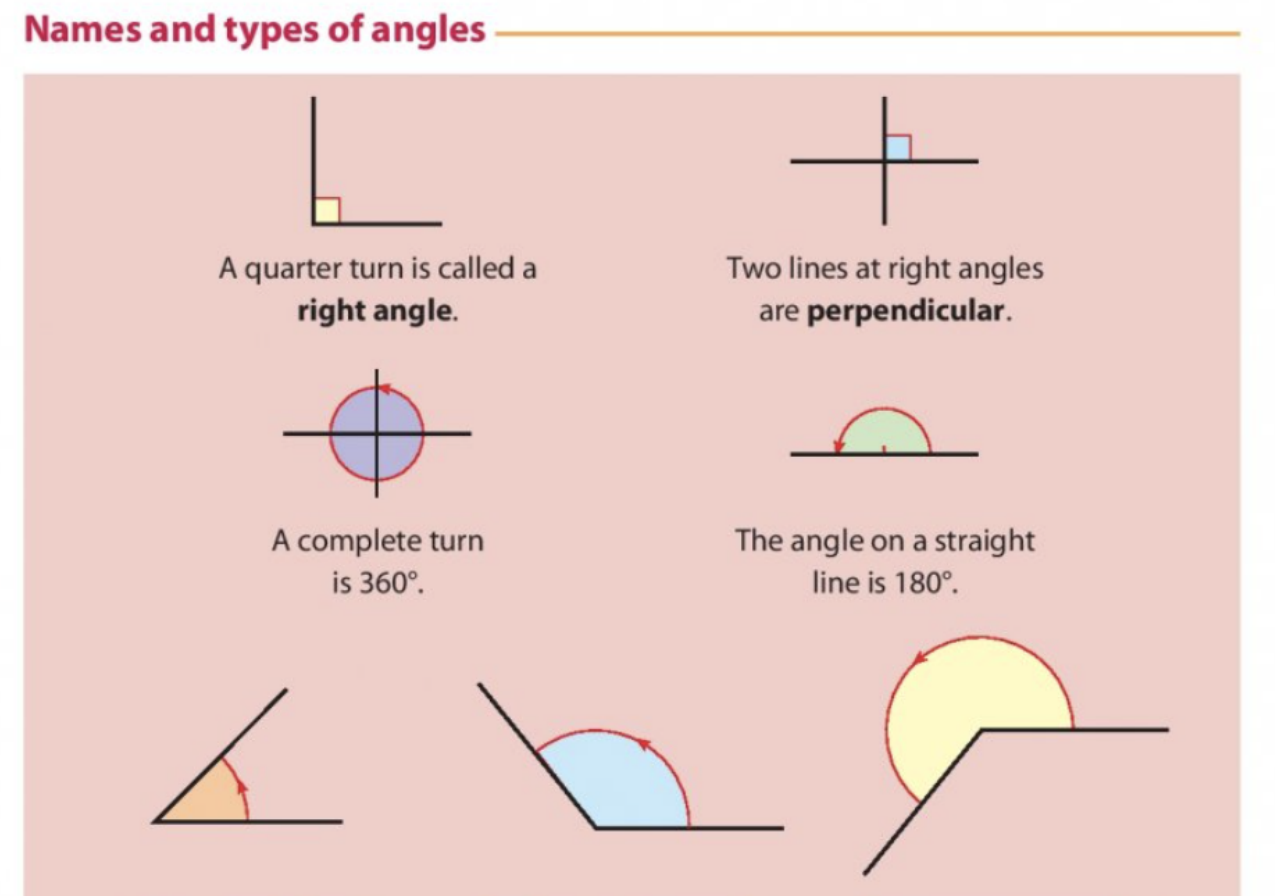
Understanding different types of angles is crucial for solving geometric problems. Each angle type has specific properties that you need to recognise and apply.
Right angle
A right angle measures exactly 90°. We can think of this as a quarter turn or one-fourth of a complete rotation. Right angles are marked with a small square symbol in diagrams.
Perpendicular lines
When two lines meet at right angles (90°), we say the lines are perpendicular to each other. This relationship is fundamental in many geometric constructions and proofs.
Note
Perpendicular lines create four right angles where they intersect, making them essential in many geometric constructions and architectural designs.
Complete turn
A complete turn measures 360°. This represents a full rotation around a point, bringing you back to your starting position.
Straight line angle
The angle on a straight line measures 180°. This represents half of a complete turn and forms a straight line.
Acute angle
An acute angle measures between 0° and 90°. These angles are smaller than a right angle and appear "sharp" or narrow.
Obtuse angle
An obtuse angle measures between 90° and 180°. These angles are larger than a right angle but smaller than a straight line angle.
Reflex angle
A reflex angle measures between 180° and 360°. These angles are larger than a straight line angle but smaller than a complete turn.
Properties of angles
Several important relationships exist between angles when lines intersect or meet at points. These properties are frequently tested in examinations.
Angles on a straight line
When angles meet along a straight line, their sum always equals 180°. This is written as:
Supplementary angles
Two angles are called supplementary angles when they add together to make 180°. If one angle measures 70°, its supplementary angle measures 110°.
Angles around a point
When angles meet at a single point, their sum always equals 360°. This represents a complete turn around the point.
Vertically opposite angles
When two straight lines cross at a point, they form two pairs of vertically opposite angles. These angles are always equal to each other.
Important
Key Angle Properties to Remember:
- Angles on a straight line = 180°
- Angles around a point = 360°
- Vertically opposite angles are equal
- Supplementary angles add to 180°
Parallel line theorems
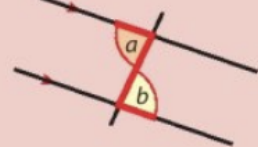
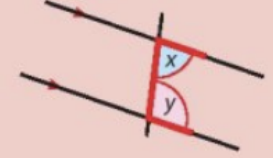
When a straight line (called a transversal) crosses two parallel lines, it creates several angle relationships that are essential for problem-solving.
Corresponding angles
Corresponding angles are equal when a transversal crosses parallel lines. You can identify them by looking for an "F" shape in the diagram. If angle a is 50°, then its corresponding angle b will also be 50°.
Alternate angles
Alternate angles are equal when a transversal crosses parallel lines. You can spot them by looking for a "Z" shape in the diagram. These angles are on opposite sides of the transversal.
Co-interior angles
The co-interior angles (also called interior angles) sum to 180° when a transversal crosses parallel lines. These angles are on the same side of the transversal and between the parallel lines:
Important
Parallel Line Memory Aid:
- F shape = Corresponding angles (equal)
- Z shape = Alternate angles (equal)
- C shape = Co-interior angles (sum to 180°)
Types of triangles
Triangles can be classified based on their side lengths and angle measurements. Each type has specific properties that are useful in problem-solving.
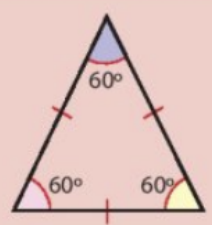
Equilateral triangle
An equilateral triangle has three equal sides and three equal angles. Each interior angle measures exactly 60°. The total of all angles is 180°, so:
Isosceles triangle
An isosceles triangle has two equal sides and two equal base angles. The two sides of equal length are marked with small parallel lines in diagrams.
Right-angled triangle
A right-angled triangle has one angle that measures exactly 90°. In these triangles, we can apply the Pythagorean theorem: where c is the hypotenuse (the longest side opposite the right angle).
Scalene triangle
A scalene triangle has no equal sides and no equal angles. Each side and angle is different from the others.
Note
Triangle Classification Tips:
- Look at the sides first: equal sides often mean equal angles
- Check for right angle markers (small squares)
- Remember that equilateral triangles always have 60° angles
Triangle angle relationships
Two fundamental theorems govern the angles in triangles. These are among the most important relationships in geometry.
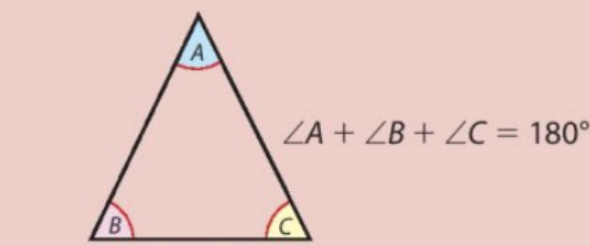
Triangle angle sum theorem
The angles inside any triangle always add up to 180°. This can be written as:
This rule applies to all triangles, regardless of their shape or size.
Exterior angle theorem
An exterior angle of a triangle equals the sum of the two interior opposite angles. If we extend one side of a triangle, the exterior angle formed equals the sum of the two non-adjacent interior angles.
Important
Triangle Angle Theorems: These two theorems are fundamental to solving triangle problems:
- Interior angles always sum to 180°
- Exterior angle = sum of opposite interior angles
Congruent triangles
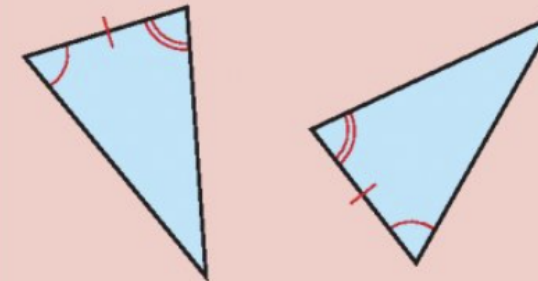
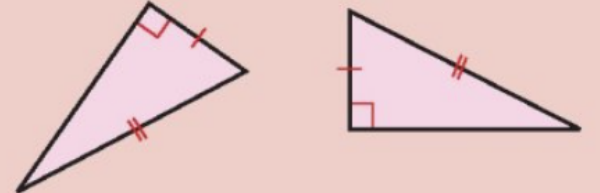
Two triangles are congruent when they are identical in shape and size. This means all corresponding sides and angles are equal. There are four main conditions that prove triangle congruence.
SSS (Side-Side-Side)
If three pairs of corresponding sides are equal, the triangles are congruent.
SAS (Side-Angle-Side)
If two pairs of corresponding sides are equal and the included angles are equal, the triangles are congruent.
ASA (Angle-Side-Angle)
If two pairs of corresponding angles are equal and the sides between them are equal, the triangles are congruent.
RHS (Right angle-Hypotenuse-Side)
For right-angled triangles, if the hypotenuses are equal and one pair of corresponding sides is equal, the triangles are congruent.
Note
Congruence Memory Aid: Remember the four conditions as SSS, SAS, ASA, RHS. Each condition provides enough information to prove that two triangles are identical in shape and size.
Worked examples
Example
Worked Example: Finding angles on parallel lines
If two parallel lines are cut by a transversal and one angle measures 65°, find the corresponding angle.
Solution: Corresponding angles are equal when parallel lines are cut by a transversal. Therefore, the corresponding angle = 65°
Example
Worked Example: Triangle angle sum
In a triangle, two angles measure 45° and 80°. Find the third angle.
Solution: Using the triangle angle sum theorem:
Example
Worked Example: Isosceles triangle
In an isosceles triangle, the apex angle is 40°. Find the base angles.
Solution: In an isosceles triangle, the base angles are equal. Let each base angle = (triangle angle sum)
Each base angle = 70°
Example
Worked Example: Exterior angle
In a triangle, two interior angles are 35° and 70°. Find the exterior angle opposite to these angles.
Solution: Using the exterior angle theorem: Exterior angle = sum of opposite interior angles Exterior angle =
Example
Worked Example: Co-interior angles
Two parallel lines are cut by a transversal. One co-interior angle is 110°. Find the other co-interior angle.
Solution: Co-interior angles sum to 180°
Summary
Key Points to Remember:
-
Angle types: Acute (0°-90°), Right (90°), Obtuse (90°-180°), Reflex (180°-360°)
-
Key angle relationships: Angles on a straight line sum to 180°, angles around a point sum to 360°, vertically opposite angles are equal
-
Parallel line rules: Corresponding angles equal (F shape), alternate angles equal (Z shape), co-interior angles sum to 180°
-
Triangle fundamentals: All triangle angles sum to 180°, exterior angle equals sum of opposite interior angles
-
Congruence conditions: Remember SSS, SAS, ASA, and RHS as the four ways to prove triangles are congruent