Angle Theorems (Leaving Cert Mathematics): Revision Notes
📚Revision Notes
Angle Theorems
Overview
Understanding angle theorems is essential for solving problems involving parallel lines, transversals, and triangles. These theorems provide foundational tools for proving relationships between angles in geometric figures. Below is a detailed explanation of each theorem:
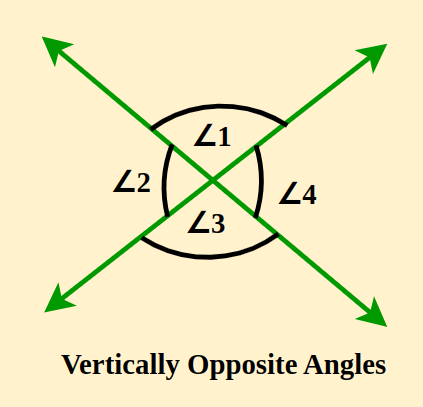
Vertically Opposite Angles
- What It States: When two straight lines intersect at a point, the angles opposite each other (vertically opposite angles) are always equal.
- Why It Works: At the point of intersection, the adjacent angles are supplementary, meaning their measures add up to . Since each pair of vertically opposite angles shares the same adjacent angles, they must have equal measures.
Alternate Angles
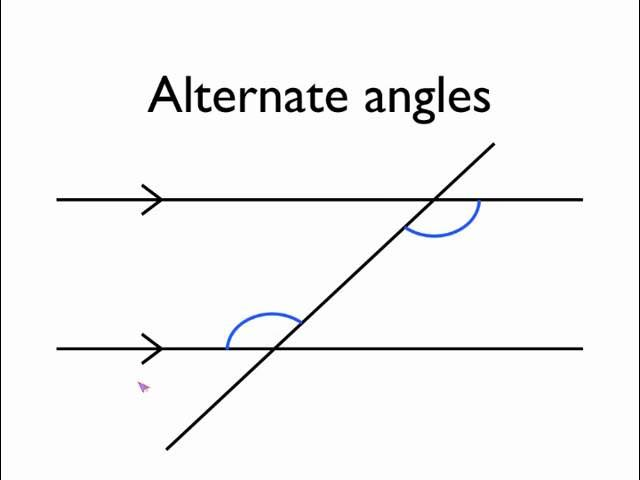
- What It States: Alternate angles are formed when a transversal crosses two lines. These angles lie on opposite sides of the transversal but are inside the two lines.
- If the two lines are parallel, the alternate angles are equal.
- Converse: If the alternate angles formed by a transversal are equal, the lines it intersects are parallel.
- Why It Works: When the lines are parallel, the transversal creates equal angles due to the consistent spacing between the two lines. This is a fundamental property of parallel lines.
Angle Sum in a Triangle
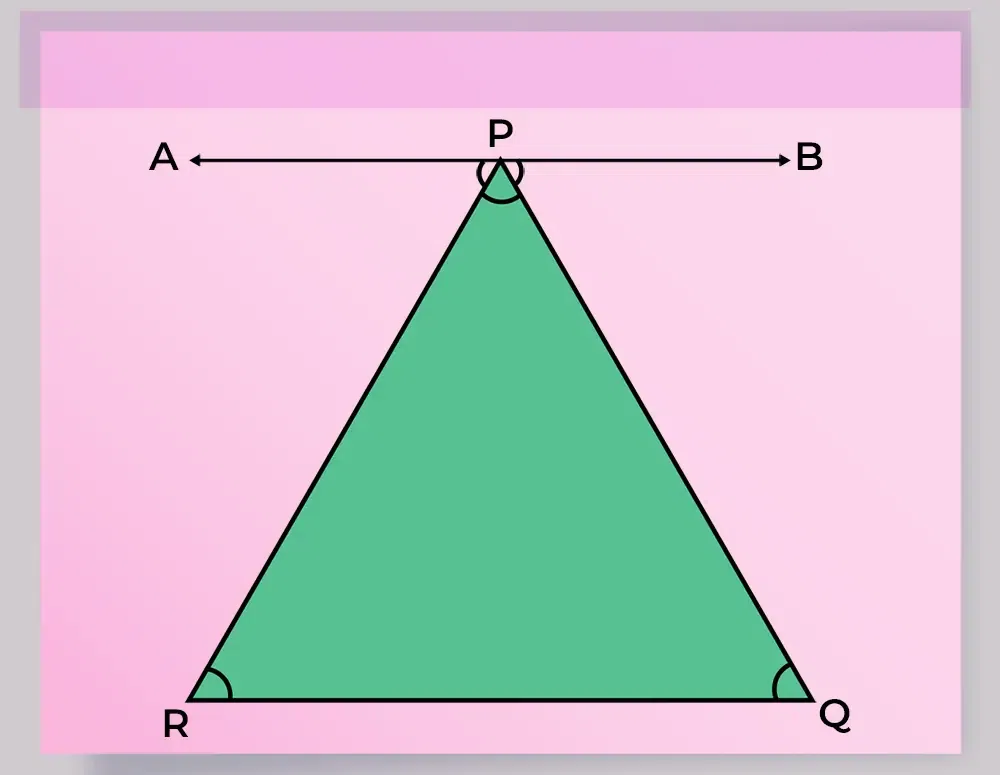
- What It States: The sum of the interior angles in any triangle is always .
- Why It Works: This can be proven by drawing a line parallel to one side of the triangle through the opposite vertex. This line creates alternate interior angles with the other two sides of the triangle, and their measures add up to form a straight angle ().
Exterior Angle of a Triangle
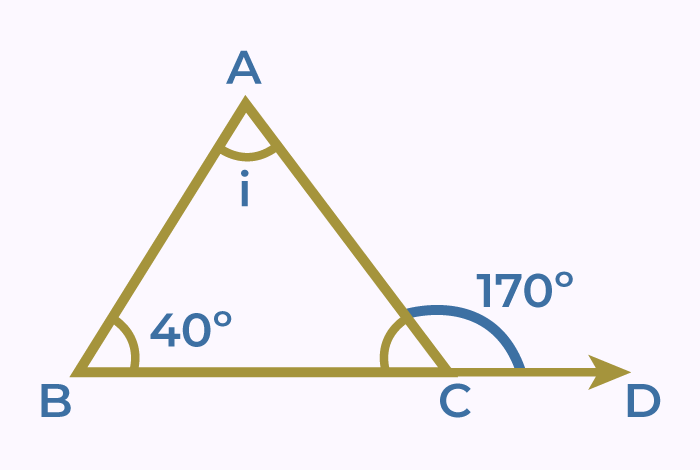
- What It States: The measure of an exterior angle of a triangle is equal to the sum of the measures of the two non-adjacent interior opposite angles.
- Why It Works: The exterior angle forms a straight line with one of the interior angles of the triangle. Using the angle sum property (), we can deduce that the exterior angle is the sum of the other two interior angles.
Worked Examples
Note
Example 1: Vertically Opposite Angles
Problem: Two lines intersect at point .
If one angle measures , find all other angles.
Solution:
- The angle opposite is also (vertically opposite angles are equal).
- The remaining two angles are supplementary to :
- The two angles are also vertically opposite and equal.
Answer: The angles are
Note
Example 2: Alternate Angles
Problem: A transversal intersects two lines, creating angles of and (alternate angles).
If the lines are parallel, find .
Solution:
By the Alternate Angle Theorem:
Answer:
Note
Example 3: Angle Sum in a Triangle
Problem: A triangle has angles and . Find the third angle.
Solution:
By the Angle Sum Theorem:
Answer: The third angle is
Note
Example 4: Exterior Angle of a Triangle
Problem: In a triangle, one exterior angle measures . If one interior opposite angle is , find the other interior opposite angle.
Solution:
By the Exterior Angle Theorem:
Answer: The other interior angle is
Summary
- Vertically Opposite Angles: Equal when two lines intersect.
- Alternate Angles: Equal if the lines are parallel; if alternate angles are equal, the lines are parallel.
- Angle Sum in a Triangle: The sum of angles is always
- Exterior Angle of a Triangle: Equal to the sum of the two interior opposite angles.
- These theorems are essential for understanding relationships between angles in geometric figures.