Triangle Theorems (Leaving Cert Mathematics): Revision Notes
📚Revision Notes
Triangle Theorems
Overview
Triangles are fundamental shapes in geometry with many important properties and relationships. The theorems discussed here focus on specific types of triangles and their unique characteristics, including isosceles triangles, right triangles, and similar triangles.
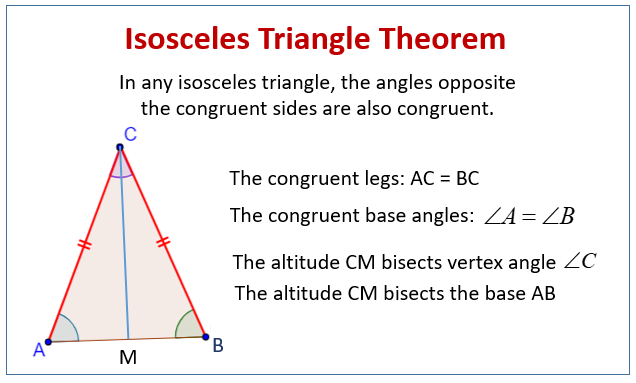
Isosceles Triangle Theorem
- Statement: In an isosceles triangle, the angles opposite the equal sides are equal.
- Converse: If two angles in a triangle are equal, the sides opposite them are also equal. Why It Works:
This theorem arises from the symmetrical nature of isosceles triangles. If two sides are equal, their corresponding angles must also be equal, maintaining balance in the shape.
The Line Joining Midpoints
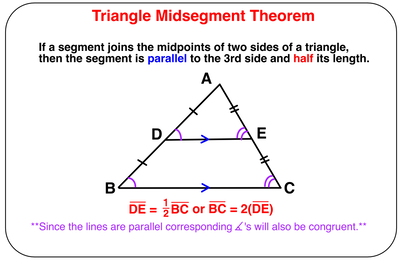
Statement:
The line joining the midpoints of two sides of a triangle is parallel to the third side and half its length.
Why It Works:
This theorem is a consequence of parallel line properties and similar triangles formed by the mid-segment. It is also known as the Midpoint Theorem.
Ratios in a Right Triangle
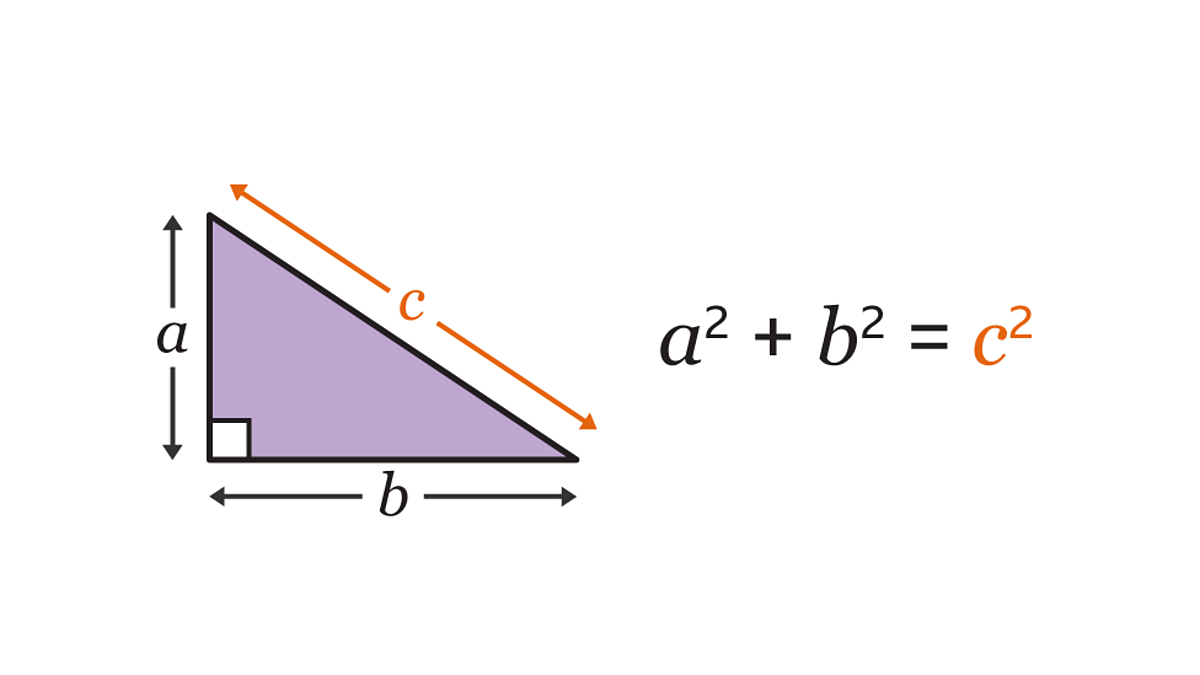
Statement: The ratio of the lengths of the sides in a right triangle follows Pythagoras' theorem.
Where is the hypotenuse, and , are the other two sides.
Why It Works:
This relationship holds because the square of the longest side is equal to the sum of the squares of the other two sides, forming the basis for trigonometry.
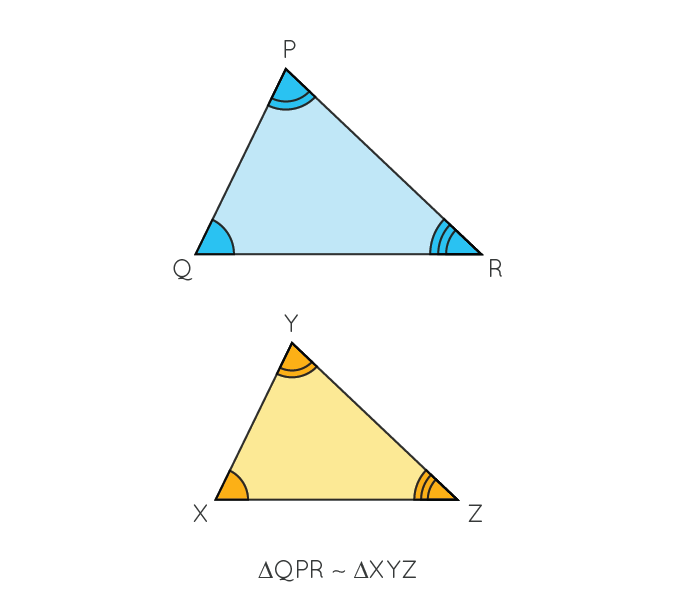
Proportionality in Similar Triangles
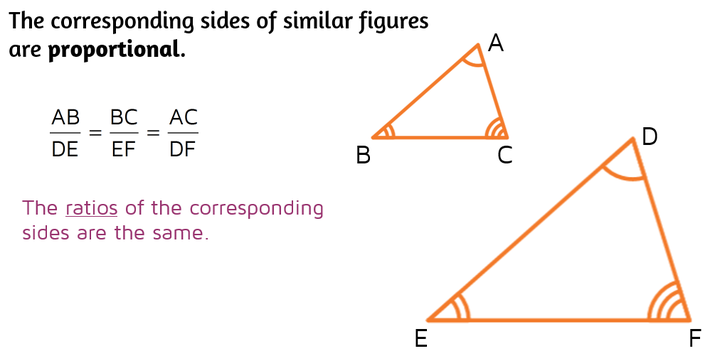
Statement: Corresponding sides of similar triangles are proportional.
Why It Works:
In similar triangles, corresponding angles are equal, which ensures proportional scaling between all corresponding sides.
Converse of Similarity
Statement: If the corresponding sides of two triangles are proportional, the triangles are similar.
Why It Works:
This converse establishes that proportional side lengths imply the equality of corresponding angles, proving similarity.
Worked Examples
Note
Example 1: Isosceles Triangle
Problem: In an isosceles triangle , , and .
Find and
Solution:
Step 1: By the Isosceles Triangle Theorem, .
Step 2: Use the Angle Sum Theorem:
Answer:
Note
Example 2: The Line Joining Midpoints
Problem: In , and are midpoints of and , respectively.
Prove that is parallel to and find its length if
Solution:
Step 1: By the Midpoint Theorem,
Step 2: The length of is half the length of :
Answer: , and
Note
Example 3: Proportionality in Similar Triangles
Problem: with .
Find .
Solution:
Step 1: Use the proportionality of corresponding sides:
Substitute the known values:
Step 2: Solve for :
Answer:
Summary
- Isosceles Triangle Theorem: Equal sides have equal opposite angles, and vice versa.
- Midpoint Theorem: The line joining midpoints of two sides is parallel to the third side and half its length.
- Pythagoras' Theorem: Relates the sides of right triangles.
- Similarity Theorems:
- Proportional sides indicate similarity.
- Similar triangles have proportional corresponding sides. These theorems are crucial for solving problems and proving relationships in triangles.