The Basics (Leaving Cert Mathematics): Revision Notes
📚Revision Notes
Definite Integrals
Definite integration is the process of calculating the exact area under a curve over a specific interval. Unlike indefinite integration, which results in a family of functions (antiderivatives) plus a constant of integration, definite integration yields a specific numerical value representing the net area under the curve.
1. The Definite Integral:
Note
The definite integral of a function from a to is denoted by: This represents the net area under the curve from to
2. Interpreting the Definite Integral:
- Area Under the Curve: If is positive over , the definite integral represents the area between the curve and the -axis from to
- Net Area: If takes on both positive and negative values over the definite integral gives the net area, with regions below the -axis subtracting from the total area.
- Total Area: To find the total area regardless of whether the function is above or below the -axis, you would integrate the absolute value of the function.
3. Fundamental Theorem of Calculus:
Note
The Fundamental Theorem of Calculus connects differentiation and integration and provides a straightforward method to compute definite integrals: where is an antiderivative of (i.e., ).
4. Steps to Compute a Definite Integral:
Note
- Find an Antiderivative of): Determine the indefinite integral
- Evaluate the Antiderivative at the Limits: Compute
- Interpret the Result: The result - gives the net area under the curve from to .
5. Examples of Definite Integration:
Note
Example 1: Basic Polynomial Function
Compute
- Step 1: Find the antiderivative: So,
- Step 2: Evaluate at the limits:
Note
Example 2: Trigonometric Function
Compute
- Step 1: Find the antiderivative: So,
- Step 2: Evaluate at the limits:
6. Properties of Definite Integrals:
Definite integrals have several important properties that can simplify calculations:
- Linearity: where c is a constant.
- Reversing Limits:
- Zero Integral:
- Additivity:
7. Applications of Definite Integrals:
- Area under a Curve: The most common application, where the definite integral represents the area under the curve between two points.
- Physics: Used to calculate quantities like displacement, work, and energy when integrating rates over time or other variables.
- Economics: Used to find consumer and producer surplus, or to calculate total revenue or cost over a given interval.
- Probability: Used in finding probabilities and expected values in continuous probability distributions.
Summary:
Note
- Definite integration provides a way to calculate the exact area under a curve between two points, yielding a specific numerical result.
- Definite integrals are widely used across mathematics, physics, economics, and many other fields to solve practical problems involving areas, accumulated quantities, and rates of change.
Definite Integral
is an example of a definite integral. The two small numbers are called limits. The integral is described as "the integral between and of ."
Perform the integration, putting the answer in square brackets with limits:
Sub in top limit and bottom limit for x and subtract:
Note: c's always cancel
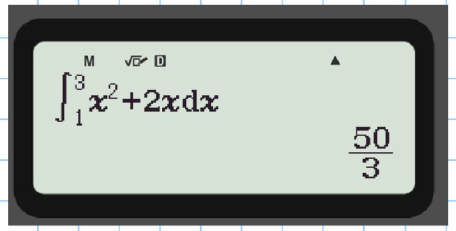
Evaluate: