Limits of a Sequence (Leaving Cert Mathematics): Revision Notes
📚Revision Notes
Limits of a Sequence
Introduction
Consider a bouncing a ball that is thrown at point . The distance that the ball travels each time is halved. Will the ball ever reach the point ?
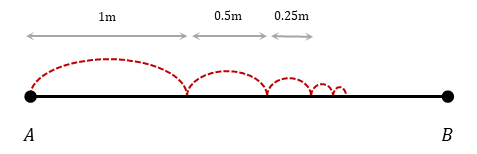
The answer is no since the jump on each consecutive bounce gets smaller and smaller contributing less to the total distance of the ball.
We say that this sequence converges, meaning it has a finite limit. If a sequence has an infinite limit (or no limit), we say it diverges.
- The sequence is divergent since the limit goes to infinity : .
- The sequence is convergent since .
- The sequence is divergent because the limit does not exist.
Example
Note
Evaluate the limit .
We need to find the value of as gets closer to , but doesn't actually reach .
We can see that the limit is approaching , so .
It's also valid to substitute for .
Properties of Limits
Given that is a constant and is variable :
Sum Rule
Constant Multiple Rule
Product Rule
Quotient Rule
Constant Rule
Power Rule
Composition Rule
Important Limits
This should be intuitive as increases the denominator of the fraction while the numerator, stays constant, converging to . Otherwise we could substitute in , .
For example, if , then the limit of will converge to as increases to infinity.
In the case of evaluating a limit that nears , we have to take some extra steps since is not defined.
Example
Note
Evaluate the limit of
Notice that taking that limit directly will result in . To overcome this, its best to take out a factor of the variable in the numerator and denominator.
The following limit is much easier to evaluate with the absence of variable terms on both the numerator and denominator.