Patterns in Number (Leaving Cert Mathematics): Revision Notes
📚Revision Notes
Patterns in Number
Introduction to patterns
Recognising patterns and sequences is a fundamental skill in mathematics. We encounter number patterns regularly, such as counting sequences like 1, 3, 5, 7... or 5, 10, 15, 20... These patterns appear not only in pure mathematics but also in practical designs like tiling and mosaics.
Note
Mathematical patterns can be visualised through geometric arrangements, making abstract concepts more concrete and easier to understand. Visual representations help us see relationships that might not be immediately obvious in pure number form.
Consider this growth pattern using squares made from matchsticks:
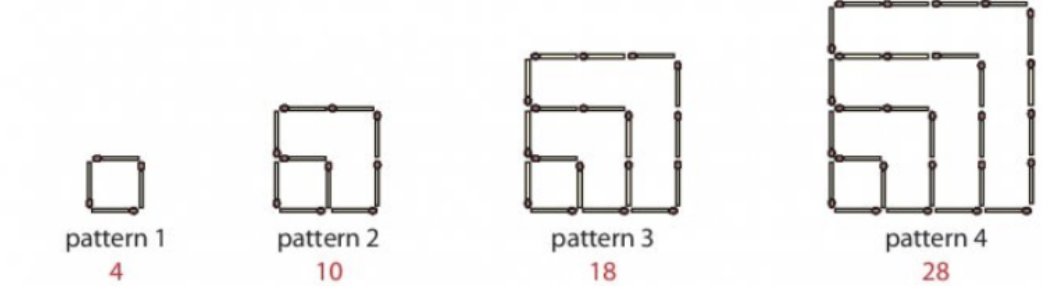
The numbers 4, 10, 18, 28... represent the number of matchsticks used in each pattern. This sequence is more complex than simple arithmetic progressions and demonstrates how visual patterns can generate interesting number sequences.
Understanding number sequences
A number sequence is an ordered set of numbers that follows a specific rule to determine every number in the sequence. The rule that takes you from one number to the next might involve simple addition or multiplication, but often requires careful examination to identify the pattern.
Note
Key terminology
- Each number in a sequence is called a term
- The first term is written as , the fourth term as , and so on
- The nth term represents the general term in position n
Types of basic patterns
Some sequences follow straightforward rules once you identify the connection between consecutive terms:
Arithmetic patterns
- Doubling sequences: 4, 8, 16, 32... (multiply by 2 each time)
- Adding sequences: 4, 7, 10, 13... (add 3 to each term)
- Subtracting sequences: 36, 32, 28, 24... (subtract 4 from each term)
These sequences become quite manageable once you discover the link between consecutive terms.
Method of differences
For sequences that aren't immediately obvious, we can use the method of differences. This involves examining the differences between consecutive terms to reveal the underlying pattern.
Example
Worked Example: Using the Method of Differences
Consider the sequence: 3, 6, 11, 18, 27...
Step 1: Find the differences between consecutive terms
- 6 - 3 = 3
- 11 - 6 = 5
- 18 - 11 = 7
- 27 - 18 = 9
Step 2: Look for a pattern in the differences The differences form their own sequence: 3, 5, 7, 9... This is an arithmetic sequence with a common difference of 2.
Step 3: Use the pattern to find the next term The next difference would be 9 + 2 = 11 Therefore, the next term in the original sequence is 27 + 11 = 38
Common sequence types
Here are some frequently encountered sequence patterns:
- 1, 4, 7, 10, ...
- 3, 9, 27, ...
- 20, 18, 16, ...
- 1, 2, 4, 8, ...
- 16, 8, 4, ...
- 2, 6, 18, ...
These sequences demonstrate various patterns:
- Arithmetic sequences: Adding or subtracting the same value each time
- Geometric sequences: Multiplying or dividing by the same value each time
- Mixed patterns: Requiring the method of differences to solve
Important
Critical Pattern Recognition Tips
- Always look for the simplest pattern first (addition, subtraction, multiplication, division)
- If the pattern isn't obvious, try the method of differences
- Write down your working clearly to show your reasoning
- Check your answer by seeing if it follows the established pattern
- Practice identifying whether sequences are arithmetic, geometric, or follow other rules
Summary
Key Points to Remember:
- Patterns are rules that help us predict the next numbers in a sequence
- Each number in a sequence is called a term, numbered , etc.
- Simple patterns involve adding, subtracting, multiplying, or dividing by the same number
- The method of differences helps identify patterns in complex sequences by examining differences between consecutive terms
- Visual patterns (like geometric shapes) can generate interesting number sequences that require careful analysis