Finding Probabilities from the Tables (Leaving Cert Mathematics): Revision Notes
📚Revision Notes
Finding Probabilities from the Tables
Overview
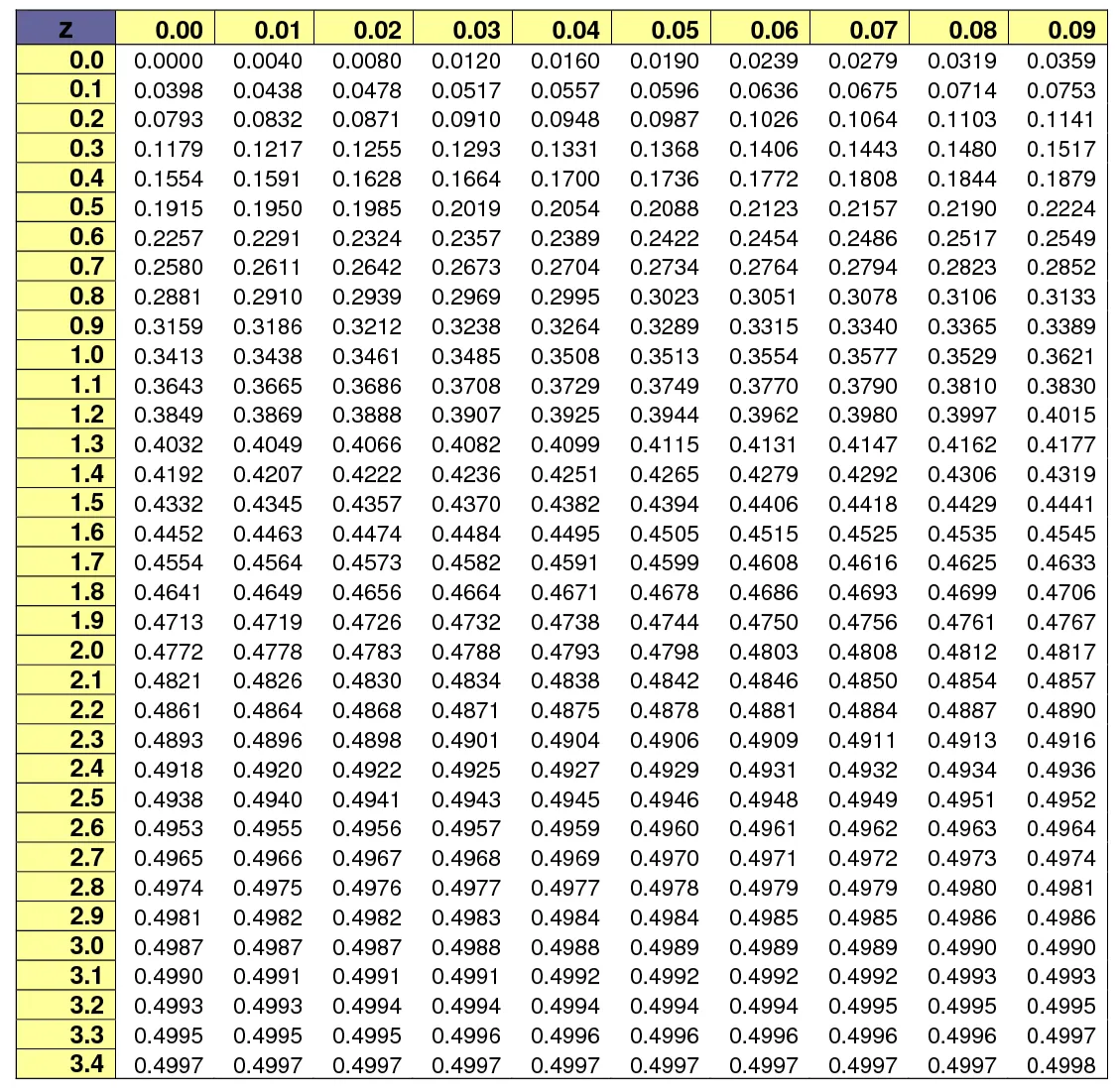
When working with the normal distribution, probabilities are often calculated using Z-scores and the Z-table. The Z-table provides cumulative probabilities for Z-scores, representing the area under the normal curve to the left of a given Z-value.
Z-Table Diagram
Steps to Find Probabilities Using the Z-Table
Step 1: Standardise the Value (Calculate Z-Score):
Use the Z-score formula:
Where:
- : the value of interest.
- : the mean.
- : the standard deviation.
Step 2: Locate the Z-Score in the Table:
- Find the row corresponding to the first two digits of the Z-score (e.g., for 1.36, look at 1.3).
- Find the column corresponding to the hundredths place (e.g., for 1.36, look under 0.06).
- The intersection gives the cumulative probability
Step 3: Interpret the Probability:
The cumulative probability represents the area under the curve to the left of the Z-score.
Step 4: Adjust for Other Scenarios:
- To find : Subtract the cumulative probability from 1.
- To find : Subtract the cumulative probability of from
Worked Examples
Note
Example 1: Finding
Problem: What is the probability of a Z-score less than 1.25?
Solution:
- Step 1: Locate in the Z-table.
- Step 2: Row = 1.2, Column = 0.05.
- Step 3: Intersection value = .
Answer: , or 89.44%.
Note
Example 2: Finding
Problem: What is the probability of a Z-score greater than -0.75?
Solution:
Step 1: Locate in the Z-table.
- For negative Z-scores, find the cumulative probability directly.
Step 2: Use the complement rule:
Answer: , or 77.34%.
Note
Example 3: Finding
Problem: What is the probability of a Z-score between -1 and 1.5?
Solution:
Step 1: Find
- Row = 1.5, Column = 0.00.
- Value = 0.9332.
Step 2: Find
Value =
Step 3: Subtract:
Answer: , or 77.45%.
Summary
- Use the Z-score formula to standardise values:
- The Z-table gives the cumulative probability to the left of a Z-score.
- Adjust using rules for complements and differences to find probabilities for other scenarios.
- Key rules include: