Graphs of Sine/Cosine Functions
Overview
The sine and cosine functions, sin(x) and cos(x), are fundamental periodic functions in trigonometry. Their graphs, often referred to as sine waves and cosine waves, are used extensively in various fields such as physics, engineering, and signal processing.
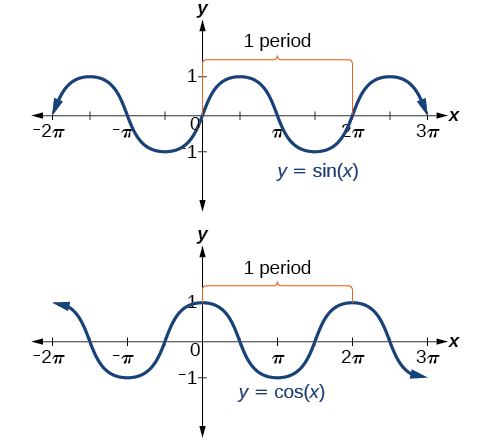
Key Properties of sin(x) and cos(x)
Periodicity
Both sin(x) and cos(x) are periodic with a period of 2π
sin(x+2π)=sin(x)
cos(x+2π)=cos(x)
Amplitude
The amplitude (maximum absolute value) is 1 for both functions.
−1≤sin(x)≤1
−1≤cos(x)≤1
Domain, Range & Period
- Domain: All real numbers x
- Range: [−1,1]
- Period: 2π radians (360°)
Key Points
- sin(x) starts at (0,0), rises to 1 at 2π, and returns to 0 at π
- cos(x) starts at (0,1), drops to 0 at 2π, and reaches −1 at π
Symmetry
sin(x) is an odd function:
sin(−x)=−sin(x)
cos(x) is an even function:
cos(−x)=cos(x)
Graph Characteristics
Sine Function sin(x)
- Starts at (0,0)
- Crosses the x−axis at multiples of π
x=0,π,2π,…
- Peaks at 2π and valleys at 23π
Cosine Function cos(x)
- Starts at (0,1)
- Crosses the x−axis at odd multiples of 2π
x=2π,23π,…
- Peaks at x=0,2π,…, and valleys at x=π,3π,…
Shifts and Scaling
General forms:
f(x)=a+bsin(cx)org(x)=a+bcos(cx)
where
- a adjusts the vertical shift
- b adjusts the amplitude
- c adjusts the frequency.