Special Angles & The Unit Circle (Leaving Cert Mathematics): Revision Notes
📚Revision Notes
The Unit Circle
Overview
The unit circle is a circle with a radius of unit, centred at the origin on the coordinate plane. It is a foundational tool in trigonometry, connecting angles to their sine, cosine, and tangent values. The unit circle helps visualise these trigonometric functions and understand their periodic nature.
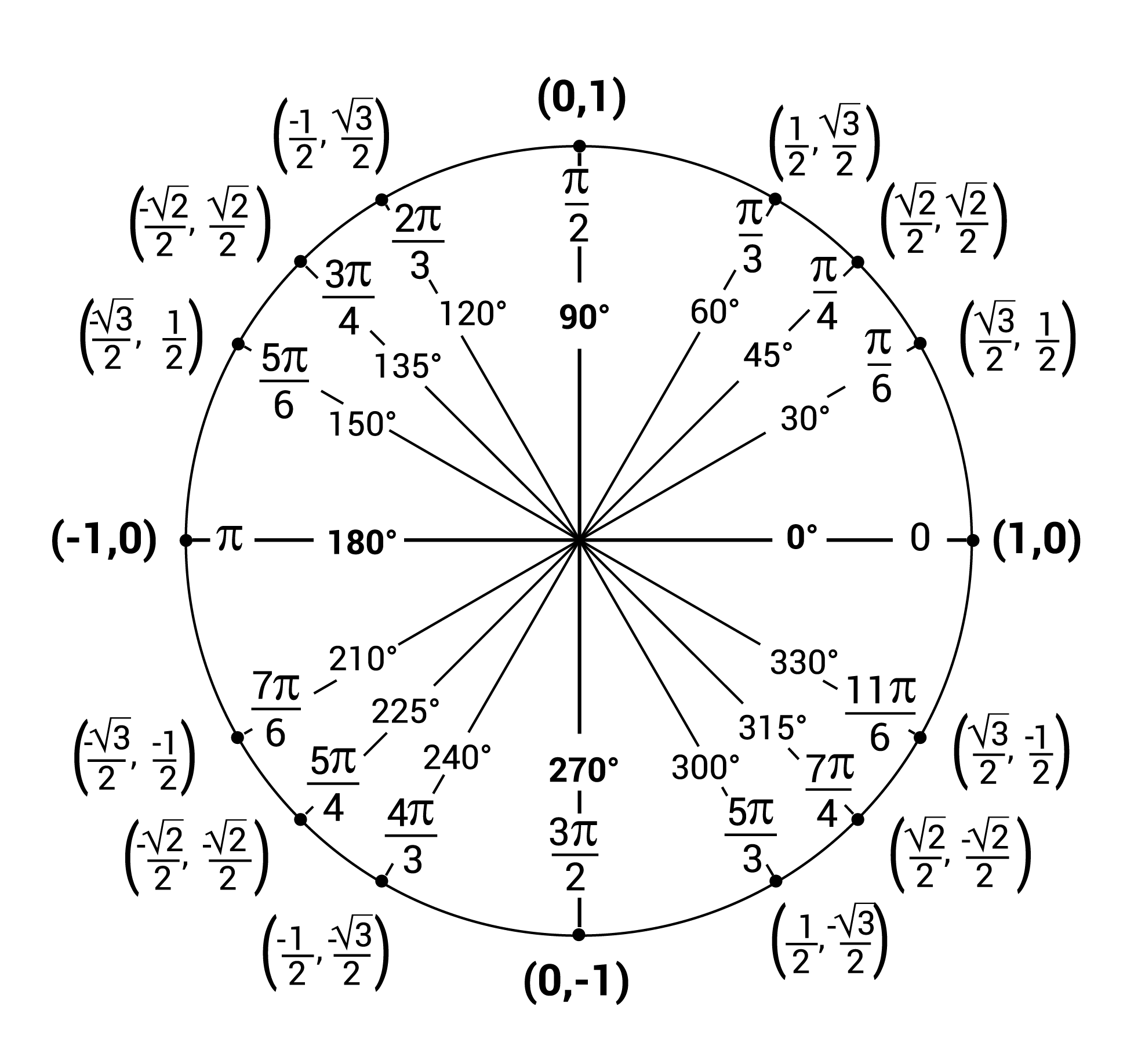
Key Features of the Unit Circle
Coordinates Represent Sine and Cosine
- Any point on the unit circle can be represented as , where is the angle formed with the positive -axis.
- The -coordinate gives , and the y-coordinate gives
Angles in Radians and Degrees
Angles can be measured in degrees or radians:
Angles are positive when measured counterclockwise and negative when measured clockwise.
Key Quadrants
Quadrant I:
( and are positive).
Quadrant II:
Quadrant III:
( and are negative).
Quadrant IV:
Key Points on the Unit Circle
- at or
- at or
- at or
- at or
Applications
Finding Trigonometric Ratios
Use the unit circle to find values of , , and for common angles.
Symmetry in Trigonometric Functions
The unit circle reveals symmetry:
Worked Examples
Note
Example 1: Finding Coordinates
Problem: Find the coordinates of the point on the unit circle at .
Solution:
At :
The coordinates are
Answer:
Note
Example 2: Using Symmetry
Problem: Find and
Solution:
lies in Quadrant III, where and
Use the reference angle :
Answer:
Summary
- Unit Circle: A circle with radius centred at the origin.
- Key Concept: Coordinates represent
- Applications: Simplifies trigonometric calculations and reveals symmetry.
- Key Angles and Quadrants: Helps in determining signs and values of trigonometric functions. The unit circle is a crucial tool for mastering trigonometry and understanding the behaviour of trigonometric functions.