Area of Sector and Length of Arc (Leaving Cert Mathematics): Revision Notes
📚Revision Notes
Area of Sector and Length of Arc
What are sectors and arcs?
When working with circles, you'll often need to calculate measurements for parts of circles rather than the whole circle. This is where sectors and arcs become essential.
A sector is a slice or wedge-shaped portion of a circle, similar to a slice of pizza. It's formed when two radii extend from the centre to the circumference.
An arc is the curved boundary that forms the edge of a sector. Think of it as the curved part of the pizza crust.
Note
The pizza analogy is particularly helpful for visualising sectors - just imagine cutting a circular pizza into slices. Each slice is a sector, and the curved crust of each slice is the arc.
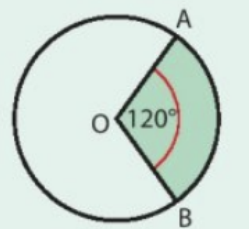
The minor arc refers to the shorter arc between two points on a circle's circumference, whilst the central angle is the angle formed at the centre of the circle between the two radii.
Essential formulas
Before diving into sector calculations, remember these fundamental circle formulas:
- Circumference of a circle =
- Area of a circle =
Important
Critical Formulas for Sectors:
The sector formulas build directly on the full circle formulas:
- Area of sector =
- Length of arc =
Where:
- = central angle in degrees
- = radius of the circle
These formulas are essential for all sector calculations!
Understanding the formulas
These sector formulas work because they calculate what fraction of the full circle your sector represents. The fraction tells you what portion of the complete 360° circle you're working with.
Note
Understanding the Fraction:
Think of as asking: "What fraction of a complete rotation is my angle?"
For example:
- A 90° sector is of the full circle
- A 180° sector is of the full circle
This fraction then multiplies the full circle area or full circle circumference to give you the sector measurement.
Worked example 1: Finding arc length and sector area
Example
Worked Example: Basic Sector Calculations
Question: A circle has radius 9cm and central angle 120°. Using , find: (i) the length of the minor arc AB (ii) the area of the shaded sector AOB
Solution:
(i) Length of arc AB:
Length of arc =
Length of arc AB =
=
=
= 18.86 cm
(ii) Area of sector AOB:
Area of sector =
Area of sector AOB =
=
=
= 84.86 cm²
Worked example 2: Finding the radius
Example
Worked Example: Finding Radius from Sector Area
Question: The area of sector AOB is 205 cm². The central angle is 120°. Find the length of the radius.
Solution:
Let be the radius.
Area of sector AOB = cm²
(multiply both sides by 3)
(using π key on calculator)
Therefore, radius = 14 cm (correct to the nearest cm)
Worked example 3: Different angle and area
Example
Worked Example: Finding Radius with 45° Sector
Question: Find the radius of a circle if a sector with central angle 45° has area 77 cm².
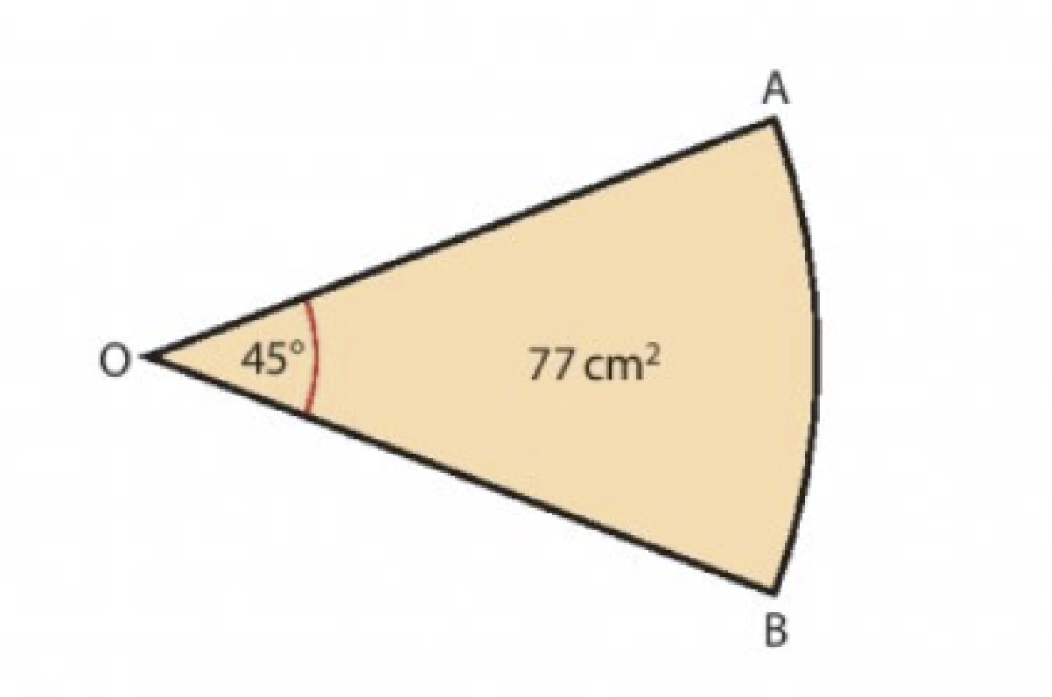
Solution:
Area of sector =
(using π key on calculator)
Therefore, radius = 14.0 cm
Worked example 4: Larger sector
Example
Worked Example: Finding Radius with 140° Sector
Question: A sector has central angle 140° and area 276 cm². Find the radius.
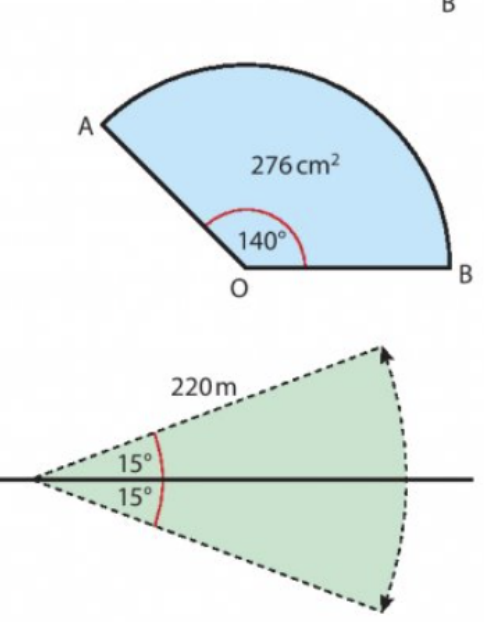
Solution:
Area of sector =
Therefore, radius = 15.1 cm
Exam tips and common mistakes
Important
Key Exam Strategies:
- Always check whether the angle is given in degrees or radians
- Round your final answer to the precision requested in the question
- Use the π key on your calculator for accuracy, unless told to use a specific value
- Show all working clearly - marks are awarded for method even if the final answer is incorrect
Common Mistakes to Avoid:
- Forgetting to convert the angle to degrees if given in another unit
- Using the wrong formula (arc length vs sector area)
- Not simplifying fractions before calculating
- Rounding too early in multi-step calculations
Memory Tip: Remember that both formulas start with the same fraction - this represents what portion of the full circle you're calculating.
Summary
Key Points to Remember:
-
A sector is a slice of a circle formed by two radii, while an arc is the curved boundary of that sector
-
Area of sector = and Length of arc =
-
Both formulas use the fraction to find what portion of the complete circle you're working with
-
When finding an unknown radius, rearrange the sector area formula and solve for , then take the square root
-
Always show your working step-by-step and round to the precision requested in the question