Ratios of Angles Greater than 90° (Leaving Cert Mathematics): Revision Notes
📚Revision Notes
Ratios of Angles Greater than 90°
The unit circle
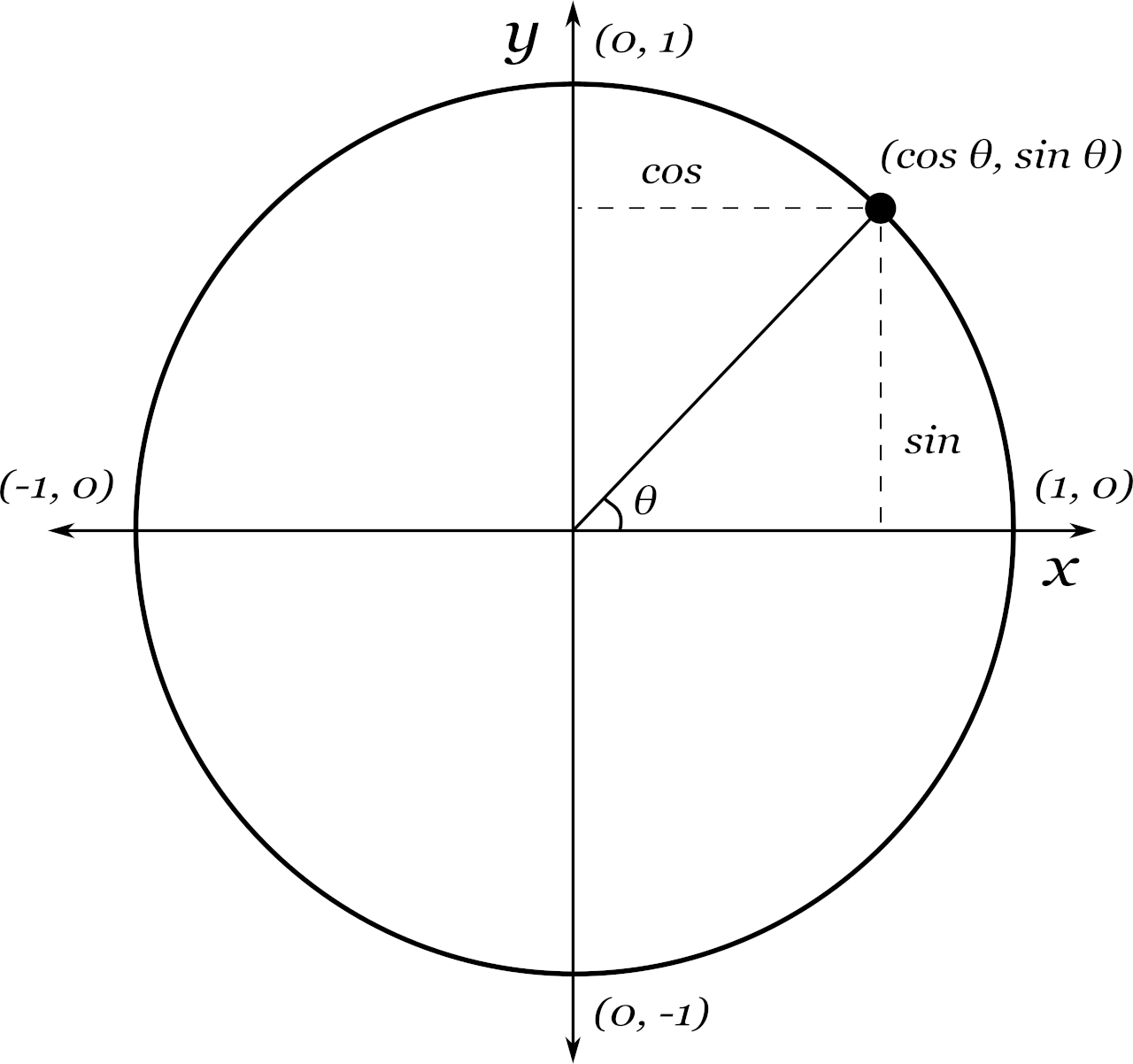
The unit circle is a circle with its centre at the origin (0, 0) and a radius of exactly 1 unit. This special circle becomes our foundation for understanding trigonometric ratios beyond the basic right triangle.
When we place any point P on the unit circle, something remarkable happens. The coordinates of this point are directly related to the trigonometric ratios of the angle θ (theta) that the radius makes with the positive x-axis.
Important
Key relationship: The coordinates of any point on the unit circle are P(cos θ, sin θ).
This means that for any angle θ, we can read the values of cos θ and sin θ directly from the x and y coordinates of the corresponding point on the unit circle.
Note
The unit circle intersects the coordinate axes at four important points:
- (1, 0) at 0° and 360°
- (0, 1) at 90°
- (-1, 0) at 180°
- (0, -1) at 270°
From these special points, we can determine exact values. For example, the point (-1, 0) gives us and .
The four quadrants
The coordinate axes divide a complete rotation of 360° into four equal sections called quadrants. Each quadrant has specific characteristics that determine whether trigonometric ratios are positive or negative.
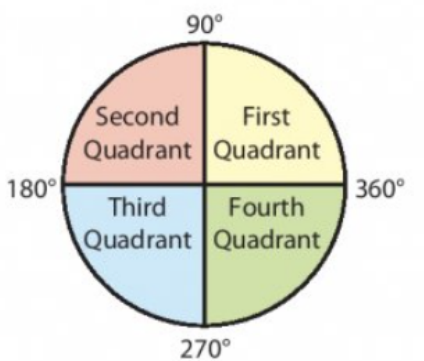
Understanding which quadrant an angle lies in becomes crucial when working with angles greater than 90°, as this determines the sign of our trigonometric ratios.
The CAST rule
The CAST rule is an essential memory tool that tells us which trigonometric ratios are positive in each quadrant. The letters S, A, T, C represent which ratios are positive in each quadrant, starting from the second quadrant and moving clockwise.
Important
CAST rule breakdown:
- Second quadrant (S): Only Sine is positive
- First quadrant (A): All ratios are positive
- Fourth quadrant (C): Only Cosine is positive
- Third quadrant (T): Only Tangent is positive
Note
Memory tip: Remember "All Students Take Calculus" going anti-clockwise from the first quadrant.
Finding ratios for angles between 90° and 360°
When we need to find the exact value of a trigonometric ratio for an angle greater than 90°, we follow a systematic four-step approach:
Important
Four-Step Method:
Step 1: Make a rough sketch to determine which quadrant the angle lies in.
Step 2: Use the CAST rule to determine whether the ratio will be positive or negative.
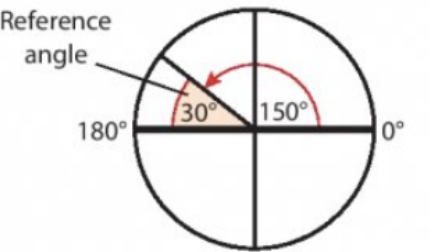
Step 3: Find the reference angle - this is the acute angle (less than 90°) between the terminal side of the angle and the x-axis.
Step 4: Use the reference angle with special triangles (30°, 45°, 60°) or a calculator to find the numerical value, then apply the correct sign from Step 2.
Reference angles
The reference angle is the acute angle between the terminal side of the given angle and the x-axis. This concept is crucial for finding exact values using our knowledge of special triangles.
Note
Reference angle formulas for different quadrants:
- Second quadrant: Reference angle = 180° - given angle
- Third quadrant: Reference angle = given angle - 180°
- Fourth quadrant: Reference angle = 360° - given angle
Special triangles
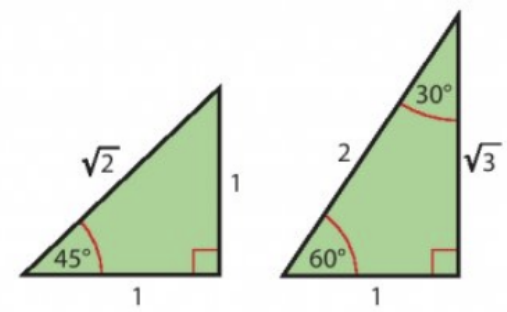
Two special right triangles are particularly useful for finding exact values and appear frequently in examinations:
Important
45-45-90 triangle:
- Sides in ratio 1 : 1 :
30-60-90 triangle:
- Sides in ratio 1 : : 2
Worked examples
Example
Worked Example 1: Finding exact values in surd form
Find: (i) and (ii)
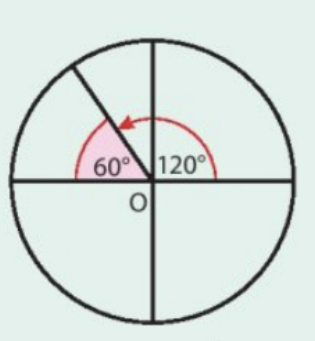
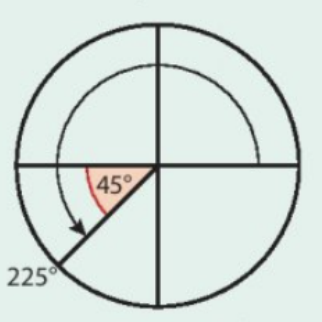
(i) :
- 120° is in the second quadrant
- Using CAST rule: sine is positive in the second quadrant
- Reference angle = 180° - 120° = 60°
- From the 30-60-90 triangle:
- Therefore:
(ii) :
- 225° is in the third quadrant
- Using CAST rule: cosine is negative in the third quadrant
- Reference angle = 225° - 180° = 45°
- From the 45-45-90 triangle:
- Therefore:
Example
Worked Example 2: Finding angles from given ratio values
Given: and
Step 1: Since cosine is negative, A must be in the second or third quadrant (where cosine is negative according to CAST rule).
Step 2: Find the reference angle by using the inverse cosine function on the positive value: Reference angle = (to 1 decimal place)
Step 3: Find the two possible values:
- Second quadrant:
- Third quadrant:
Therefore: and
Note
Exam tips:
- Always sketch the angle to visualise which quadrant it's in
- Use CAST rule consistently to determine the sign
- Remember the special triangles - they appear frequently in exams
- Check your calculator is in degree mode when finding reference angles
- Be careful with negative signs - they're easy to drop or add incorrectly
Summary
Key Points to Remember:
- The unit circle shows that coordinates of any point are (cos θ, sin θ)
- CAST rule determines signs: All positive in 1st, Sine in 2nd, Tangent in 3rd, Cosine in 4th quadrant
- Reference angles are always acute and help us use special triangles for exact values
- The four-step method works for any angle: sketch, determine sign, find reference angle, calculate
- Special triangles (30-60-90 and 45-45-90) give exact values for common angles