Sine, Cosine, and Tangent Ratios (Leaving Cert Mathematics): Revision Notes
📚Revision Notes
Sine, Cosine, and Tangent Ratios
What are trigonometric ratios?
Trigonometric ratios are special relationships between the sides and angles of right-angled triangles. These ratios help us work out unknown lengths and angles in triangles, making them incredibly useful in many areas of mathematics and real-world applications.
The three most important trigonometric ratios are sine, cosine, and tangent. Each ratio compares two different sides of a right-angled triangle relative to a specific angle.
Note
Trigonometric ratios are fundamental to many fields including engineering, physics, navigation, and architecture. Understanding these relationships allows us to solve complex real-world problems involving angles and distances.
The three basic trigonometric ratios
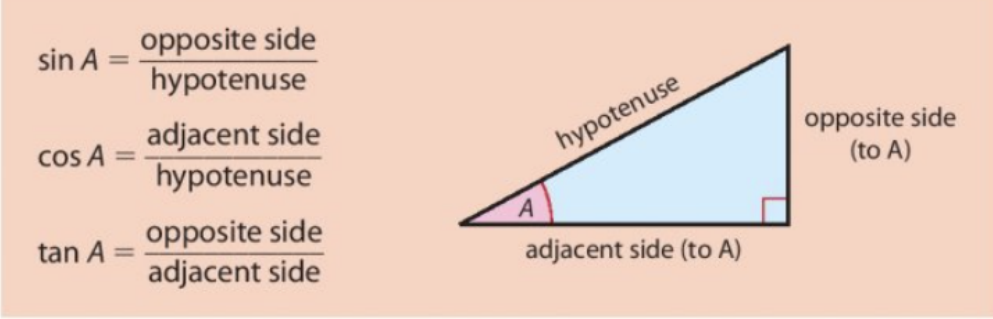
In any right-angled triangle, we can identify three sides relative to any acute angle:
- The hypotenuse - the longest side opposite the right angle
- The opposite side - the side opposite to the angle we're considering
- The adjacent side - the side next to the angle we're considering (but not the hypotenuse)
Important
These three side definitions are the foundation of all trigonometric calculations. Always identify these sides correctly before applying any trigonometric ratio.
The three fundamental ratios are defined as:
Sine (sin): The ratio of the opposite side to the hypotenuse
Cosine (cos): The ratio of the adjacent side to the hypotenuse
Tangent (tan): The ratio of the opposite side to the adjacent side
Memory aid: SOHCAHTOA
A helpful way to remember these ratios is the acronym SOHCAHTOA:
Important
SOHCAHTOA Memory Aid:
- SOH: Sine = Opposite over Hypotenuse
- CAH: Cosine = Adjacent over Hypotenuse
- TOA: Tangent = Opposite over Adjacent
This memory aid will help you recall which sides to use for each trigonometric ratio during exams.
Using trigonometric ratios with the Pythagorean theorem
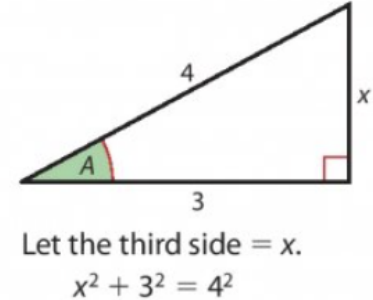
When working with trigonometric ratios, you'll often need to find missing sides first using the Pythagorean theorem before calculating the ratios.
Example
Worked Example: Finding a missing side
If we know that , this tells us that the adjacent side is 3 and the hypotenuse is 4. To find the opposite side (x), we use:
Worked example 1: Finding sine and cosine from tangent
Example
Worked Example: Finding sine and cosine from tangent
Given:
Find: The values of and
Step 1: Understand what the tangent ratio tells us Since , we know:
- Opposite side to B =
- Adjacent side to B = 2
Step 2: Find the hypotenuse using Pythagorean theorem
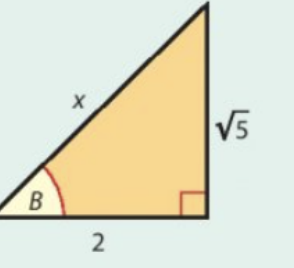
Let the hypotenuse = x
Step 3: Calculate sine and cosine
Common right triangle relationships
Some triangles appear frequently in trigonometry problems and are worth memorising:

Note
Common Right Triangle Patterns:
- 3-4-5 triangle: A common Pythagorean triple
- 5-12-13 triangle: Another Pythagorean triple
- 1-√3-2 triangle: Related to 30° and 60° angles
Recognising these patterns can speed up your calculations in exams.
The fundamental trigonometric identity
An extremely important relationship exists between sine and cosine for any angle:
Important
The Fundamental Trigonometric Identity:
This identity is always true for any angle A and can be used to find one ratio if you know the other.
Example
Worked Example: Using the fundamental identity
If you know , you can find :
Therefore: (taking the positive value for acute angles)
Exam tips
Note
Essential Exam Strategies:
- Always draw a diagram when solving trigonometry problems - this helps identify which sides are opposite, adjacent, and hypotenuse
- Remember that the hypotenuse is always the longest side in a right triangle
- Use SOHCAHTOA to check you're using the correct ratio
- When finding missing sides, use the Pythagorean theorem first if needed
- The fundamental identity often appears in exam questions
Remember!
Summary
Key Points to Remember:
- Sine relates the opposite side to the hypotenuse in a right triangle
- Cosine relates the adjacent side to the hypotenuse in a right triangle
- Tangent relates the opposite side to the adjacent side in a right triangle
- SOHCAHTOA is your key memory aid for remembering these ratios
- The identity is fundamental and always true