The Area of a Triangle (Leaving Cert Mathematics): Revision Notes
📚Revision Notes
The Area of a Triangle
Understanding triangle notation
When working with triangles in trigonometry, we follow a standard labelling system that makes calculations easier to follow. This systematic approach is fundamental to solving trigonometric problems effectively.
In any triangle, we use capital letters (A, B, C) to represent the angles at each vertex, and lowercase letters (a, b, c) to represent the sides opposite to those angles.
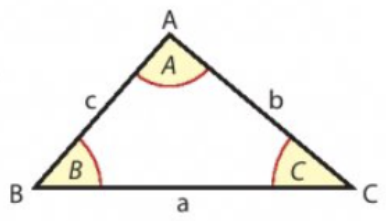
Note
Triangle Labelling Convention:
- Angle A is opposite side a
- Angle B is opposite side b
- Angle C is opposite side c
This consistent notation is essential for applying trigonometric formulas correctly in exam questions.
Deriving the trigonometric area formula
The basic formula for the area of any triangle is Area = ½ × base × height. However, when we know two sides and the included angle, we can use trigonometry to find the area more directly.
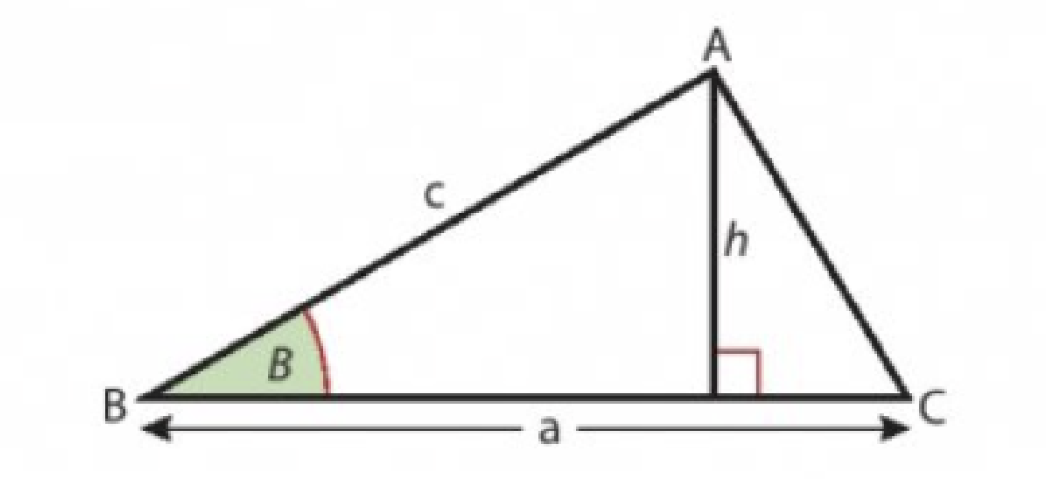
Starting with the basic area formula where the base is side and the height is :
From the right triangle formed by the height, we know that:
- Therefore:
Substituting this back into our area formula:
Note
Trigonometric Area Formula:
This formula allows us to find the area when we know two sides and the included angle.
The general trigonometric area formula
The formula can be written using any two sides and their included angle:
In words: The area equals half the product of any two sides multiplied by the sine of the angle between them.
Important
Critical Point: The angle must be between the two sides you're using in the calculation. This is the most common error students make when applying this formula.
Worked examples
The following examples demonstrate how to apply the trigonometric area formula in different types of problems.
Example
Worked Example 1: Finding area when given two sides and included angle
Find the area of a triangle with sides 7 and 8, and an included angle of 46°.
Solution: Using the formula:
Step-by-step calculation:
- Using a calculator:
Answer: 20.1 square units (to 1 decimal place)
Example
Worked Example 2: Finding an angle when given area and two sides
If a triangle has an area of 40 cm², and two sides of lengths 10 cm and 14 cm, find the included angle A.
Solution: Start with the area formula and rearrange to solve for the angle:
- Start with:
- Substitute known values:
- Simplify:
- Rearrange:
- Find the angle:
- Using a calculator:
Answer: A = 35° (to the nearest degree)
Example
Worked Example 3: Working with given sine values
If , find the area of a triangle with sides 18 cm and 22 cm where θ is the included angle.
Solution:
Answer: 139 cm² (to the nearest cm²)
Key exam techniques
Mastering these techniques will help you tackle trigonometric area problems with confidence in your exams.
Note
Calculator Usage Tips:
- When finding an angle, use the inverse sine function: SHIFT + sin + (value) + =
- Always check your calculator is in degree mode for Leaving Cert questions
- Round final answers as requested in the question
Note
Common Problem Types:
- Finding area: Use directly
- Finding an angle: Rearrange to , then use
- Finding a side: Rearrange the area formula to solve for the unknown side
Note
Exam Success Tips:
- Always identify which two sides and which angle you're working with
- Check that the angle is between the two given sides
- Show your working step-by-step for full marks
- Include units in your final answer
- Round to the accuracy requested in the question
Summary
Key Points to Remember:
- The angle must be between the two sides you're using in the formula
- Area = ½ab sin C where C is the angle between sides a and b
- Capital letters represent angles, lowercase letters represent opposite sides
- When finding an angle from area and sides, use sin⁻¹ on your calculator
- Always check your calculator is in degree mode for exam questions