The Sine Rule (Leaving Cert Mathematics): Revision Notes
📚Revision Notes
The Sine Rule
What is the sine rule?
The Sine Rule is a mathematical formula that helps us find unknown sides and angles in any triangle, not just right-angled triangles. This makes it incredibly useful when dealing with triangles that don't have a 90° angle.
Until now, most trigonometry work has focused on right-angled triangles using SOH-CAH-TOA. The Sine Rule extends our ability to solve problems involving all types of triangles.
The sine rule formula
The Sine Rule can be written in two equivalent ways:
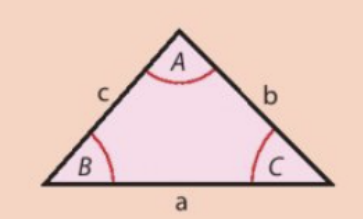
Important
Mathematical form:
or
Both forms represent the same relationship - choose the one that makes your calculations easier!
Word form:
The word version states that for any triangle, the ratio of any side to the sine of its opposite angle equals the ratio of any other side to the sine of its opposite angle.
When to use the sine rule
Note
To apply the Sine Rule successfully, you need to know:
- One complete pair: a side and its opposite angle
- One additional piece of information: either another side or another angle
This gives you enough information to find the remaining unknown sides or angles.
Key application principle
Important
Remember this crucial tip for setting up your equations correctly:
- To find a side: put the sides on top of the fractions
- To find an angle: put the angles on top of the fractions
This simple rule helps you avoid confusion when arranging the Sine Rule formula.
Worked example 1: Finding a side length
Example
Worked Example: Finding a Side Length
Let's find the length of side in a triangle where we know one side is 12 units, with angles of 34° and 62°.
Step 1: Set up the Sine Rule with sides on top (since we're finding a side)
Step 2: Calculate the sine values
Step 3: Substitute and solve
Step 4: Cross multiply
Step 5: Solve for
Answer: units (to the nearest whole number)
Worked example 2: Finding an angle and calculating area
Example
Worked Example: Finding an Angle and Calculating Area
Let's find angle in a triangle where side cm, side cm, and angle .
Step 1: Set up the Sine Rule with angles on top (since we're finding an angle)
Step 2: Rearrange to solve for
Step 3: Calculate
Step 4: Cross multiply and solve
Step 5: Find angle using inverse sine
Answer: (to the nearest degree)
Finding the area: Now we can calculate the triangle's area. First, find angle :
Using the area formula: Area =
Area =
Area =
Exam tips
Note
Essential Exam Guidance:
- Always check that you have enough information before applying the Sine Rule
- Label your triangle clearly with sides , , opposite to angles , , respectively
- Use your calculator's function (often marked as SHIFT + sin) to find angles
- Round appropriately according to the question requirements
- When finding areas, you may need to calculate a missing angle first using the angle sum property (angles in a triangle sum to 180°)
Remember!
Summary
Key Points to Remember:
- The Sine Rule works for any triangle, not just right-angled ones
- Use "sides on top" when finding unknown sides, "angles on top" when finding unknown angles
- You need one complete side-angle pair plus one other piece of information to use the rule
- The ratio of any side to the sine of its opposite angle is constant for all three sides of the triangle
- Always check your calculator is in degree modewhen working with angle measurements