Three Important Angles (Leaving Cert Mathematics): Revision Notes
📚Revision Notes
Three Important Angles
Introduction
In trigonometry, the angles 30°, 45°, and 60° are considered special because they appear frequently in calculations and allow us to find exact trigonometric values without using a calculator. These angles produce exact values that can be expressed as simple fractions or surds (expressions involving square roots).
Understanding these three important angles is essential for Leaving Cert success, as they often appear in exam questions where calculator use may be restricted or where exact answers are required.
The 45° angle
The 45° angle comes from a special type of triangle called an isosceles right triangle. This triangle has two equal sides of length 1 unit each, making it perfectly symmetrical.
Note
In an isosceles right triangle:
- The two equal sides each measure 1 unit
- The hypotenuse measures units (found using Pythagoras' theorem: )
- Both base angles are 45°
From this triangle construction, we can determine the exact trigonometric ratios for 45°:
Notice that sine and cosine have the same value for 45°, which makes sense because the opposite and adjacent sides are equal in this isosceles triangle.
The 30° and 60° angles
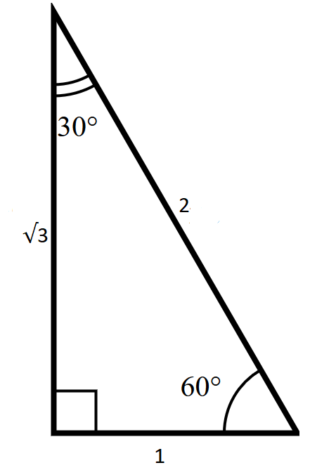
The 30° and 60° angles are found together in what's called a 30-60-90 triangle. This is a right-angled triangle where the sides are in the ratio 1 : √3 : 2.
Note
In a 30-60-90 triangle:
- The shortest side (opposite to the 30° angle) has length 1
- The middle side (opposite to the 60° angle) has length
- The hypotenuse has length 2
From this triangle, we can find the exact ratios for both 30° and 60°:
For 60°:
For 30°:
Summary table of exact values
| Angle | sin | cos | tan |
|---|---|---|---|
| 30° | |||
| 45° | |||
| 60° |
Worked example 1
Example
Worked Example: Finding sides in a 30-60-90 triangle
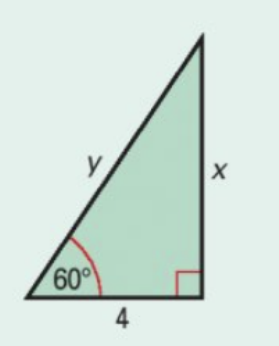
Question: Without using a calculator, find the values of x and y in the right-angled triangle where one angle is 60°, and the adjacent side to this angle is 4 units.
Solution:
To find x (opposite side):
- We use
- Therefore:
To find y (hypotenuse):
- We use
- Therefore:
Worked example 2
Example
Worked Example: Calculating exact values
Question: Find the exact value of
Solution:
First, find each value:
- , so
- , so
Therefore:
Worked example 3
Example
Worked Example: Proving trigonometric identities
Question: Without a calculator, show that
Solution:
We know that:
Therefore: ✓
Note
Exam Tips
- These exact values are provided in the Formulae and Tables booklet (page 13)
- Always express answers in their simplest surd form when exact values are required
- Remember that 30° and 60° are complementary angles (add to 90°), so their sine and cosine values are "swapped"
- For 45°, sine and cosine are always equal
- Practice recognising when these special angles appear in more complex problems
Important
Common Mistakes to Avoid
- Don't confuse the exact values - memorise the key ratios or know how to derive them quickly
- Remember that can be rationalised to if required
- Be careful with the signs - these angles are all in the first quadrant so all ratios are positive
Summary
Key Points to Remember:
- The three important angles (30°, 45°, 60°) give exact trigonometric values that don't require a calculator
- 45° comes from an isosceles right triangle with sides 1:1:√2
- 30° and 60° come from a 30-60-90 triangle with sides 1:√3:2
- For 45°: , and
- For 30° and 60°: their sine and cosine values are complementary (swapped)