The Heating Effect of an Electric Current and Voltage (Leaving Cert Physics): Revision Notes
📚Revision Notes
The Heating Effect of an Electric Current and Voltage
Understanding the heating effect
When an electric current flows through any conductor that has resistance, heat energy is produced. This fundamental principle has numerous practical applications in everyday life, from electric heaters and kettles to hair dryers and cooking appliances.
Note
The heating effect occurs because moving electrons collide with atoms in the conductor material. These collisions transfer kinetic energy to the atoms, causing them to vibrate more vigorously, which we observe as an increase in temperature.
Key relationships and formulas
Heat energy calculation
The amount of heat energy produced when current flows through a resistor depends on three main factors: current, resistance, and time.
Heat energy formula:
Where:
- = heat energy produced (joules)
- = current flowing through the conductor (amperes)
- = resistance of the conductor (ohms)
- = time for which current flows (seconds)
Proportionality relationships
Understanding how heat energy changes with different variables is crucial for practical applications:
- When resistance and time are constant: (heat energy is proportional to current squared)
- When current and time are constant: (heat energy is proportional to resistance)
Important
This means doubling the current will produce four times as much heat energy, whilst doubling the resistance will double the heat energy produced.
Power calculations
Power represents the rate at which energy is converted or transferred. For electrical circuits, we can calculate power using different formulas depending on the known quantities:
Main power formulas:
- (power in terms of current and resistance)
- (power in terms of voltage and current)
- (power in terms of voltage and resistance)
Where:
- = power (watts)
- = voltage (volts)
- = current (amperes)
- = resistance (ohms)
How heat affects current-voltage relationships
Ohmic conductors
For materials that follow Ohm's law, the relationship between current and voltage remains linear even when the material heats up. These are called ohmic conductors.
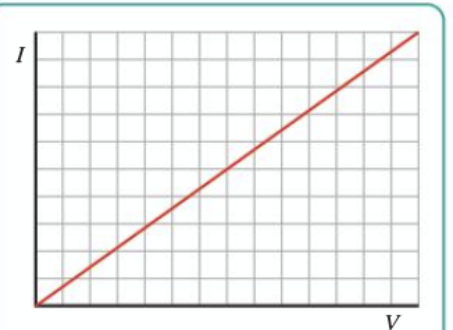
The graph shows a straight line passing through the origin, indicating that current is directly proportional to voltage. The resistance remains constant regardless of the current flowing through it.
Non-ohmic conductors
Many materials, particularly filament bulbs, do not follow Ohm's law when they heat up. These are called non-ohmic conductors.
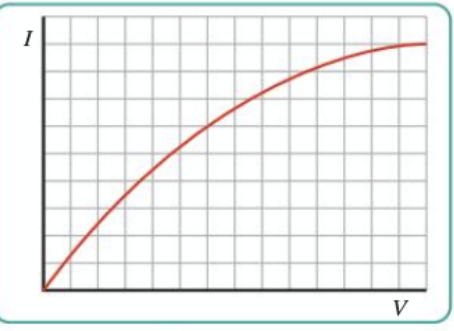
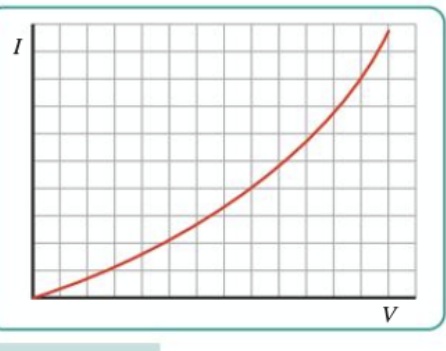
As the voltage across a filament bulb increases, the current increases, but not proportionally. The filament gets significantly hotter, causing its resistance to increase. This creates a curved I-V graph that levels off at higher voltages.
Temperature effects on resistance
Note
Increased resistance: In most metals and filament bulbs, as temperature rises, resistance increases. This means that for the same voltage, less current will flow as the material heats up.
Decreased resistance: Some materials, like thermistors and semiconductors, actually decrease in resistance as temperature increases, leading to higher current flow as they warm up.
Worked examples
Example
Worked Example 1: Basic heat calculation
Question: Find the heat produced in a 20 Ω resistor by a current of 3 A flowing for 40 s.
Solution: Using :
Example
Worked Example 2: Power calculation
Question: Find the rate at which heat is produced (power dissipated) by a current of 60 mA in a 2 kΩ resistor.
Solution: Using :
Example
Worked Example 3: Finding current from power and resistance
Question: When 3 A flows in a wire, heat is produced at a rate of 60 W. What current would produce heat at a rate of 540 W in the same wire?
Solution: First find the resistance: , so
Then find the new current:
Efficiency calculations
When electrical devices convert electrical energy to heat, we often need to calculate their efficiency to understand how effectively they use electrical power:
This helps us understand how much of the electrical energy is actually converted to useful heat energy versus energy lost to the surroundings.
Applications and safety considerations
Note
Practical Applications: The heating effect of electric current has many practical applications:
- Electric heating: radiators, kettles, toasters
- Lighting: incandescent bulbs (though inefficient)
- Safety devices: fuses and circuit breakers
- Industrial processes: electric furnaces and welding
Important
Safety Considerations: However, unwanted heating can also cause serious problems:
- Overheating of electrical components leading to failure
- Fire hazards from overloaded circuits
- Energy waste in power transmission lines
- Risk of burns from hot electrical components
Always consider safety implications when dealing with high current applications that produce significant heat.
Summary
Key Points to Remember:
- Heat energy produced depends on current squared, resistance, and time:
- Power can be calculated using three equivalent formulas: , , or
- Doubling current quadruples the heat produced (because of the relationship)
- Ohmic conductors maintain constant resistance, while non-ohmic conductors have resistance that changes with temperature
- Always consider safety implications when dealing with high current applications that produce significant heat