Force, Mass, and the Newton (Leaving Cert Physics): Revision Notes
📚Revision Notes
Force, Mass, and the Newton
What is force?
Force is one of the most fundamental concepts in physics. When you push a book across a table, pull a door open, or kick a football, you are applying a force. But what exactly is force, and how does it affect the motion of objects?
A force is simply something that causes an object to change its velocity - this could mean speeding up, slowing down, or changing direction. The key word here is "change". If an object is already moving at a constant speed in a straight line, it doesn't need a force to keep it moving. However, if you want to make it move faster, slower, or in a different direction, you must apply a force.
Note
Forces are everywhere in our daily lives! Every time you walk, write, or even breathe, you're experiencing forces in action. Understanding forces helps us make sense of how the physical world works around us.

The diagram above shows a perfect example of forces in action. When you push a block along a rough surface, two forces are at work: your push force (moving the block forwards) and friction force (opposing the motion). This demonstrates an important principle that the famous scientist Galileo Galilei discovered centuries ago.
Force as a vector quantity
Important
Force is what we call a vector quantity. This means that force has both magnitude (how strong it is) and direction (which way it points). When you describe a force completely, you must specify both pieces of information.
For example, "10 newtons to the right" gives the complete description of a force.
Understanding mass
Before we can fully grasp how forces work, we need to understand mass. Mass is a measure of how much matter an object contains. It's also a measure of how difficult it is to change an object's motion - physicists call this "inertia".
The kilogramme (kg) is the SI unit for measuring mass. An important point to remember is that mass is different from weight. Your mass stays the same whether you're on Earth, the Moon, or floating in space, but your weight would be different in each location.
Note
Mass vs. Weight - A Common Confusion
Many people confuse mass and weight, but they're different! Mass is the amount of matter in an object and stays constant everywhere. Weight is the gravitational force acting on that mass and changes depending on where you are in the universe.
Here are some key facts about mass:
- Mass is a scalar quantity (it has magnitude but no direction)
- The SI unit of mass is the kilogramme (kg)
- Mass doesn't change with location
- Objects with more mass are harder to accelerate
The newton - unit of force
The SI unit of force is called the newton, named after the brilliant physicist Sir Isaac Newton. But what exactly is a newton?
Important
One newton (1 N) is defined as the force that gives a mass of 1 kilogramme an acceleration of 1 metre per second squared.
Mathematically:
In practical terms, 1 newton is roughly the weight of a 100-gram object (like a small apple) here on Earth.
This definition might seem a bit circular at first, but it's actually very precise and allows scientists to measure forces accurately anywhere in the universe.
Newton's second law - the F = ma relationship
The most important relationship in mechanics is Newton's second law, which can be written as:
Where:
- = force (measured in newtons, N)
- = mass (measured in kilogrammes, kg)
- = acceleration (measured in metres per second squared, m s⁻²)
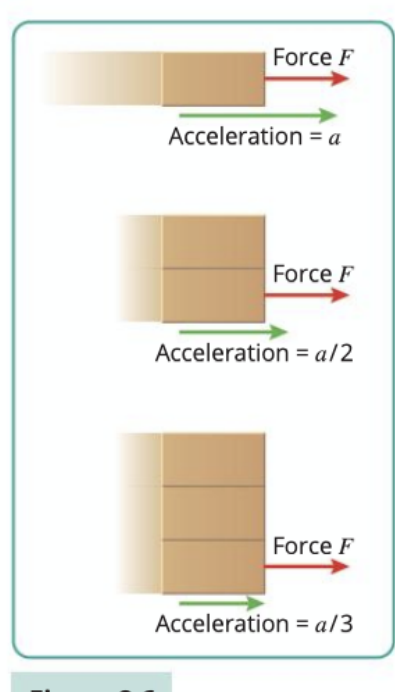
This diagram beautifully illustrates how the same force affects objects of different masses. Notice that:
- When mass doubles, acceleration halves (for the same force)
- When mass triples, acceleration reduces to one-third
- Force and acceleration are directly proportional
- Mass and acceleration are inversely proportional
Understanding the equation
Let's break down what tells us:
- Force is proportional to acceleration: If you double the force, you double the acceleration
- Force is proportional to mass: If you want to give a heavier object the same acceleration as a lighter one, you need more force
- The direction matters: Force and acceleration always point in the same direction
Units in F = ma
When we use , we must ensure our units are consistent:
- Force: newtons (N)
- Mass: kilogrammes (kg)
- Acceleration: metres per second squared (m s⁻²)
Therefore:
Working with multiple forces
In real situations, objects often experience multiple forces acting simultaneously. When this happens, we need to find the net force (also called the resultant force) to determine the acceleration.

The diagram above shows three different scenarios with the same 8 kg mass experiencing different combinations of forces. To find the acceleration in each case, we:
- Calculate the net force by considering the direction of each force
- Apply using the net force
- Determine both the magnitude and direction of the resulting acceleration
Example
Worked Example: Finding Net Force and Acceleration
In scenario A from the diagram:
- Forces: 10 N left, 34 N right
- Net force = 34 N - 10 N = 24 N to the right
- Using : to the right
Practical applications and problem solving
When solving force problems, follow these steps:
- Identify all forces acting on the object
- Choose a positive direction (usually right or up)
- Calculate the net force by adding forces in the positive direction and subtracting forces in the negative direction
- Apply to find the unknown quantity
- Check your units and ensure your answer makes physical sense
Example problem types
Example
Type 1: Finding force when mass and acceleration are known
- Given: ,
- Find:
Example
Type 2: Finding acceleration when force and mass are known
- Given: ,
- Find:
Example
Type 3: Finding mass when force and acceleration are known
- Given: ,
- Find:
External forces and motion
An important principle in physics is that only external forces can change an object's motion. Internal forces (like the forces between different parts of the same object) cannot cause the whole object to accelerate.
Note
Think about this practically: if you're sitting in a car and push on the dashboard, you won't make the car move faster. The force you apply is internal to the car-passenger system. To accelerate the car, an external force is needed - like the force from the engine acting through the wheels on the road.
Summary
Key Points to Remember:
- Force causes acceleration - without a net external force, objects continue moving at constant velocity
- F = ma is the fundamental relationship - force equals mass times acceleration
- The newton is defined as the force that gives 1 kg an acceleration of 1 m s⁻²
- Force is a vector quantity - it has both magnitude and direction
- Mass measures both the amount of matter and resistance to acceleration in an object
- Only external forces can change an object's motion
- When multiple forces act, calculate the net force first before applying