The Heat Pump and Heat Transfer (Leaving Cert Physics): Revision Notes
📚Revision Notes
The Heat Pump and Heat Transfer
The heat pump
A heat pump is a clever device that moves heat energy from a cooler place to a warmer place, which might seem backwards at first! This process requires work to be done, which is why heat pumps use electricity. You'll find heat pumps working hard in refrigerators and air conditioning systems in buildings and cars.
Note
The key to understanding how a heat pump works lies in the refrigeration cycle. Unlike natural heat flow (which goes from hot to cold), heat pumps use energy to force heat to flow "uphill" from cold to hot areas.
How a heat pump works
The system uses a special liquid called a refrigerant that has useful properties:
- It has a high specific latent heat of vaporisation
- It has a low boiling point
- It circulates around a closed circuit
The cycle works in four main stages:
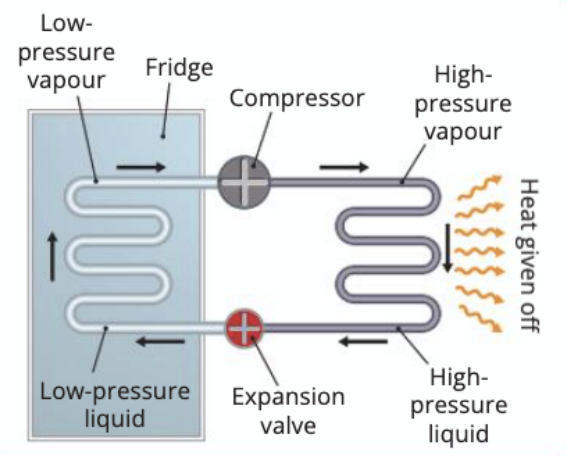
- Inside the fridge (low pressure): The liquid refrigerant is at low pressure and absorbs heat from inside the fridge, causing it to evaporate and become a gas
- At the compressor: The gas is compressed, which increases its pressure and temperature significantly
- Outside the fridge (high pressure): The hot, high-pressure gas releases its latent heat to the surroundings through the black pipes and cooling fins at the back of the fridge, condensing back into a liquid
- At the expansion valve: The liquid passes through the expansion valve where its pressure drops dramatically, preparing it to absorb heat again
This continuous cycle effectively pumps heat from the cold interior of the fridge to the warmer room outside.
Heat transfer
Heat can move from one place to another through three main methods: conduction, convection, and radiation. Understanding these processes is crucial for explaining how heat pumps work and how we can control heat flow in buildings.

Conduction
Conduction happens when heat energy moves through solid materials without the material itself moving. Think of it as a molecular relay race!
When one end of a solid object reaches a higher temperature than the other, the molecules at the hotter end vibrate more vigorously. This increased vibration gets passed from molecule to molecule along the object, transferring heat energy from the hot end to the cool end.
Important
Important distinctions:
- Thermal conductors (like metals) allow heat to flow through them easily
- Thermal insulators (like wood or plastic) resist heat flow and conduct poorly
Remember: The rate of conduction depends entirely on the material's properties, not on the movement of the material itself.
The simple experiment shown demonstrates this perfectly - different materials conduct heat at different rates, which is why coins fall off metal rods faster than wooden ones when heated.
Convection
Convection is the transfer of heat energy through fluids (liquids and gases) by the actual movement of the fluid itself.
Here's how it works:
- When a fluid is heated, the warmer particles move faster and spread out more
- This makes the warmer fluid less dense than the cooler fluid
- The warmer, less dense fluid rises while cooler, denser fluid sinks
- This creates a convection current - a circular flow pattern that transfers heat energy
Important
Key point: Convection only happens when there's gravity and the fluid can move freely. That's why it works in your heating system at home but wouldn't work in space!
Note
Hot water systems use convection currents to circulate water. The hot water outlet is positioned at the top of the tank because hot water naturally rises, while cooler water sinks to be heated again.
Radiation
Radiation is completely different from conduction and convection because it doesn't need any material to transfer heat - it can even work through empty space!
How radiation works:
- All objects emit electromagnetic waves when they have thermal energy
- The hotter the object, the shorter the wavelength of radiation emitted
- These waves travel at the speed of light ( m/s)
- When the waves hit another object, they transfer heat energy
Note
Important note: Heat from the Sun reaches Earth through radiation - this is called radiated heat.
Important
The colour of an object affects how it handles radiation:
- Dark colours (especially black) are excellent at both absorbing and emitting heat radiation
- Light colours (especially white or silver) reflect much of the heat radiation away
This explains why both cars tend to get hotter in summer when they're dark coloured, and why space blankets are shiny silver!
U-value
The U-value is a crucial concept for understanding how well (or poorly) building materials prevent heat loss. It's a measure of thermal conductivity that helps architects and engineers design energy-efficient buildings.
Definition and units
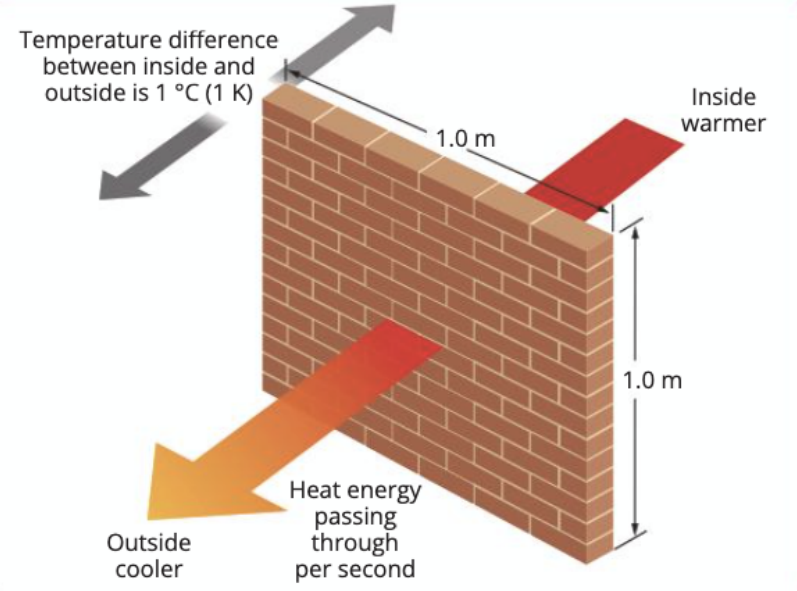
U-value represents the amount of heat energy conducted per second through 1 m² of a structure when there's a temperature difference of 1°C (or 1 K) between the two sides.
Units: W m⁻² K⁻¹ (watts per square metre per kelvin)
Note
Understanding U-values:
- High U-value = poor insulator (lots of heat gets through)
- Low U-value = good insulator (little heat gets through)
For example:
- A single-glazed window might have a U-value of 5.0 W m⁻² K⁻¹
- A well-insulated wall might have a U-value of 0.3 W m⁻² K⁻¹
Calculating heat loss
To find the heat energy transmitted through a structure:
Example
Worked Example: Heat Loss Calculation
Heat energy per second = Area × U-value × Temperature difference
Or in formula form:
Where:
- = power (heat energy per second) in watts
- = area in m²
- = U-value in W m⁻² K⁻¹
- = temperature difference in °C or K
Sample calculation: If a window has an area of 2 m², a U-value of 3.0 W m⁻² K⁻¹, and the temperature difference is 15°C:
watts of heat loss
Energy efficiency and insulation
Understanding energy efficiency is vital for reducing our environmental impact and saving money on heating bills.
Energy efficiency
Energy efficiency shows how effectively we use energy to perform a task:
In buildings, becoming more energy efficient means using less energy to maintain the same comfortable temperature. This involves minimising energy waste through better insulation and design.
The impact of insulation on energy consumption
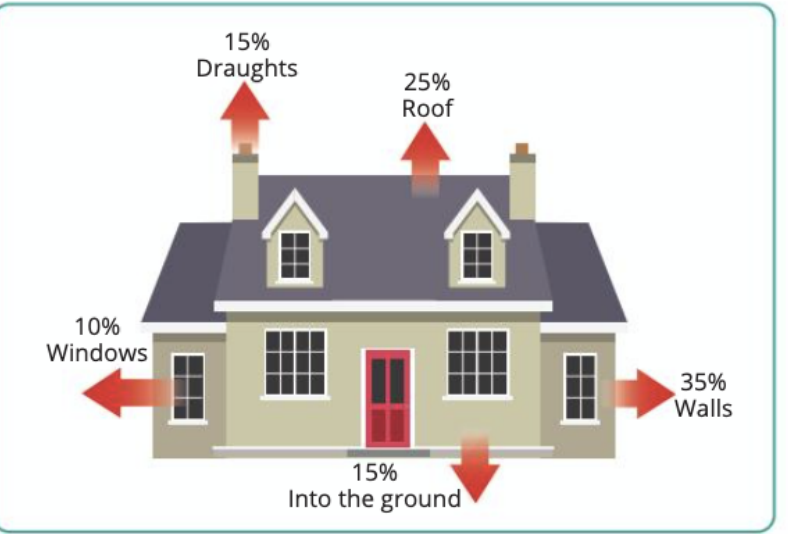
Proper insulation dramatically reduces heat loss from buildings. The diagram shows typical energy losses from an uninsulated house:
- 35% through walls - the largest single source of heat loss
- 25% through the roof - warm air rises and escapes
- 15% through draughts - gaps around doors, windows, chimneys
- 15% into the ground - heat conducted through foundations
- 10% through windows - glass is a relatively poor insulator
Reducing heat loss
Different types of insulation target different heat transfer methods:
Note
Insulation Methods and Their Targets:
- Cavity wall insulation reduces conduction through walls
- Loft insulation prevents heat rising and escaping through the roof
- Double glazing creates an air gap that reduces conduction through windows
- Draught excluders prevent convection currents carrying warm air outside
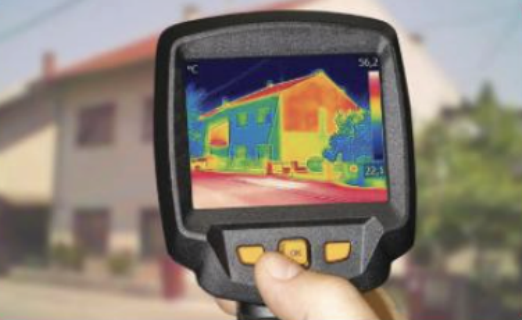
Thermal imaging cameras help identify where buildings lose the most heat. Warmer areas show up as red/orange colours, while cooler areas appear blue/green. This technology is invaluable for energy audits and identifying insulation problems.
Building regulations and U-values
Modern building regulations set maximum U-values for different parts of buildings:
- This ensures new buildings meet minimum insulation standards
- Retrofitting insulation to older buildings can reduce U-values dramatically
- Better insulation means lower energy bills and reduced carbon emissions
Example
Worked Example: Insulation Improvement
For example, improving roof insulation might reduce the U-value from 2.5 W m⁻² K⁻¹ to 0.18 W m⁻² K⁻¹ - a reduction of more than 90% in heat loss through the roof!
Summary
Key Points to Remember:
- Heat pumps use electricity to transfer heat from cold areas to warm areas, working against the natural direction of heat flow
- Conduction transfers heat through solids by molecular vibration without bulk movement of material
- Convection transfers heat through fluids by the actual movement of heated fluid creating currents
- Radiation transfers heat through electromagnetic waves and works even through empty space
- U-values measure thermal conductivity - lower values mean better insulation and less heat loss
- Energy efficiency in buildings comes from reducing heat loss through proper insulation targeting all three heat transfer methods