The States of Matter and Heat Capaciy (Leaving Cert Physics): Revision Notes
📚Revision Notes
The States of Matter and Heat Capacity
States of matter
Matter around us exists in three main physical states: solid, liquid, and gas. Understanding how particles behave in each state helps explain many everyday phenomena, from ice melting to steam rising from hot water.
Particle model for changes of state
The particle model explains the behaviour of matter by describing how tiny particles (atoms and molecules) move and interact differently in each state. This model helps us understand why substances change state when heated or cooled.
Note
The particle model is a simplified way of thinking about matter that helps us predict and explain the behaviour of different substances. While real particles are more complex, this model provides an excellent foundation for understanding thermal physics.
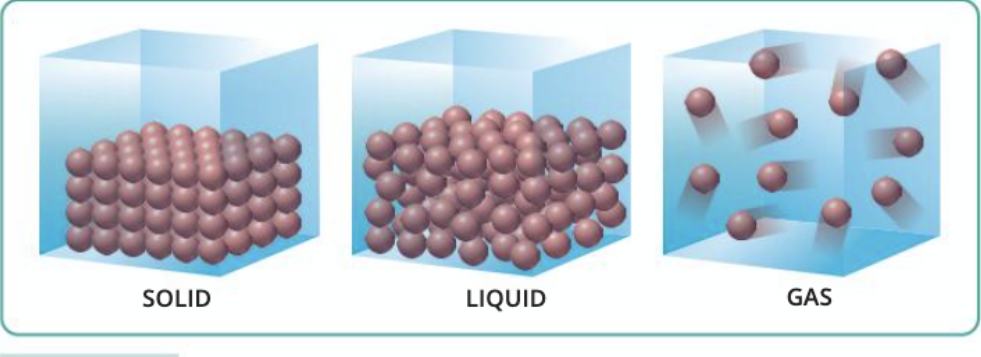
Solids
In solid materials, particles are arranged in a highly organised structure with several key characteristics:
- Tightly packed arrangement: The particles are positioned very close together, making solids extremely difficult to compress into smaller volumes
- Strong attractive forces: Large forces exist between neighbouring particles, keeping them firmly in place
- Fixed positions: Particles cannot move through the solid but can vibrate around their fixed positions at higher temperatures
- Regular structure: The organised arrangement gives solids their definite shape and means they cannot flow like liquids or gases
- Thermal expansion: As temperature increases, particles vibrate more vigorously, causing slight increases in the average distance between particles and making the solid expand slightly
Important
Remember that solid particles are not completely motionless - they vibrate more as temperature increases. This vibration is what causes thermal expansion in solids.
Liquids
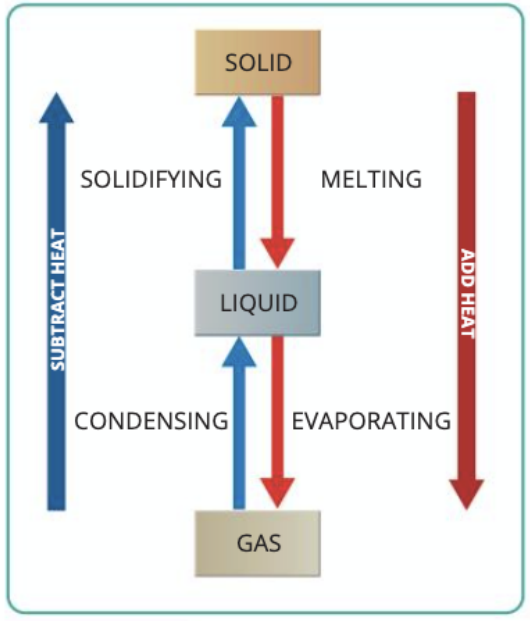
When sufficient thermal energy is added to a solid, it reaches its melting point and transforms into a liquid state:
- Mobile particles: Particles can slide freely around each other while remaining relatively close together
- Weaker forces: Attractive forces between particles still exist but are weaker than in solids
- No fixed shape: The ability of particles to move means liquids take the shape of their container
- Still difficult to compress: Particles remain close together, so liquids maintain nearly constant volume
- Surface evaporation: Some particles at the liquid surface gain enough energy to escape, leading to evaporation
Note
The key difference between solids and liquids is particle mobility. While solid particles vibrate in fixed positions, liquid particles can move past each other while staying close together.
Gases
As more thermal energy is added, liquids eventually reach their boiling point and become gases:
- Widely separated particles: Large distances exist between individual particles, making gases much easier to compress than solids or liquids
- Negligible forces: Attractive forces between particles become extremely weak except during brief collisions
- Random, rapid movement: Particles move in completely random directions at very high speeds
- Fill available space: Gases expand to completely fill any container they occupy
- High compressibility: The large spaces between particles mean gases can be compressed significantly
- Atmospheric behaviour: At Earth's surface temperature (around 15°C), the average speed of air particles reaches approximately 500 metres per second
Important
The massive difference in particle spacing between gases and liquids explains why gases are so compressible while liquids are not. This principle is fundamental to understanding pressure and volume relationships.
Heat capacity
Heat capacity is a fundamental concept that describes how much thermal energy an object needs to change its temperature. Understanding this relationship is essential for many practical applications, from cooking food to designing heating systems.
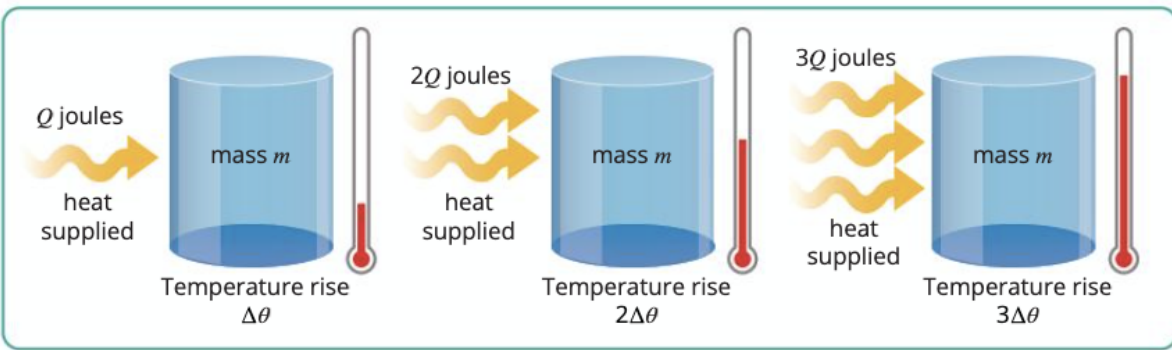
The heat capacity of an object represents the amount of heat energy required to raise its temperature by exactly 1 kelvin (or 1 degree Celsius). This property depends on both the material and the total amount of substance present.
The heat capacity formula
The relationship between heat energy and temperature change follows a simple mathematical pattern:
Where:
- Q = heat energy added or removed (measured in joules, J)
- C = heat capacity of the object (measured in joules per kelvin, J K⁻¹)
- Δθ = change in temperature (measured in kelvin, K, or degrees Celsius, °C)
Key principles
Several important principles govern heat capacity:
Note
Understanding Heat Capacity Relationships:
- Proportional relationship: The temperature rise is directly proportional to the amount of heat energy supplied
- Reversible process: The same amount of energy needed to heat an object will be released when it cools by the same amount
- Object-specific: Different objects require different amounts of energy to achieve the same temperature change
- Conservation of energy: Heat energy lost by one object equals heat energy gained by another in thermal interactions
Specific heat capacity
While heat capacity tells us about individual objects, specific heat capacity provides information about materials themselves. This property helps scientists and engineers compare how different substances respond to thermal energy.
Definition and importance
Specific heat capacity represents the heat energy needed to raise the temperature of exactly 1 kilogramme of a substance by 1 kelvin. This material property remains constant regardless of how much of the substance you have.
The specific heat capacity formula extends our understanding:
Where:
- Q = heat energy (joules, J)
- m = mass of the substance (kilogrammes, kg)
- c = specific heat capacity (joules per kilogramme per kelvin, J kg⁻¹ K⁻¹)
- Δθ = temperature change (kelvin, K)
Common specific heat capacity values
Different materials require vastly different amounts of energy to change their temperature:
| Substance | Specific heat capacity (J kg⁻¹ K⁻¹) |
|---|---|
| Water | 4180 |
| Copper | 390 |
| Iron | 451 |
| Glass | 674 |
| Aluminium | 910 |
| Paraffin oil | 2100 |
| Alcohol | 2500 |
| Wood | 1700 |
| Ice | 2100 |
| Air | 1000 |
Note
Understanding Specific Heat Capacity Values:
The table reveals several important patterns:
- Water's exceptional value: At 4180 J kg⁻¹ K⁻¹, water has by far the highest specific heat capacity of common substances, explaining why coastal areas have moderate climates and why water is excellent for cooling systems
- Metals have low values: Copper, iron, and aluminium have relatively low specific heat capacities, which is why metal objects heat up and cool down quickly
- Practical implications: Materials with high specific heat capacity store more thermal energy and change temperature slowly, while those with low values respond rapidly to heating or cooling
Calculation methods
When solving specific heat capacity problems, remember these key relationships:
Important
Essential Calculation Formulas:
- Heat energy added = mass × specific heat capacity × temperature rise
- Heat energy lost = mass × specific heat capacity × temperature fall
- Energy conservation: In thermal interactions, total energy input equals total energy output
Summary
Key Points to Remember:
-
Particle behaviour defines states: Solids have fixed, closely packed particles; liquids have mobile, close particles; gases have rapidly moving, widely separated particles
-
Phase changes require energy: Adding heat causes melting and evaporation, while removing heat causes condensing and solidifying
-
Heat capacity formula: relates thermal energy to temperature change for any object
-
Specific heat capacity formula: allows calculations for specific masses of materials
-
Water is special: With the highest specific heat capacity (4180 J kg⁻¹ K⁻¹), water requires more energy than other common substances to change temperature, making it excellent for thermal regulation