Force on a Current-Carrying Conductor in a Magnetic Field (Leaving Cert Physics): Revision Notes
📚Revision Notes
Force on a Current-Carrying Conductor in a Magnetic Field
What is the motor effect?
When an electric current flows through a conductor that is placed in a magnetic field, the conductor experiences a force. This phenomenon is known as the motor effect and forms the fundamental principle behind how electric motors work.
Note
The key insight is that a current-carrying conductor will always experience a force when placed in a magnetic field, unless the conductor runs parallel to the magnetic field lines (in which case no force occurs).
Direction of the force
The perpendicular relationship
The direction of the force on a current-carrying conductor follows a specific pattern. Experimentally, scientists have discovered that the force is always perpendicular to both:
- The direction of the current through the conductor
- The direction of the magnetic field
This means there are potentially two directions the force could act. To determine which direction is correct, we use Fleming's left-hand rule.
Fleming's left-hand rule
Important
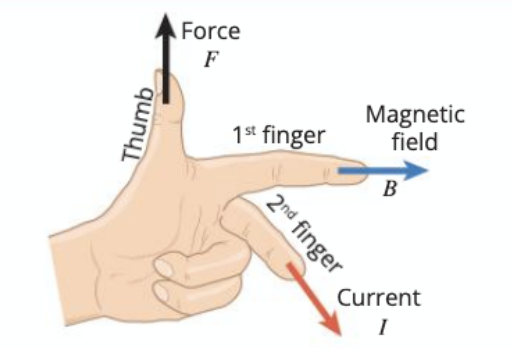
Fleming's left-hand rule is a simple hand gesture that helps you determine the direction of force on a current-carrying conductor in a magnetic field.
Here's how to use it:
- First finger - Point in the direction of the magnetic field (from North to South pole)
- Second finger - Point in the direction of conventional current (positive to negative)
- Thumb - Points in the direction of the force on the conductor
Remember the phrase: "First finger Field, second finger Current, thumb Force"
Experimental demonstration
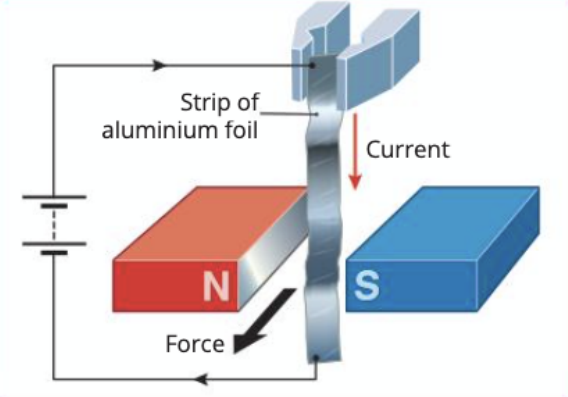
A simple experiment can demonstrate the motor effect using basic equipment.
Method
- Set up a strip of aluminium foil vertically between two opposing magnets (North and South poles)
- Connect the aluminium strip to a battery to create a current through the conductor
- Observe that the foil moves when current flows
Results
The aluminium foil will move either forwards or backwards depending on the direction of current flow. This movement demonstrates that a current-carrying conductor experiences a force in a magnetic field.
Conclusion
This experiment provides clear evidence that a current-carrying conductor placed in a magnetic field will experience a force, confirming the motor effect.
Size of the force
The magnitude of the force experienced by a current-carrying conductor in a magnetic field depends on three key factors:
Proportional relationships
- Current (I): The force is directly proportional to the current flowing through the conductor
- Length (L): The force is directly proportional to the length of conductor in the magnetic field
- Magnetic field strength (B): The force is directly proportional to the strength of the magnetic field
Important
The Force Equation
These relationships combine to give us the fundamental equation:
Where:
- = Force (measured in Newtons, N)
- = Magnetic flux density (measured in Tesla, T)
- = Current (measured in Amperes, A)
- = Length of conductor in the field (measured in metres, m)
Understanding magnetic flux density
Magnetic flux density (symbol B) is a measure of the strength of a magnetic field. It's defined as the force per unit current per unit length on a conductor placed perpendicular to the magnetic field.
Note
Key Properties of Magnetic Flux Density:
- Unit: Tesla (T)
- Magnetic flux density is a vector quantity - it has both magnitude and direction
- The direction of B is the same as the direction of the magnetic field (from North to South pole)
In practical terms, a stronger magnetic field (higher B value) will exert a greater force on the same current-carrying conductor.
Worked example
Example
Worked Example: Determining Force Direction
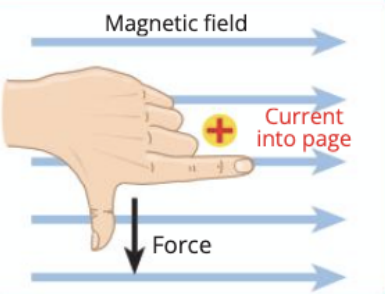
Question: A wire carrying a current into the page is placed in a magnetic field. Use Fleming's left-hand rule to determine the direction of force.
Solution:
- First finger points in direction of magnetic field (left to right in the diagram)
- Second finger points in direction of current (into the page)
- Thumb gives direction of force (downwards)
Answer: Therefore, the force acts downward on the conductor.
Applications
Understanding the force on current-carrying conductors is essential because:
- It explains how electric motors work
- It's used in loudspeakers and other electromagnetic devices
- It helps us understand the interaction between electricity and magnetism
Summary
Key Points to Remember:
- A current-carrying conductor in a magnetic field always experiences a force (unless parallel to the field)
- The force is perpendicular to both the current direction and magnetic field direction
- Use Fleming's left-hand rule to find the force direction: First finger (Field), Second finger (Current), Thumb (Force)
- The force magnitude follows where force increases with stronger field, higher current, or longer conductor length
- Magnetic flux density (B) measures field strength in Tesla (T) and determines how much force the field can exert