Magnetic Fields and Electric Current (Leaving Cert Physics): Revision Notes
📚Revision Notes
Magnetic Fields and Electric Current
What are magnetic fields?
Just as we understand gravitational and electrical forces, we can explore the concept of magnetic fields. When you place a bar magnet somewhere, the space around that magnet becomes different from what it was before. The magnet has created a magnetic field in the surrounding area.
This field can exert forces on other magnets or magnetic materials that enter the region. Objects closer to the magnet experience stronger forces, while those further away feel weaker effects.

Important
A magnetic field is defined as any region of space where magnetic forces can be detected. The direction of the field at any point is the direction in which a north pole would experience a force if placed at that location.
Understanding magnetic field lines
We can visualise invisible magnetic fields using magnetic field lines. These imaginary lines help us understand both the direction and strength of magnetic forces around magnets.
Important properties of magnetic field lines:
- Direction: Lines point away from north poles and towards south poles
- Strength indication: Closer lines mean stronger magnetic fields
- Never cross: Field lines cannot intersect each other
- Form loops: Lines create complete circuits from north to south pole
Note
A magnetic field line represents the path along which a north pole would move if placed in the field. These lines show us both where the magnetic field exists and how strong it is in different regions.
Plotting magnetic fields experimentally
You can map magnetic field patterns using a plotting compass - a small magnetic needle that aligns with local field directions.
Example
Experimental Method: Plotting Field Lines Around a Bar Magnet
- Place your magnet on paper and position the plotting compass near one pole
- Mark both ends of the compass needle with dots on the paper
- Move the compass so one end touches your previous dot, then mark the other end
- Continue this process, connecting dots to trace complete field lines
- Draw smooth curves through your dots and add arrows showing field direction
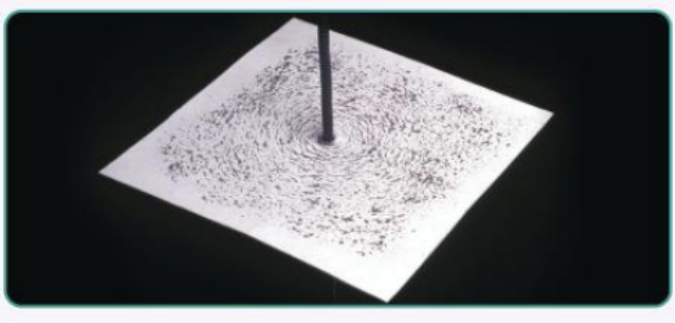
Alternative methods include sprinkling iron filings around magnets. These tiny pieces align themselves along field lines, creating visible patterns that reveal the magnetic field structure.
The magnetic effect of electric current
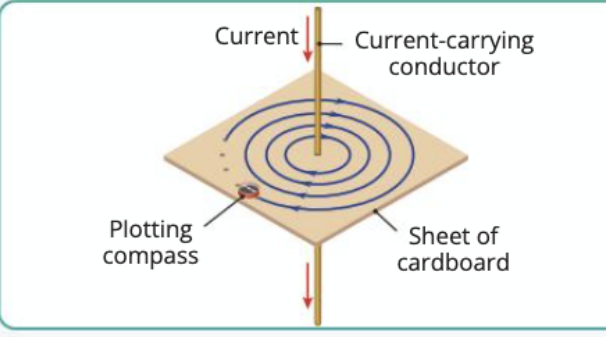
In 1819, Danish physicist Hans Christian Oersted made a revolutionary discovery: electric current flowing through any conductor creates a magnetic field around that conductor. This finding linked electricity and magnetism for the first time.
When current flows through a wire near a plotting compass, the needle deflects from its normal north-south position. This deflexion proves that electric current produces magnetic effects.
Key observations from current and magnetism experiments:
- With current flowing: Compass needle deflects, indicating magnetic field presence
- Current switched off: Needle returns to normal north-south alignment
- Current direction reversed: Needle deflects in the opposite direction
- Higher current: Greater deflexion shows stronger magnetic field
Important
Conclusion about current and magnetism
Every current-carrying conductor creates a magnetic field around itself. The field exists as long as current flows, and disappears when current stops. The field strength depends on the current magnitude - stronger currents produce stronger magnetic fields.
The right-hand grip rule
To predict the direction of magnetic fields around current-carrying conductors, we use the right-hand grip rule.
Example
Using the Right-Hand Grip Rule
- Grip the current-carrying conductor with your right hand
- Point your thumb in the direction of conventional current flow (positive to negative)
- Your curled fingers indicate the direction of circular magnetic field lines around the wire
This rule helps determine which direction a compass needle will point at any position around a current-carrying conductor. It's essential for understanding electromagnetic effects and predicting magnetic field directions.
Magnetic fields in circular loops and coils
When current flows through wire shaped into circular loops, the magnetic field pattern becomes more concentrated and useful.
Single circular loop
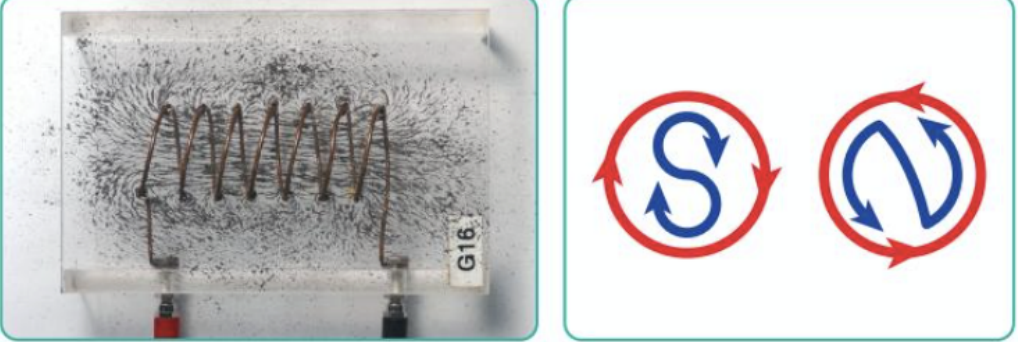
Applying the right-hand grip rule to a circular loop shows that magnetic field lines pass through the centre of the loop. One face of the loop behaves like a north pole, while the opposite face acts like a south pole.
Multiple loops forming coils
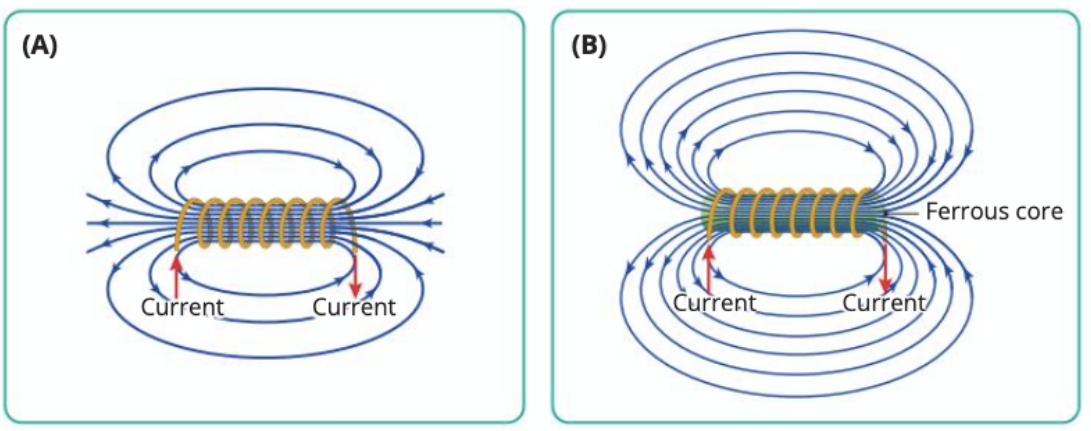
When several wire loops are wound together, their individual magnetic fields combine and strengthen each other. The resulting field pattern resembles that of a bar magnet, with clear north and south poles at opposite ends.
Note
Several loops wound together form a coil. The magnetic field produced by a coil is much stronger than that from a single loop carrying the same current. The field shapes are identical, but the coil version is more intense.
Solenoids and electromagnets
Understanding solenoids
A solenoid is a coil where the length is much greater than the diameter. Current flowing through a solenoid creates a strong, uniform magnetic field similar to that of a bar magnet.
Characteristics of solenoid magnetic fields:
- Inside the solenoid: Field lines run parallel and uniform
- Outside the solenoid: Field lines form loops like those around bar magnets
- Field strength: Much stronger than around straight wires or single loops
Electromagnets in practice
An electromagnet consists of a solenoid with a ferrous core (iron or similar magnetic material) inserted inside. When current flows through the solenoid, the iron core becomes magnetised, dramatically increasing the overall magnetic field strength.
Note
Advantages of electromagnets:
- Controllable: Magnetism can be switched on and off with current
- Variable strength: Field strength varies with current magnitude
- Temporary magnetism: Core loses magnetism when current stops
- Practical applications: Motors, speakers, magnetic cranes, and MRI machines
The electromagnet combines the controllability of electric current with the useful properties of strong magnetic fields, making it invaluable in modern technology.
Summary
Key Points to Remember:
- Magnetic fields exist around magnets and current-carrying conductors, with strength decreasing with distance
- Field lines show direction (north to south externally) and strength (closer lines indicate stronger fields)
- Electric current always creates circular magnetic field lines around the conductor (Oersted's discovery)
- Right-hand grip rule determines field direction: thumb shows current direction, fingers curl showing field direction
- Solenoids and electromagnets concentrate magnetic fields and provide controllable magnetism for practical applications