Splitting the Nucleus (Leaving Cert Physics): Revision Notes
📚Revision Notes
Splitting the Nucleus
Introduction to artificial nuclear splitting
In 1932, two English physicists named John Cockcroft and Ernest Walton achieved something remarkable - they became the first scientists to split a nucleus using artificially accelerated particles. This groundbreaking experiment marked the beginning of a new era in nuclear physics and demonstrated that humans could deliberately cause nuclear transformations in the laboratory.
Note
Before this achievement, nuclear changes had only been observed using naturally occurring radioactive particles. Cockcroft and Walton's work proved that scientists could control and study nuclear reactions using man-made equipment, opening up entirely new possibilities for understanding atomic structure.
The Cockcroft-Walton experiment
The historic experiment involved bombarding lithium nuclei with high-energy protons that had been artificially accelerated. When a proton struck a lithium nucleus, something extraordinary happened - the lithium nucleus split apart, producing two alpha particles and releasing energy.
The nuclear reaction that took place can be written as:
This equation shows that a lithium-7 nucleus combines with a hydrogen nucleus (proton) to produce two helium-4 nuclei (alpha particles) plus energy. This was the first example of a linear accelerator being used successfully, as the protons were accelerated in straight lines rather than in circular paths.
Experimental apparatus and setup
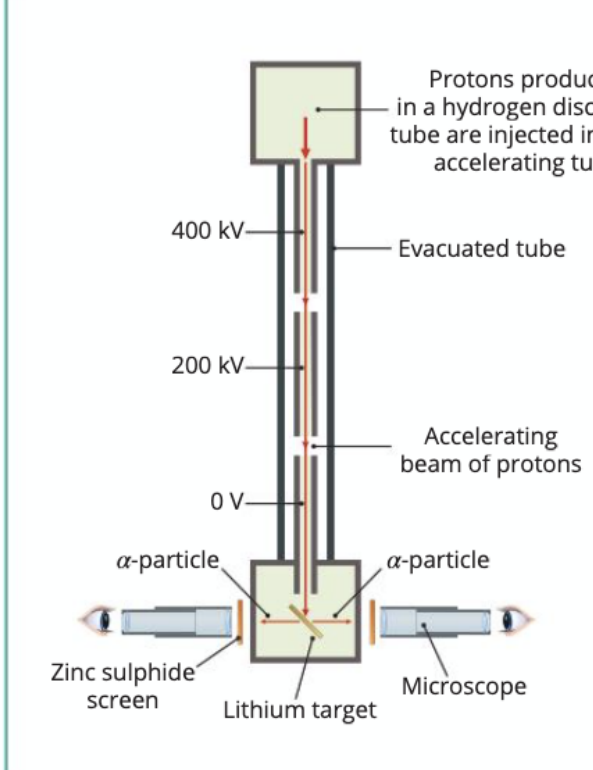
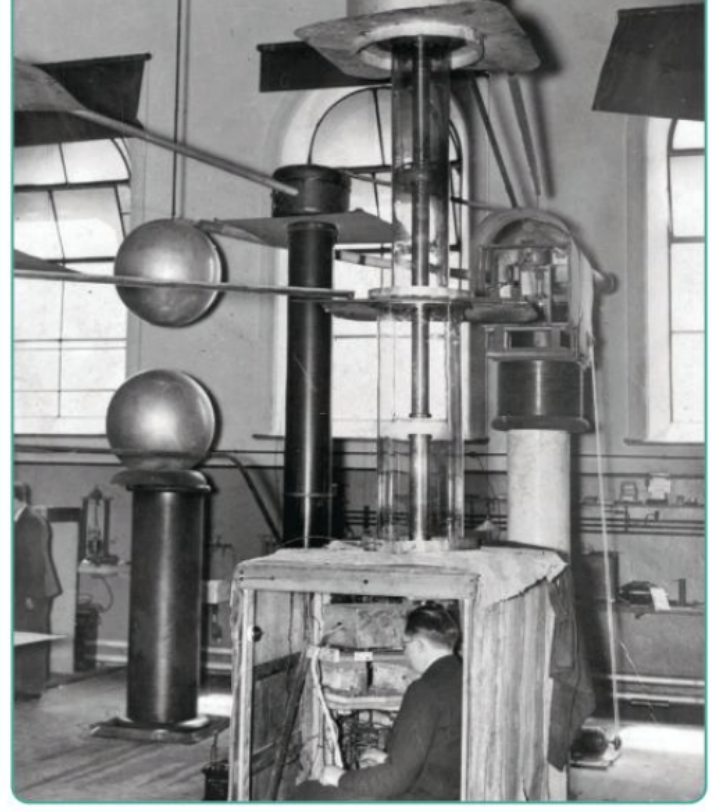
The experimental equipment was quite sophisticated for its time. The apparatus consisted of several key components working together to accelerate protons and detect the resulting nuclear reactions.
Note
The sophisticated nature of this 1930s equipment was remarkable for its time, requiring precise engineering to create the necessary high voltages and maintain the vacuum conditions needed for the experiment.
The setup included:
- Hydrogen discharge tube: This produced protons by ionising hydrogen gas
- Evacuated acceleration tube: A long tube with no air inside, allowing protons to travel freely
- High voltage system: Transformers, rectifiers, and capacitors created the necessary high DC voltage to accelerate protons through different voltage stages (400 kV, 200 kV, down to 0 V)
- Lithium target: A thin piece of lithium metal placed at an angle of 45° to the proton beam
- Detection system: Zinc sulphide screens positioned at right angles to the proton beam, observed through microscopes
Nuclear reaction process and detection
When the accelerated protons struck the lithium target, the collision caused the lithium nuclei to split. The two alpha particles produced in each reaction were emitted at right angles to the original proton beam direction. This was a crucial detail that helped confirm the reaction was actually occurring.
The alpha particles were detected using zinc sulphide screens, which are special materials that produce tiny flashes of light called scintillations when struck by alpha particles. Scientists could observe these flashes through microscopes, providing visual evidence that nuclear reactions were taking place.
Important
Several experimental tests confirmed the results:
- Different tests showed that helium nuclei (alpha particles) were indeed the products
- When momentum conservation was checked, two helium nuclei were found to be emitted in opposite directions at the same speed
- The energy measurements matched theoretical predictions
Mass-energy conversion in nuclear reactions
One of the most significant aspects of this experiment was that it provided the first experimental verification of Einstein's famous equation in a laboratory setting. The experiment showed that when nuclei are split, a small amount of mass is converted into a large amount of energy.
Important
In nuclear physics, this energy release occurs because the total mass of the products (two alpha particles) is slightly less than the total mass of the reactants (lithium nucleus plus proton). This missing mass, called the mass defect, is converted into kinetic energy of the reaction products.
The energy released in the Cockcroft-Walton experiment was about 1 MeV (mega-electron volt). While this might seem small, it represented a gain in energy of 17.3 MeV from a loss in mass, demonstrating the enormous energy content locked within atomic nuclei.
The unified atomic mass unit
When working with nuclear reactions, scientists use a special unit called the unified atomic mass unit, symbol u. This unit is much more convenient than kilogrammes when dealing with the incredibly small masses of atoms and nuclei.
The unified atomic mass unit is defined as:
Using this unit makes nuclear calculations much simpler. For example:
- Mass of a lithium nucleus = 7.01600 u
- Mass of a proton = 1.00783 u
- Mass of an alpha particle = 4.00260 u
Note
When solving problems involving nuclear reactions, masses must be converted from atomic mass units to kilogrammes before using the equation .
Worked calculation example
Example
Worked Example: Energy Released in Nuclear Splitting
Question: When lithium is bombarded with a proton, two alpha particles are produced. How much energy is released?
Given information:
- Mass of lithium nucleus = kg
- Mass of proton = kg
- Mass of alpha particle = kg
Solution:
The nuclear reaction is:
Step 1: Calculate total mass of reactants Total mass of reactants = kg
Step 2: Calculate total mass of products
Total mass of products = kg
Step 3: Find the mass defect Mass defect = kg
Step 4: Convert mass defect to energy using J
This energy corresponds to about 17.39 MeV, which matches experimental measurements.
Significance of the discovery
The Cockcroft-Walton experiment was groundbreaking for several reasons:
- It was the first successful artificial nuclear transformation using man-made equipment
- It provided experimental proof of Einstein's mass-energy equation
- It demonstrated that nuclear reactions could be studied and controlled in laboratory conditions
- It marked the beginning of modern nuclear physics and particle accelerator technology
- Cockcroft and Walton won the Nobel Prize in Physics in 1951 for this achievement
Note
This work laid the foundation for all future developments in nuclear physics, including nuclear power generation, nuclear medicine, and our understanding of the fundamental structure of matter.
Summary
Key Points to Remember:
- Historic achievement: Cockcroft and Walton (1932) first split nuclei artificially using accelerated protons
- Nuclear reaction: produces two alpha particles from lithium bombardment
- Mass-energy conversion: Small mass defect converts to large energy release via
- Detection method: Zinc sulphide screens produce scintillations when struck by alpha particles
- Unified atomic mass unit: makes nuclear calculations more manageable