The Fundamental Forces of Nature (Leaving Cert Physics): Revision Notes
📚Revision Notes
The Fundamental Forces of Nature
In physics, everything that happens in the universe can be explained by just four fundamental forces. These forces govern all interactions between particles and objects, from the tiniest atoms to the largest galaxies. Understanding these forces is essential for grasping how our universe works.
Note
These four forces are so fundamental that every single physical phenomenon you can observe - from a falling apple to the formation of galaxies - can ultimately be traced back to the action of one or more of these forces.
What are fundamental forces?
Fundamental forces are the basic interactions that cause all physical phenomena in nature. Every push, pull, attraction, or repulsion you observe is ultimately due to one or more of these four forces working together. These forces vary enormously in their strength and the distances over which they can act.
The four fundamental forces
Gravitational force
The gravitational force is the force you're most familiar with in everyday life. It's what keeps your feet on the ground and causes objects to fall.
Key characteristics:
- Always attractive - gravity only pulls objects together, never pushes them apart
- Acts on all objects with mass - everything that has mass experiences gravitational attraction
- Infinite range - gravitational effects extend across the entire universe, though they get weaker with distance
- Weakest of all forces - by far the weakest fundamental force, but becomes significant when dealing with very large masses like planets and stars
The strength of gravitational attraction follows an inverse square law - if you double the distance between two objects, the gravitational force becomes four times weaker. This is why you feel Earth's gravity strongly but barely notice the gravitational pull from distant objects.
Note
The Inverse Square Law in Action
This mathematical relationship means that gravitational force decreases as , where is the distance between objects. This is why astronauts can escape Earth's gravitational pull, but why the Moon still orbits our planet from 384,000 km away.
Electromagnetic force
The electromagnetic force is responsible for most of the interactions you observe in chemistry and everyday materials.
Key characteristics:
- Acts on charged particles - affects protons, electrons, and any other particles with electric charge
- Can be attractive or repulsive - opposite charges attract, like charges repel
- Infinite range - like gravity, electromagnetic effects can extend infinitely, but weaken with distance
- Much stronger than gravity - about times stronger than gravitational force between two protons
This force is what:
- Binds electrons to atoms
- Holds atoms together in molecules
- Creates the structure of all ordinary matter
- Powers most modern technology, from electric motors to computers
Important
The electromagnetic force is responsible for essentially all the chemistry and material properties you encounter in daily life. Without it, atoms couldn't exist, and matter as we know it would be impossible.
Strong nuclear force
The strong nuclear force is what holds the nucleus of atoms together.
Key characteristics:
- Strongest of all forces - the most powerful fundamental force
- Very short range - only acts over distances of about metres (roughly the size of an atomic nucleus)
- Acts on protons and neutrons - binds these particles together in the nucleus
- Overcomes electromagnetic repulsion - without this force, positively charged protons in the nucleus would repel each other and atoms would fall apart
The strong force is essential for:
- Keeping atomic nuclei stable
- Enabling nuclear fusion in stars
- The formation of all elements heavier than hydrogen
Important
Why the Strong Force is Crucial
Without the strong nuclear force, atomic nuclei would be impossible. The positively charged protons in every nucleus would repel each other due to electromagnetic force and fly apart instantly. The strong force is the only thing powerful enough to overcome this repulsion and hold nuclei together.
Weak nuclear force
The weak nuclear force is responsible for certain types of radioactive decay.
Key characteristics:
- Very short range - even shorter than the strong force, acting over about metres
- Acts on all particles - can affect any type of particle
- Responsible for beta decay - causes certain unstable nuclei to decay by converting neutrons into protons (or vice versa)
- Much weaker than strong and electromagnetic forces - but stronger than gravity
This force is crucial for:
- Nuclear reactions in stars
- Radioactive dating techniques
- Certain medical imaging procedures
Note
Applications of the Weak Force
The weak nuclear force enables the nuclear fusion processes that power stars, including our Sun. It's also the force behind carbon-14 dating, which archaeologists use to determine the age of ancient artefacts.
Comparing the fundamental forces
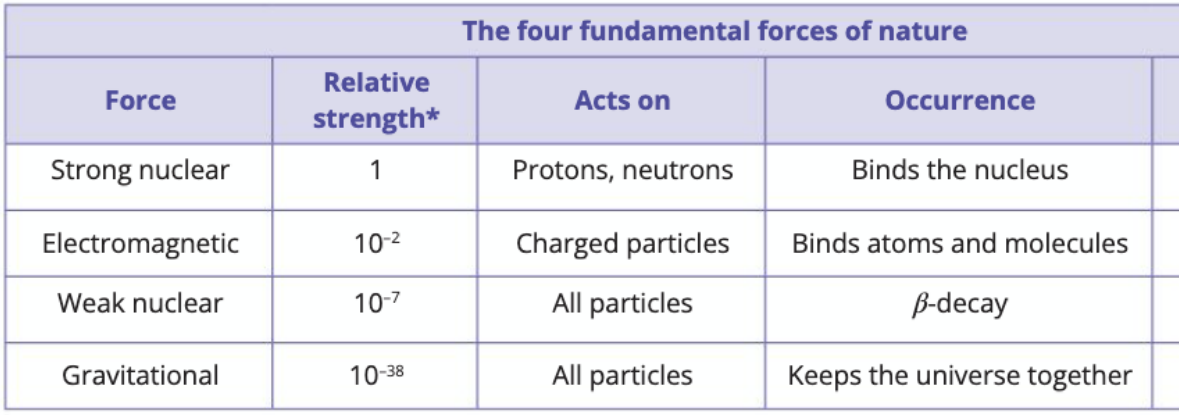
Note
The table above summarises the key properties of all four fundamental forces. Notice the enormous range in their relative strengths - from the strong nuclear force (strength = 1) to gravity (strength = ). This means the strong force is about 100 million trillion trillion trillion times stronger than gravity!
Why these forces matter
Understanding the fundamental forces helps explain many fundamental questions about our universe:
- Why atoms are stable - the strong force overcomes electromagnetic repulsion in nuclei
- How stars work - gravity brings matter together, while nuclear forces power fusion
- Why chemistry happens - electromagnetic forces determine how atoms bond
- How the universe evolved - the balance between these forces shaped everything we see
Each force operates most significantly at different scales:
- Gravity dominates on large scales (planets, stars, galaxies)
- Electromagnetic force governs atomic and molecular interactions
- Strong nuclear force operates within atomic nuclei
- Weak nuclear force is important in certain nuclear processes
Note
Scale and Significance
The fascinating thing about these forces is how they each dominate at different scales. While gravity is by far the weakest, it becomes the dominant force when dealing with massive objects like stars and planets because it has infinite range and is always attractive.
Summary
Key Points to Remember:
- Four fundamental forces govern all interactions in nature: gravitational, electromagnetic, strong nuclear, and weak nuclear
- Gravity is weakest but has infinite range - it becomes important only with very large masses
- Electromagnetic force is much stronger than gravity and binds atoms and molecules together
- Strong nuclear force is the strongest but has the shortest range, holding nuclei together
- Weak nuclear force causes certain types of radioactive decay and has extremely short range
- The balance of these forces determines the structure and behaviour of everything in the universe