Density and Pressure (Leaving Cert Physics): Revision Notes
📚Revision Notes
Density and Pressure
Understanding density
Density is a fundamental property that tells us how much matter is packed into a given space. When you compare different materials of the same size, you'll notice they have very different weights - this is because of their different densities.
Density is defined as the mass per unit volume of a substance. In mathematical terms:
Where:
- ρ (Greek letter rho) represents density
- m represents mass
- V represents volume
The SI unit for density is kilogrammes per cubic metre (kg m⁻³). This unit tells us how many kilogrammes of material fit into one cubic metre of space.
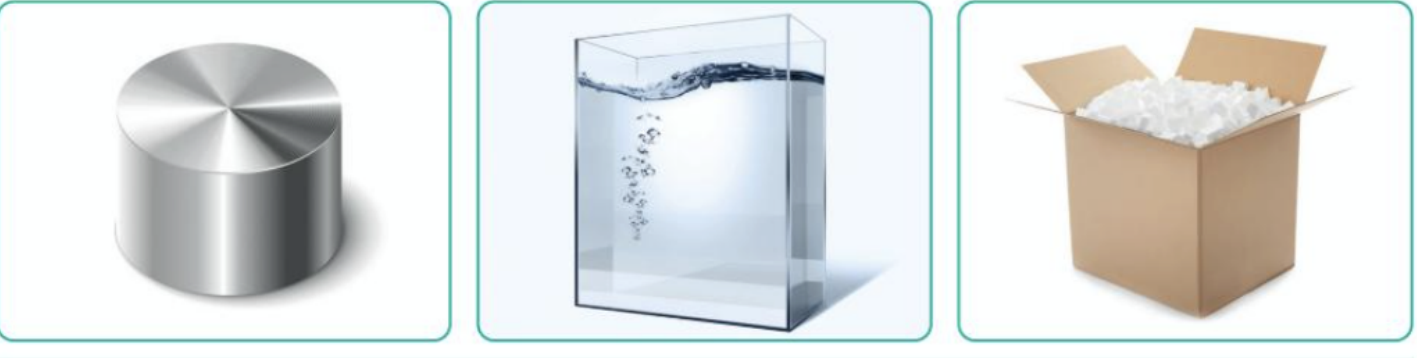
To understand density better, imagine you have three containers of exactly the same size - one made of steel, one filled with water, and one made of lightweight polystyrene foam. Even though they're the same size, the steel container will be much heavier than the water, and the water will be heavier than the polystyrene. This happens because steel atoms are packed much more tightly than water molecules, and water molecules are more densely packed than the air-filled polystyrene structure.
Note
Understanding Density Properties
Density is a scalar quantity - it has magnitude but no direction. This means density values are always positive numbers without any directional component, unlike vector quantities such as velocity or force.
Important
Key Points About Density:
- Different materials have vastly different densities
- The same material will always have the same density (at the same temperature and pressure)
- Dense materials feel "heavy for their size" while less dense materials feel "light for their size"
Measuring density
To measure the density of any object, you need to find both its mass and volume, then divide the mass by the volume.
For regular solids: Measure the dimensions and calculate volume using geometry formulas, then weigh the object to find mass.
For irregular solids: Use displacement method - submerge the object in water and measure how much water is displaced to find volume.
For liquids: Measure a known volume and weigh it to find mass.
Example
Worked Example: Calculating Density
Step 1: Identify the measurements
- Mass = 2.4 kg
- Volume = 0.003 m³
Step 2: Apply the density formula
Step 3: Interpret the result This density value suggests the material could be a type of wood or plastic.
Flotation and density
Understanding density helps explain why some objects float while others sink. This concept involves fluids - substances that can flow, including both liquids and gases.
Note
Flotation Rules:
- If an object's density is less than the fluid's density, it will float
- If an object's density is greater than the fluid's density, it will sink
- If densities are equal, the object will be suspended in the fluid
This is why ice floats on water (ice is less dense than liquid water), but a steel nail sinks (steel is much denser than water).
Understanding pressure
Pressure explains why you can walk easily on snow wearing snowshoes but would sink deeply wearing regular shoes, even though your weight is exactly the same in both cases.
Pressure is defined as the force acting per unit area:
Where:
- P represents pressure
- F represents force
- A represents area
The SI unit for pressure is the pascal (Pa), named after French scientist Blaise Pascal. One pascal equals one newton per square metre (1 Pa = 1 N m⁻²).

Real-world applications of pressure
The tractor image shows why agricultural vehicles use very large tyres. By spreading the weight over a much larger area, the pressure on the soil is reduced significantly. This prevents the heavy machinery from sinking into soft ground and damaging the soil structure.
Note
Examples of Pressure in Daily Life:
- Sharp knives work because they concentrate force over a very small area, creating high pressure
- Thumbtacks have sharp points to create high pressure for easy penetration
- Bed of nails demonstrations work because your weight is spread over many points, reducing pressure per point
- High-heeled shoes can damage floors because they create very high pressure
Units and conversions
While the pascal is the official SI unit, you might encounter other pressure units:
- 1 pascal (Pa) = 1 newton per square metre (1 N m⁻²)
- Pressure is also a scalar quantity like density
Important
Exam Tip: Always convert measurements to standard SI units before calculating. For pressure problems, ensure force is in newtons (N) and area is in square metres (m²).
Key calculation strategies
Example
Worked Example: Problem-Solving Steps
For density problems:
- Identify the mass (in kg) and volume (in m³)
- Apply ρ = m/V
- Express answer in kg m⁻³
For pressure problems:
- Identify the force (in N) and area (in m²)
- Apply P = F/A
- Express answer in pascals (Pa)
Important
Remember: When dealing with rectangular objects, you may need to calculate different pressures depending on which face is in contact with the surface, as the contact area changes.
Remember!
Summary
Key Points to Remember:
-
Density measures how much mass fits in a given volume (ρ = m/V), with SI unit kg m⁻³
-
Pressure measures how much force acts over a given area (P = F/A), with SI unit pascal (Pa)
-
Objects float if their density is less than the fluid's density, and sink if their density is greater
-
Large contact areas reduce pressure, while small contact areas increase pressure for the same applied force
-
Both density and pressure are scalar quantities that help explain many everyday phenomena from floating ice cubes to why sharp objects penetrate easily