Static Electricity (Leaving Cert Physics): Revision Notes
📚Revision Notes
Static Electricity and Electric Charge
What is static electricity?
Static electricity is a fascinating phenomenon that has been observed for thousands of years. The ancient Greeks discovered that when amber was rubbed with cloth, it would attract small objects like dust or hair. Today we understand this as one of the most dramatic examples of static electricity in action.

Note
The word "electricity" actually comes from the Greek word "elektron" meaning amber, reflecting humanity's long history with static electrical phenomena.
Static electricity occurs when electric charge builds up on the surface of objects and cannot flow away easily. This differs from current electricity, where charges move continuously through conductors.
Charging objects by friction
When you rub two different materials together vigorously, they can become electrically charged through a process called charging by friction.
How friction charging works
The process follows these key steps:
- When different materials are brought into close contact by rubbing them together, they become electrically charged
- Electrons transfer from one material to the other during the rubbing process
- The material that loses electrons becomes positively charged
- The material that gains electrons becomes negatively charged
Example
Worked Example: Charging a Balloon
Step 1: Take a balloon and rub it vigorously on your hair or a wool sweater
Step 2: During rubbing, electrons transfer from your hair to the balloon
Step 3: The balloon becomes negatively charged (gained electrons)
Step 4: Your hair becomes positively charged (lost electrons)
Step 5: The charged balloon can now attract small pieces of paper or make your hair stand up!
Types of electric charge
There are only two types of electric charge:
- Positive charge - occurs when an object has lost electrons
- Negative charge - occurs when an object has gained electrons
Forces between charges
The fundamental rule governing electric charges is:
- Like charges repel each other (positive repels positive, negative repels negative)
- Unlike charges attract each other (positive attracts negative)
This can be demonstrated using simple experiments with charged rods made from materials like polythene and cellulose acetate.
Atomic nature of electric charge
To understand electric charge properly, we need to look at the structure of atoms.
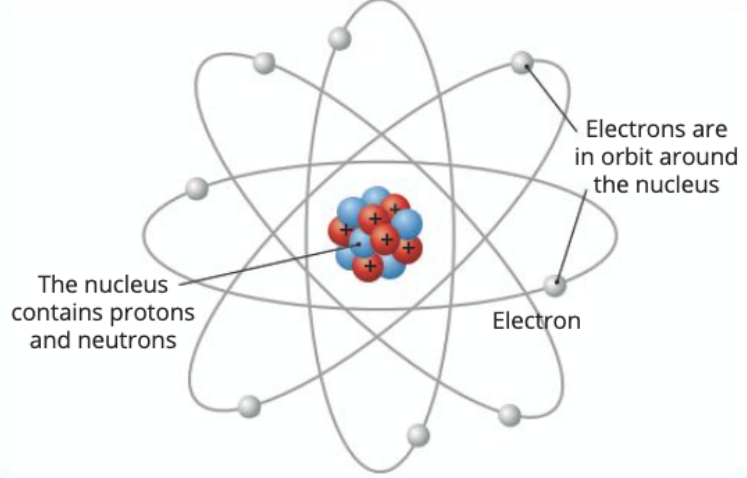
Atomic structure basics
Every atom consists of:
- A nucleus containing protons (positively charged) and neutrons (no charge)
- Electrons (negatively charged) that orbit around the nucleus
In a neutral atom:
- The number of protons equals the number of electrons
- The positive and negative charges cancel out
- The overall charge is zero
How objects become charged by friction
When objects are rubbed together:
- Only electrons can move between atoms and materials
- Protons remain fixed in the nucleus and cannot move from atom to atom
- If an object gains electrons, it becomes negatively charged
- If an object loses electrons, it becomes positively charged
Important
Critical Concept: Electron Movement
Remember that in all charging processes, only electrons move between materials. Protons are locked in the atomic nucleus and cannot transfer from one material to another. This is why we always talk about objects gaining or losing electrons, never protons.
Conservation of electric charge
An important principle governs all charging processes:
Electric charge cannot be created or destroyed - it can only be transferred from one object to another.
This means that in any charging process, the total amount of positive charge created always equals the total amount of negative charge created.
Conductors and insulators
Materials can be classified into two main categories based on how easily electric charge can flow through them.
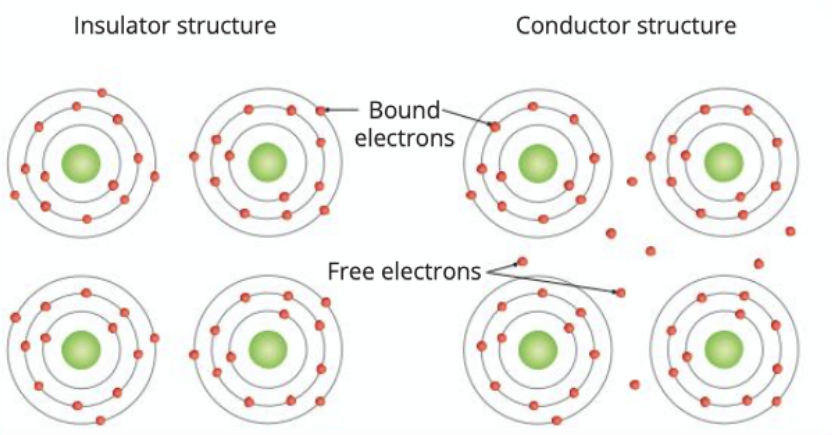
Conductors
Conductors are materials that allow electric charge to flow through them easily. Examples include:
- Metals (copper, aluminium, gold)
- Graphite
- Salt water
- The human body
In conductors:
- Electrons are free to move from atom to atom
- These mobile electrons are called free electrons
- When a charge is applied, it can flow throughout the material
Note
Why Metals are Good Conductors
Metals have a special structure where some electrons are not bound to specific atoms but form a "sea of electrons" that can move freely throughout the material. This is why metals are excellent conductors of both electricity and heat.
Insulators
Insulators are materials that do not allow electric charge to flow through them easily. Examples include:
- Plastics (polythene, PVC)
- Glass
- Rubber
- Dry air
- Pure water
In insulators:
- Electrons are tightly bound to their atoms
- Very few free electrons are available to carry charge
- Static charge tends to remain where it is placed
Earthing or grounding
When a charged conducting object is connected to the Earth using another conductor, the process is called earthing or grounding.
Because the Earth is so large, it can receive or supply virtually unlimited amounts of charge without changing its electrical state significantly. This makes earthing an effective way to:
- Remove unwanted static charge from objects
- Provide a safe path for electrical current
- Protect against dangerous electric shocks
Important
Safety Through Earthing
Earthing is a crucial safety measure in electrical systems. Many electrical appliances have three-pin plugs where the third pin provides an earth connection. This ensures that if a fault occurs, dangerous current flows safely to earth rather than through a person's body.
Charging objects by induction
Objects can be charged without direct contact through a process called charging by induction.
The induction process
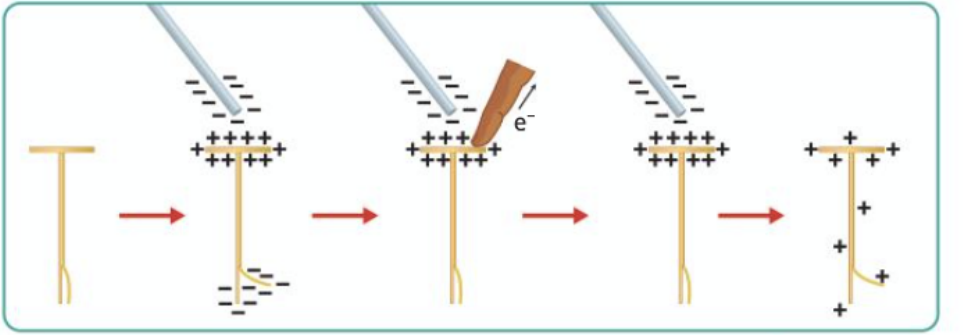
Induction charging works by redistributing existing charges rather than transferring electrons between materials.
Example
Worked Example: Charging by Induction
Step 1: Bring a negatively charged rod near (but not touching) a metal conductor
Step 2: The negative charge on the rod repels electrons in the conductor, pushing them to the far side
Step 3: The near side of the conductor becomes positively charged, the far side becomes negatively charged
Step 4: Connect the conductor to earth using a wire while keeping the charged rod nearby
Step 5: Electrons flow from the earth to neutralise the positive charge on the near side
Step 6: Remove the earth connection first, then remove the charged rod
Step 7: The conductor now has a net positive charge
Induced charges
The charges that appear on the conductor during induction are called induced charges. The key points are:
- The induced charge is always opposite in sign to the charge doing the inducing
- The amount of induced charge depends on the distance between objects
- Closer objects produce stronger induction effects
The gold leaf electroscope
The gold leaf electroscope is a sensitive instrument used to detect and measure electric charge.
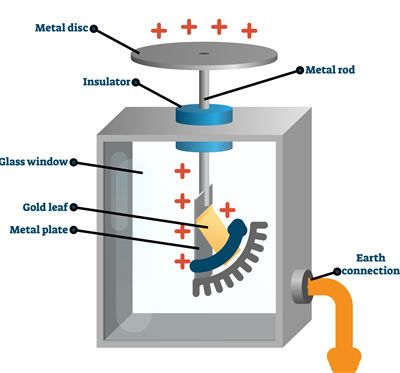
Structure of the electroscope
The electroscope consists of:
- A metal cap at the top for receiving charge
- A metal rod that conducts charge down into the case
- An insulator that prevents charge from leaking away
- Gold leaf attached to the bottom of the metal rod
- A metal case that shields the delicate gold leaf
- A window for observing the gold leaf
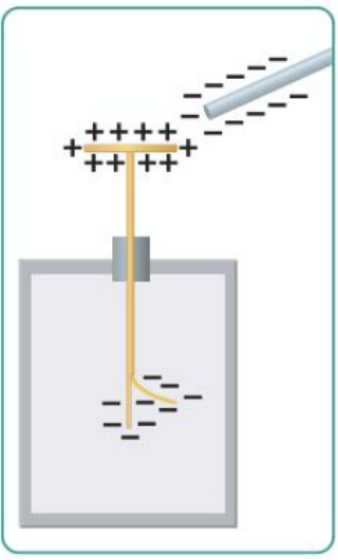
How the electroscope works
When charge is placed on the metal cap:
- The charge flows down the metal rod
- The gold leaf and the rod both acquire the same type of charge
- Since like charges repel, the gold leaf moves away from the rod
- The greater the charge, the further the gold leaf deflects
Note
Why Gold Leaf?
Gold leaf is used because it is extremely thin and lightweight, making it very sensitive to small electrical forces. Gold is also unreactive, so it doesn't corrode or change properties over time, ensuring reliable operation.
Testing conductors and insulators
The electroscope can determine whether an unknown material is a conductor or insulator:
Example
Testing Materials with an Electroscope
Testing a Conductor:
- Charge the electroscope so the gold leaf stands out
- Touch the unknown material to the metal cap
- If it's a conductor: the charge flows through your body to earth, and the gold leaf collapses
Testing an Insulator:
- Charge the electroscope so the gold leaf stands out
- Touch the unknown material to the metal cap
- If it's an insulator: no charge flows, and the gold leaf remains deflected
The distribution of charge on an insulated conductor
When static charge is placed on an isolated conductor, it behaves in predictable ways.
Key principles of charge distribution
Important
Fundamental Rules of Charge Distribution
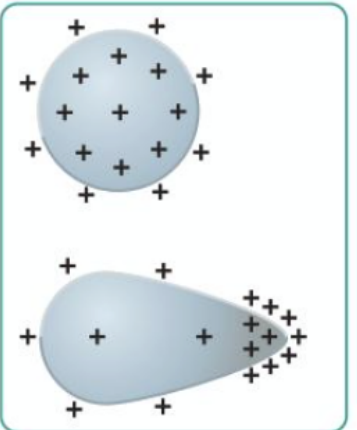
- All charge resides on the outside surface of the conductor
- No charge exists inside a conductor
- Charges spread themselves out as far as possible to minimise repulsion
- Extra charge accumulates at sharp points and edges
Point discharge
Sharp points on conductors create very strong electric fields because charge accumulates there. This leads to a phenomenon called point discharge.
At sharp points:
- The high concentration of charge creates strong electric forces
- These forces can be strong enough to remove electrons from air molecules, creating ions
- The ions are attracted to or repelled by the point, creating air currents
- This effectively removes charge from the conductor
Practical applications of point discharge
Point discharge is used in:
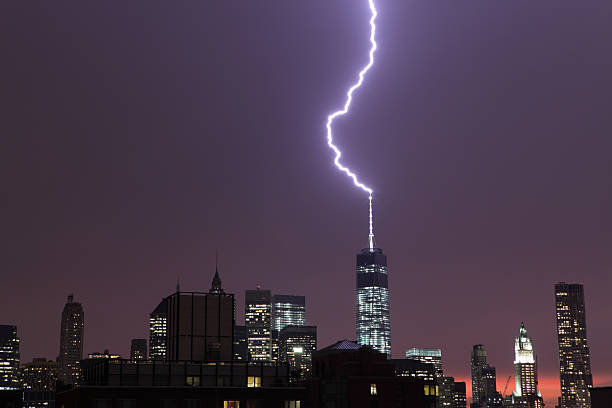
- Lightning conductors - the sharp point helps discharge buildings safely
- Static discharge wicks on aircraft - these remove static charge that builds up during flight
SI unit of electric charge
The coulomb (C) is the SI unit of electric charge.
To put this in perspective:
- One coulomb represents the charge on approximately electrons
- This is an enormous number of electrons
- Most static electricity involves much smaller amounts of charge (typically microcoulombs or nanocoulombs)
Note
The coulomb is named after French physicist Charles-Augustin de Coulomb, who studied the forces between electric charges in the 18th century.
Everyday effects of static electricity
Lightning
Lightning represents one of nature's most spectacular displays of static electricity.
During thunderstorms:
- Large amounts of static charge build up in clouds
- Charge separation occurs due to friction between ice particles and water droplets
- When the electric field becomes strong enough, lightning strikes occur
- Lightning seeks the easiest path to Earth, often through tall, pointed objects
Lightning protection
Buildings are protected from lightning strikes using lightning conductors:
- A metal rod with a sharp point is mounted on the highest part of the building
- This rod is connected by a thick copper strip to a large metal plate buried in the ground
- The sharp point helps attract lightning and provides a safe path for the current to reach Earth
Note
How Lightning Conductors Work
Lightning conductors don't prevent lightning strikes - they attract them! By providing the easiest path for lightning current to reach the ground safely, they protect the building from damage that would occur if lightning struck elsewhere and had to find its own path to earth.
Static electricity hazards
Important
Safety Warning: Static Electricity Dangers
Static electricity can be dangerous when:
- Flammable vapours or gases are present (risk of explosion)
- Sensitive electronic equipment could be damaged
- Large amounts of charge build up on aircraft or industrial equipment
Always take proper precautions when working in environments where static electricity could pose risks.
Static discharge prevention
Aircraft use static discharge wicks - small pointed rods attached to wing tips and control surfaces that safely discharge static electricity that builds up during flight.
Summary
Key Points to Remember:
- Static electricity occurs when electric charge builds up on objects and cannot flow away easily
- Friction charging happens when electrons transfer between materials that are rubbed together - only electrons move, never protons
- Like charges repel, unlike charges attract - this is fundamental to understanding all electric charge interactions
- Conductors have free electrons that can move easily, while insulators have electrons bound tightly to atoms
- The gold leaf electroscope detects electric charge by using the repulsion between like charges
- Charge always accumulates on the outside surface of conductors, with extra charge building up at sharp points where point discharge can occur
- Conservation of charge means charge cannot be created or destroyed, only transferred
- Earthing provides a safe way to remove unwanted static charge and protect against electrical hazards