Temperature and Thermometers (Leaving Cert Physics): Revision Notes
📚Revision Notes
Temperature and Thermometers
What is temperature?
Temperature is a fundamental concept in physics that measures how hot or cold something is. When we touch different objects, we can sense whether they feel hot or cold, but our senses can be unreliable for making accurate measurements.
Note
Our sense of touch can be misleading when judging temperature. What feels "warm" to one person might feel "cool" to another, and our perception changes based on what we've touched previously. This is why scientific measurement is essential.
Temperature specifically measures the average kinetic energy of particles in a substance. The faster the particles are moving and vibrating, the higher the temperature. This is why scientists needed to develop precise ways to measure temperature using instruments called thermometers.
The key point to understand is that temperature tells us about the internal energy of a material, not just how it feels to touch. This is why we need scientific temperature scales and measuring instruments rather than relying on our senses alone.
Temperature scales and units
The Celsius scale
The Celsius scale is the temperature scale most commonly used in everyday life. It's based on the properties of water under standard atmospheric pressure:
- Water freezes at 0°C
- Water boils at 100°C
This makes the Celsius scale very practical for daily use, as most people are familiar with these reference points. The scale is divided into 100 equal parts between these two points, which is why it was originally called the "centigrade" scale.
The Kelvin scale
The Kelvin scale is the scientific standard for measuring temperature and is one of the seven base units in physics. Unlike Celsius, the Kelvin scale is an absolute temperature scale, which means:
- It starts at absolute zero (0 K), the coldest possible temperature
- At absolute zero, all molecular motion theoretically stops
- Kelvin temperatures are always positive numbers
Important
The important advantage of the Kelvin scale is that it directly relates to the actual kinetic energy of particles. This makes it essential for scientific calculations and laws in physics and chemistry.
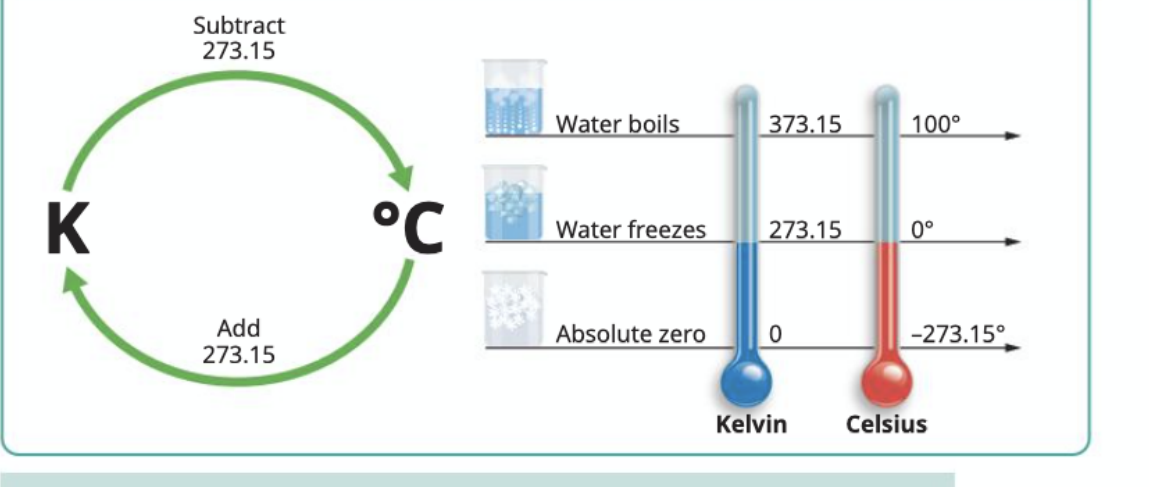
Converting between temperature scales
Converting between Celsius and Kelvin is straightforward because the size of one degree is identical in both scales. The only difference is where each scale starts:
To convert from Celsius to Kelvin:
To convert from Kelvin to Celsius:
Example
Worked Example: Temperature Conversions
Convert 25°C to Kelvin:
Convert 300 K to Celsius:
Key reference points to remember:
- Water freezes: 0°C = 273.15 K
- Water boils: 100°C = 373.15 K
- Absolute zero: -273.15°C = 0 K
The number 273.15 represents the difference between the starting points of the two scales. In most calculations for Leaving Cert Physics, you can round this to 273 for simplicity.
Thermometric properties
What makes a good thermometric property
A thermometric property is any physical characteristic that changes measurably and predictably with temperature. Scientists use these properties to create thermometers that can give accurate temperature readings.
For a property to be useful in temperature measurement, it should:
- Change continuously as temperature changes
- Be measurable across a wide range of temperatures
- Respond quickly to temperature changes
- Be very sensitive to even small temperature variations
- Not require much heat energy from the object being measured
- Change consistently in the same way each time
Common thermometric properties
Length of a liquid column
When liquids are heated, they expand in a predictable way. Mercury and alcohol thermometers work on this principle - as temperature increases, the liquid expands and rises higher in a narrow tube. The height of the liquid column directly indicates the temperature.

Electrical resistance
Most materials change their electrical resistance when their temperature changes. Metals typically increase their resistance as they get hotter, while semiconductors decrease their resistance. This property is used in digital thermometers and precision scientific instruments.
Colour changes
Some materials change colour as their temperature changes. This is the principle behind temperature strips that can be placed on a person's forehead to check for fever. The colour change occurs because of changes in the molecular structure at different temperatures.

Voltage (EMF) in thermocouples
When two different metals are joined together and heated, they generate a small electrical voltage. The amount of voltage depends directly on the temperature, making this useful for measuring very high temperatures or temperatures in hard-to-reach places.
Types of thermometers
Different types of thermometers are suited to different temperature ranges and applications. Here's a comparison of the main types:
| Type of thermometer | Thermometric property | Typical temperature range | Comments |
|---|---|---|---|
| Mercury-in-glass | Length of liquid column | -39 to 356°C | Cheap and portable but not very accurate. Safety concerns due to mercury toxicity |
| Alcohol (spirit)-in-glass | Length of liquid column | -114 to 78°C | Cheap and portable but not very accurate |
| Platinum resistance | Electrical resistance | -200 to 1200°C | Very accurate with low heat capacity for rapid temperature tracking |
| Thermocouple | Voltage/EMF | -250 to 1500°C | Compact and suitable for measuring changing temperatures in small spaces |
Note
Each type of thermometer has advantages and disadvantages:
Liquid-in-glass thermometers are simple and don't need power sources, making them reliable for everyday use. However, they can break easily and may not be accurate enough for scientific work.
Platinum resistance thermometers are extremely accurate and can measure a very wide range of temperatures. They're commonly used in scientific research and industrial applications where precision is crucial.
Thermocouple thermometers are valuable because they can measure very high temperatures and respond quickly to temperature changes. They're often used in industrial processes and scientific experiments where temperatures change rapidly.
The choice of thermometer depends on factors like the temperature range needed, required accuracy, response time, and the specific application.
Summary
Key Points to Remember:
-
Temperature measures the average kinetic energy of particles - the faster they move, the higher the temperature
-
Kelvin is the absolute temperature scale starting at absolute zero (0 K = -273.15°C), while Celsius is based on water's freezing and boiling points
-
Convert between scales easily: Add 273.15 to go from Celsius to Kelvin, subtract 273.15 to go from Kelvin to Celsius
-
Thermometric properties are physical characteristics that change predictably with temperature - like liquid expansion, electrical resistance, or colour changes
-
Different thermometers suit different purposes - choose based on temperature range, accuracy needed, and specific application requirements