Atoms (Leaving Cert Physics): Revision Notes
📚Revision Notes
Atoms
What are atoms?
Atoms are the fundamental building blocks of all matter in the universe. They are incredibly tiny - so small that they cannot be seen even with the most powerful light microscopes available today. To put their size in perspective, about 2 million atoms would fit across just one of the full stops on this page!
Every element in the periodic table is made up of atoms of the same kind. For example, hydrogen atoms make up hydrogen gas, oxygen atoms make up oxygen, and gold atoms make up gold metal. Since there are 118 different elements known today, there are 118 different kinds of atoms, each with its own unique properties.
Note
Each element can be represented by one or two letters as its atomic or chemical symbol. For instance, H represents a hydrogen atom, and He represents a helium atom. This system helps scientists communicate clearly about different types of atoms.
The development of atomic models
The Thomson model
In 1897, the brilliant physicist J.J. Thomson made a groundbreaking discovery - he found that atoms contain negatively charged particles called electrons. However, since atoms are normally electrically neutral, Thomson reasoned that they must also contain positive charge to balance out the negative electrons.
Thomson proposed that atoms were structured like a "plum pudding" - imagine a sphere of positive charge with tiny negative electrons embedded throughout it, like raisins scattered through a pudding. In this model, the positive charge was spread evenly throughout the entire atom, with the negative electrons distributed within it.

Note
This model seemed reasonable at the time and explained why atoms were electrically neutral. The "plum pudding" analogy helped people visualise how positive and negative charges could coexist within a single atom.
The Rutherford model
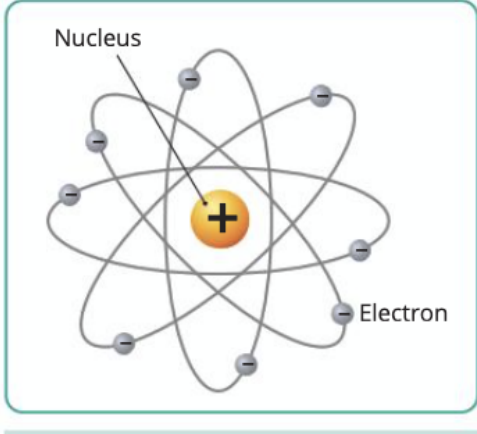
By 1911, Ernest Rutherford had conducted experiments that completely revolutionised our understanding of atomic structure. His work led to the nuclear model of the atom, which proposed something quite different from Thomson's idea.
Important
Rutherford's model suggested that:
- The atom has a tiny, extremely dense centre called the nucleus
- The nucleus contains all the positive charge and most of the atom's mass
- Electrons orbit around the nucleus in various paths
- Most of the atom's volume is actually empty space
This was a radical departure from the "plum pudding" model and had profound implications for our understanding of matter.
Rutherford's gold foil experiment
The experimental setup
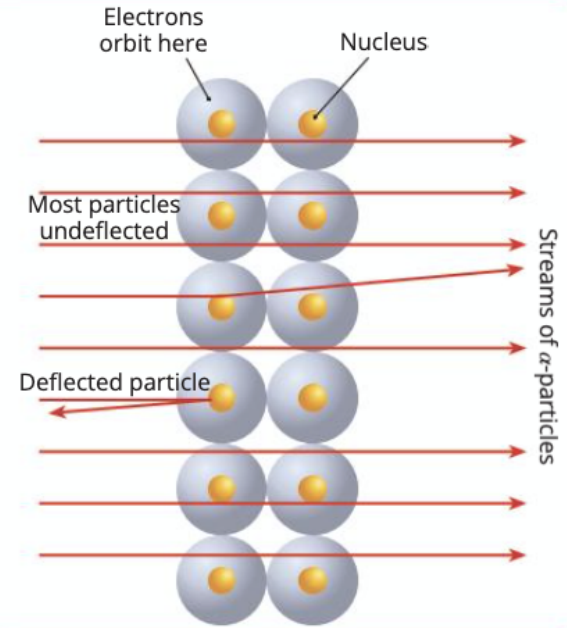
Rutherford's famous experiment involved firing a stream of alpha particles (α-particles) at a very thin sheet of gold foil. Alpha particles are positively charged particles that move at high speeds. The gold foil used was incredibly thin - only about 2000 atoms thick.
Note
Rutherford expected that if Thomson's model were correct, the alpha particles would pass through with only slight deflections, since the positive charge was supposed to be spread out evenly throughout each atom.
Key observations and results
The experimental results were absolutely astonishing and completely unexpected:
Example
Experimental Results:
Observation 1: Most alpha particles passed straight through the gold foil without any deflexion at all
Observation 2: Some particles were deflected through small angles as they passed near the gold atoms
Observation 3: A very small number of particles were deflected through angles greater than 90° - some even bounced straight back!
Rutherford famously described his surprise: "It was almost as incredible as if you fired a 15-inch shell at a piece of tissue paper and it came back and hit you."
What the results revealed
These results led Rutherford to several revolutionary conclusions:
Important
Rutherford's Revolutionary Discoveries:
- The atom is mostly empty space - this explains why most alpha particles passed through undeflected
- The positive charge is concentrated in a tiny, dense region - this explains the large-angle deflections when particles came close to or hit this region
- This dense region (the nucleus) is incredibly small compared to the overall size of the atom
- The nucleus contains most of the atom's mass despite being so small
The experiment proved that Thomson's "plum pudding" model was incorrect and established the nuclear model of the atom that we still use today.
The structure of the atom
The nucleus
The nucleus is the tiny, incredibly dense centre of the atom. It contains:
- Protons - positively charged particles
- Neutrons - particles with no electric charge (discovered later)
Despite being so small, the nucleus contains virtually all of the atom's mass. It's the positive charge of the protons that was detected in Rutherford's experiment.
Electrons
Electrons are negatively charged particles that exist in the space surrounding the nucleus. They are much lighter than protons or neutrons and move in various orbits around the nucleus.
Note
The number of electrons in a neutral atom equals the number of protons, making the overall atom electrically neutral.
Size and scale comparisons
The size difference between the nucleus and the entire atom is truly mind-boggling:
- Nuclear radius: approximately metres
- Atomic radius: approximately metres
Important
Scale Comparison: This means the nucleus is about 100,000 times smaller than the entire atom!
To help visualise this incredible difference, imagine that if the nucleus were scaled up to the size of a tennis ball, the outer electrons would be orbiting at a distance of about 3.3 kilometres away.
The radius of the nucleus
The nucleus has a radius on the order of metres, while the radius of the entire atom is on the order of metres. This means that most of the volume of an atom is empty space.
If we could somehow make the nucleus the size of a tennis ball, the outer boundary where electrons orbit would be approximately 3.3 km away. This comparison helps us understand just how much empty space exists within atoms - and therefore within all the matter around us, including our own bodies!
Summary
Key Points to Remember:
- Atoms are incredibly small - millions would fit across a full stop, yet they're the building blocks of everything around us
- Thomson's "plum pudding" model suggested positive charge was spread throughout the atom like a pudding with embedded electrons
- Rutherford's gold foil experiment proved atoms have a tiny, dense, positively charged nucleus surrounded by mostly empty space
- The nuclear model shows that atoms consist of a central nucleus (containing protons and neutrons) with electrons orbiting around it
- Size matters - the nucleus is 100,000 times smaller than the atom itself, making atoms mostly empty space