Emission Spectra and the Bohr Model of the Atom (Leaving Cert Physics): Revision Notes
📚Revision Notes
Emission Spectra and the Bohr Model of the Atom
What are emission spectra?
When atoms are supplied with sufficient energy (such as by heating or electrical discharge), they emit light. This emitted light creates distinctive patterns called emission spectra. Think of these spectra as unique "fingerprints" for different elements — each element produces its own characteristic pattern of light.
Note
The energy can be supplied in several ways:
- Heating a solid until it glows (like a light bulb filament)
- Passing an electric current through a gas
- Using other forms of electromagnetic radiation
Types of emission spectra
Continuous emission spectrum
A continuous spectrum contains all possible wavelengths of visible light, appearing as a smooth rainbow of colours from red to violet. This type of spectrum is produced when hot solids or liquids emit light, such as incandescent materials like tungsten filaments or white-hot iron.
Note
The key characteristic is that all wavelengths are present — there are no gaps or missing colours in the spectrum.
Line emission spectrum
A line spectrum shows only specific wavelengths as distinct coloured lines against a dark background. This occurs when hot gases emit light, atoms of a particular element are excited, or electric discharge passes through a gas.

Each element produces its own unique set of spectral lines. For example:
- Hydrogen shows four prominent lines in the visible region
- Neon exhibits many lines, particularly dense in the yellow-orange-red region
This uniqueness allows scientists to identify elements just by examining their spectral lines — even in distant stars!
The Bohr model of the atom
Background and development
Niels Henrik David Bohr (1885–1962) was a Danish physicist who revolutionised our understanding of atomic structure. His model, developed in 1913, successfully explained why atoms produce line spectra rather than continuous spectra.
Key principles of the Bohr model
Important
The Bohr model is built on several important ideas:
- Quantised energy levels — electrons can only exist in specific energy levels (like steps on a ladder), not anywhere in between.
- Stable orbits — when electrons are in these allowed energy levels, they don't emit electromagnetic radiation.
- Energy absorption and emission — electrons can absorb energy to jump to higher levels, or emit energy when falling to lower levels.
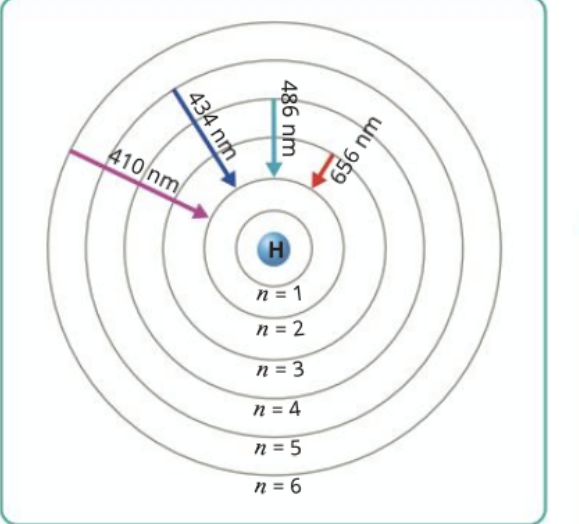
Energy levels in atoms
Each allowed energy level has a specific energy value. In the Bohr model, the ground state (n = 1) is the lowest energy level where electrons normally exist, while excited states (n = 2, 3, 4, etc.) are higher energy levels. Each energy level is associated with a principal quantum number (n).
Note
Definition: An energy level is a fixed energy value that an electron in an atom can have.
For hydrogen, the energy levels have specific values:
- n = 1: J (ground state)
- n = 2: J
- n = 3: J
- n = 4: J
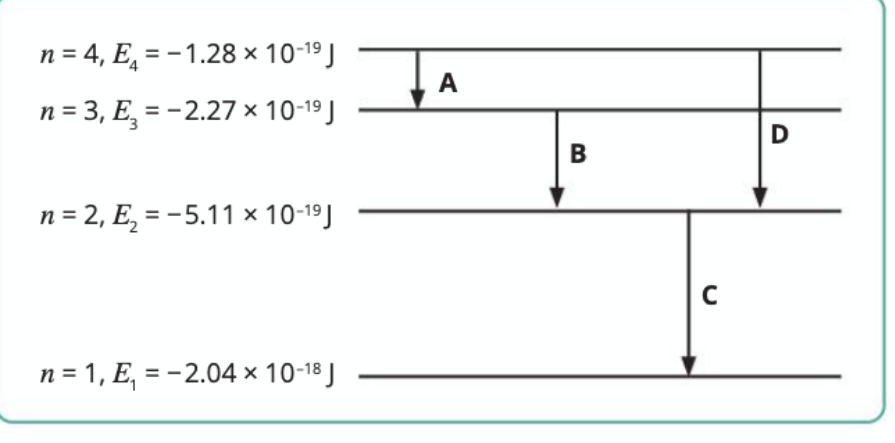
Electron transitions and photon emission
When an atom absorbs energy, electrons can jump from lower to higher energy levels. However, electrons naturally want to return to lower energy states. When this happens, the electron "falls" from a higher energy level to a lower one, the energy difference is released as a photon of light, and the energy of this photon equals the energy difference between the levels.
Important
The mathematical relationship is:
Where:
- is the energy of the emitted photon
- is Planck’s constant ( J·s)
- is the frequency of the light
The relationship between energy and wavelength
The energy of light is related to both its frequency and wavelength through these key equations:
Where:
- is the speed of light ( m/s)
- is the wavelength
- is the frequency
By combining these equations:
Note
This means:
- Higher energy transitions produce shorter wavelengths (bluer light)
- Lower energy transitions produce longer wavelengths (redder light)
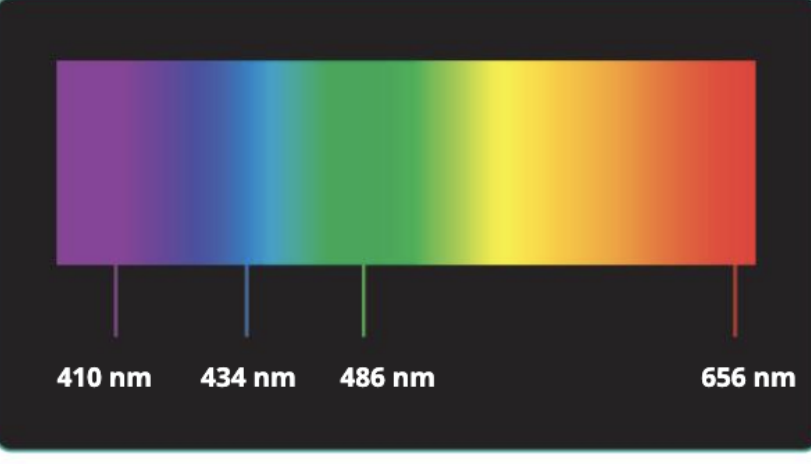
The hydrogen spectrum and Balmer series
Hydrogen is the simplest atom, making it ideal for understanding atomic spectra. The visible lines in hydrogen’s spectrum are called the Balmer series, which consists of:
- 656 nm (red light) — transition from n = 3 to n = 2
- 486 nm (blue-green light) — transition from n = 4 to n = 2
- 434 nm (blue light) — transition from n = 5 to n = 2
- 410 nm (violet light) — transition from n = 6 to n = 2
All these transitions end at the n = 2 energy level, which is why they form a "series."
Spectroscopy and understanding the universe
Applications in astronomy
Spectroscopy — the study of emission and absorption spectra — is one of the most powerful tools in astronomy. By analysing the light from distant objects, scientists can determine:
- The elements present in stars, planets, and galaxies
- The temperature of celestial objects
- Whether objects are moving towards or away from Earth
- The composition of planetary atmospheres
- The distance to far-off galaxies through redshift measurements
How spectroscopy works in space
When we observe light from stars and other celestial objects, the light travels through space for potentially millions of years, passes through our atmosphere and telescopes, and spectrometers split the light into its component wavelengths. Scientists then compare the observed spectral lines with known element signatures, which reveals the composition and properties of distant objects.
Note
This technique has shown us that the universe contains the same elements we find on Earth, demonstrating the fundamental unity of matter throughout the cosmos.
Worked example: calculating photon energy and wavelength
Example
Worked Example: Calculating Photon Energy and Wavelength
Problem: An electron in hydrogen drops from the n = 3 energy level to the n = 2 energy level, emitting a photon. Calculate the frequency and wavelength of the light emitted.
Given data:
- J
- J
- J·s
- m/s
Solution:
Step 1: Calculate the energy difference:
Step 2: Find the frequency using :
Step 3: Calculate wavelength using :
This wavelength corresponds to red light, which matches observations of the hydrogen spectrum.
Remember!
Summary
Key Points to Remember:
- Emission spectra are unique patterns of light emitted by excited atoms — each element has its own "fingerprint" of spectral lines.
- Line spectra come from hot gases and show only specific wavelengths, while continuous spectra from hot solids contain all wavelengths.
- The Bohr model explains that electrons exist in fixed energy levels, and light is emitted when electrons transition between these levels.
- Energy and wavelength are inversely related: higher energy transitions produce shorter wavelengths (bluer light), while lower energy transitions produce longer wavelengths (redder light).
- Spectroscopy allows us to identify elements in distant stars and galaxies, revealing that the same elements found on Earth exist throughout the universe.