Radioactivity (Leaving Cert Physics): Revision Notes
📚Revision Notes
Radioactivity
What is radioactivity?
Radioactivity was first discovered by Henri Becquerel in 1896 when he noticed that uranium salts could cause a photographic plate to become exposed, even when wrapped in dark paper. This led scientists to realise that certain elements naturally emit invisible radiation.
Radioactivity is the process by which unstable atomic nuclei spontaneously break down and release energy in the form of particles or electromagnetic radiation. This process is also called nuclear decay or nuclear disintegration.
Note
The discovery of radioactivity was actually accidental! Becquerel was studying fluorescence when he noticed that uranium salts affected photographic plates even without exposure to sunlight, leading to this groundbreaking discovery.
The key points about radioactivity:
- It involves the nucleus of atoms, not the electrons
- Unstable nuclei contain excess energy that they need to release
- The process transforms one element into another element
- Energy is released during this transformation
Three types of nuclear radiation
Scientists discovered that there are three distinct types of radiation emitted by radioactive materials. These were initially named using Greek letters: alpha (α), beta (β), and gamma (γ) radiation.
Alpha radiation
- Nature: Alpha particles are actually helium nuclei — each consists of 2 protons and 2 neutrons bound together
- Symbol: ^4_2He or α
- Charge: +2 (due to the 2 protons)
- Mass: Relatively heavy compared to other radiation types
Note
Alpha particles are identical to helium nuclei, which is why they can be written as ^4_2He. This connection wasn't immediately obvious to early researchers!
Beta radiation
- Nature: Beta particles are high-speed electrons ejected from the nucleus
- Symbol: ^0_{-1}e or β⁻
- Charge: -1 (negative, like all electrons)
- Mass: Very light (much lighter than alpha particles)
Gamma radiation
- Nature: High-frequency electromagnetic radiation (like very energetic X-rays)
- Symbol: γ
- Charge: No charge (electromagnetic radiation is neutral)
- Mass: No mass (it's energy, not matter)
Experimental evidence for the three types
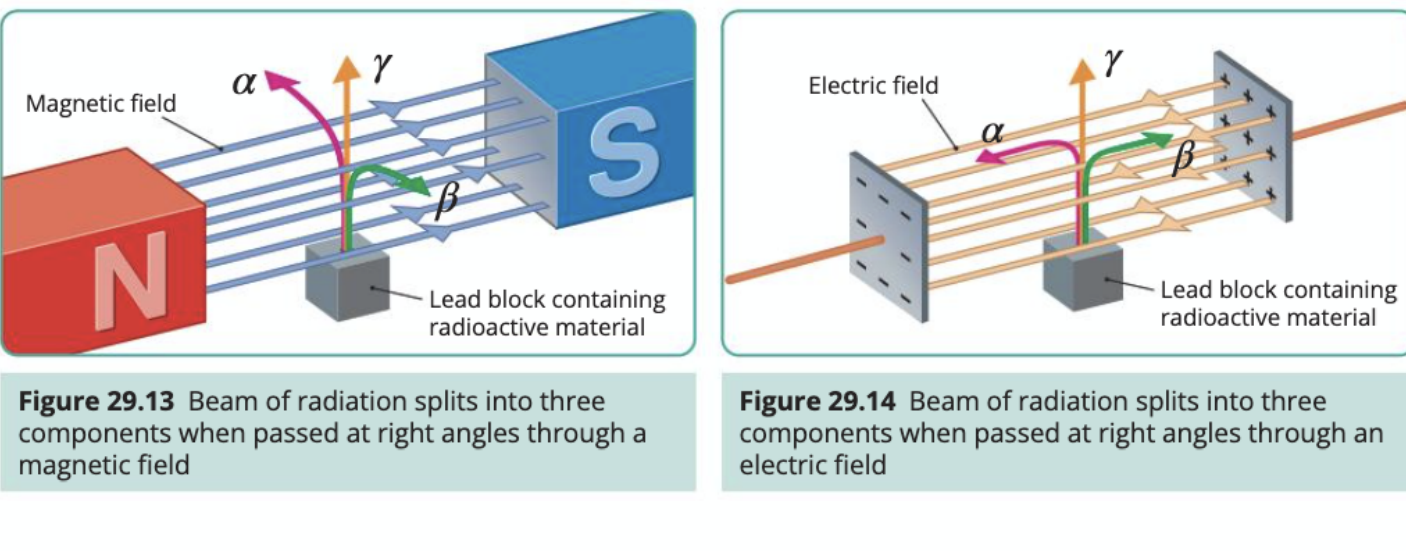
The existence of these three different types of radiation was proven through deflexion experiments using electric and magnetic fields.
Important
The deflexion experiment is crucial evidence that proves radiation consists of different types of particles and energy. Without this experiment, we wouldn't know that radioactive decay produces three distinct forms of radiation.
When a beam of radiation from a radioactive source passes through electric or magnetic fields:
- Alpha particles are deflected towards the negative plate/pole (because they're positively charged)
- Beta particles are deflected towards the positive plate/pole (because they're negatively charged)
- Gamma rays pass straight through without deflexion (because they have no charge)
The amount of deflexion also tells us about their masses — lighter particles are deflected more than heavier ones.
Properties of the three types of radiation
Penetrating power
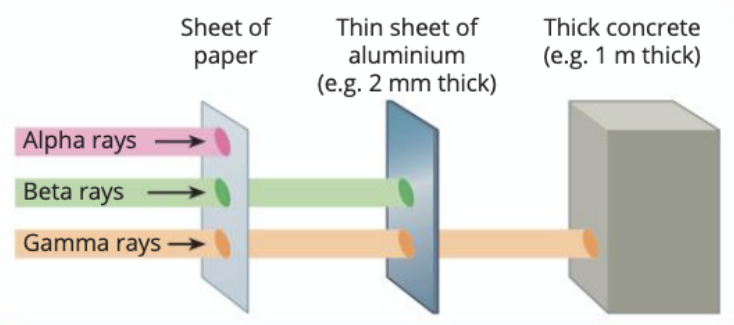
The three types of radiation have very different abilities to penetrate through materials:
Note
Understanding Penetrating Power
Penetrating power depends on the size, mass, and charge of the radiation. Larger, heavier, and more highly charged particles interact more strongly with matter and are stopped more easily.
- Alpha particles: Stopped by a thin sheet of paper or a few centimetres of air
- Beta particles: Stopped by a few millimetres of aluminium
- Gamma rays: Require thick concrete (about 1 metre) or lead to significantly reduce their intensity
Ionising ability
Ionisation occurs when radiation removes electrons from atoms, creating charged particles (ions).
- Alpha particles: Greatest ionising ability — they cause extensive ionisation along their path
- Beta particles: Moderate ionising ability — less than alpha but more than gamma
- Gamma rays: Least ionising ability — they cause very little ionisation
Important
There's an inverse relationship between penetrating power and ionising ability: the more ionising a radiation type is, the less penetrating it becomes. This is because highly ionising radiation loses energy quickly as it interacts with matter.
Summary of properties
| Property | Alpha (α) | Beta (β) | Gamma (γ) |
|---|---|---|---|
| Nature | Helium nucleus | Electron | Electromagnetic radiation |
| Charge | +2 | -1 | 0 |
| Mass | 4 atomic units | ~0 | 0 |
| Ionising ability | Greatest | Moderate | Least |
| Penetrating power | Least | Moderate | Greatest |
| Stopped by | Paper | Aluminium (2 mm) | Thick concrete (1 m) |
Nuclear decay processes
Alpha emission
When a nucleus undergoes alpha decay, it loses 2 protons and 2 neutrons (an alpha particle). This means:
- Mass number decreases by 4
- Atomic number decreases by 2
- The element changes to a different element
General equation for alpha emission:
Example
Worked Example: Alpha Decay of Radium-226
Radium-226 undergoes alpha decay:
Step 1: Identify the changes
- Mass number: 226 → 222 (decrease of 4)
- Atomic number: 88 → 86 (decrease of 2)
Step 2: Identify the new element
- Element with atomic number 86 is Radon (Rn)
- The daughter nucleus is Radon-222
Beta emission
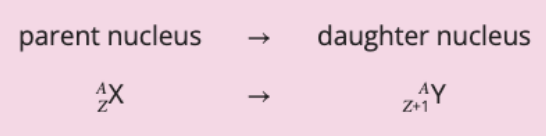
When a nucleus undergoes beta decay, a neutron converts into a proton and an electron. The electron is ejected as a beta particle. This means:
- Mass number stays the same
- Atomic number increases by 1
- The element changes to the next element in the periodic table
General equation for beta emission:
Example
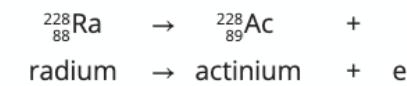
Worked Example: Beta Decay of Radium-228
Radium-228 undergoes beta decay:
Step 1: Identify the changes
- Mass number: 228 → 228 (no change)
- Atomic number: 88 → 89 (increase of 1)
Step 2: Identify the new element
- Element with atomic number 89 is Actinium (Ac)
- The daughter nucleus is Actinium-228
Gamma emission
Gamma emission usually follows alpha or beta decay. After emitting an alpha or beta particle, the daughter nucleus may still have excess energy. It releases this energy as gamma rays without changing its mass number or atomic number.
Note
Gamma emission is the nucleus's way of "settling down" after undergoing alpha or beta decay. Think of it as the nucleus releasing leftover energy to become more stable, similar to how a bell continues to vibrate and make sound after being struck.
Gamma rays help the nucleus reach a more stable, lower energy state.
Radioactive decay series
Many radioactive isotopes undergo a series of successive decays before reaching a stable nucleus. Each step in the series produces a different radioactive isotope until a stable element is finally formed.
For example, uranium-238 undergoes a series of alpha and beta decays before eventually becoming stable lead-206.
Note
Decay series can be quite long! The uranium-238 decay series involves 14 different steps, including 8 alpha decays and 6 beta decays, before reaching the stable lead-206 endpoint.
Summary
Key Points to Remember:
- Radioactivity is the spontaneous breakdown of unstable atomic nuclei with energy release
- Three types of radiation: Alpha (helium nuclei), Beta (electrons), Gamma (electromagnetic radiation)
- Penetrating power increases: Alpha < Beta < Gamma (paper stops α, aluminium stops β, concrete needed for γ)
- Ionising ability decreases: Alpha > Beta > Gamma
- Alpha decay: Mass number −4, atomic number −2
- Beta decay: Mass number unchanged, atomic number +1
- Different types of radiation can be identified by their behaviour in electric and magnetic fields