Characteristics of Sound and Frequency Limits (Leaving Cert Physics): Revision Notes
📚Revision Notes
Characteristics of Sound and Frequency Limits
Sound is a fundamental part of our daily experience, but understanding its scientific properties helps us grasp how we hear and how sound can be used in technology and medicine. This revision note covers the key characteristics that define sound waves and explores the limits of human hearing, along with important applications of ultrasonic frequencies.
What makes sounds different from each other?
Sound waves have two main characteristics that determine what we actually hear: loudness and pitch. These properties are directly linked to the physical features of the sound wave itself.
Note
The way we perceive sound depends entirely on the physical properties of the sound waves reaching our ears. By understanding amplitude and frequency, we can explain why sounds seem loud or quiet, high or low.
Loudness and amplitude
The loudness of a sound depends on how much energy the sound wave carries as it enters your ear each second. This energy is directly related to the amplitude of the sound wave - the bigger the amplitude, the more energy it carries, and therefore the louder the sound appears to us.
Think of amplitude as the "height" of the wave - larger waves carry more energy and create louder sounds. When you turn up the volume on your music, you're increasing the amplitude of the sound waves being produced.
Example
Worked Example: Understanding Amplitude and Loudness
Consider two sound waves:
- Wave A: Small amplitude = Quiet sound (like a whisper)
- Wave B: Large amplitude = Loud sound (like a shout)
Both waves might have the same frequency (same pitch), but Wave B carries much more energy per second, making it sound louder to our ears.
Pitch and frequency
The pitch of a sound relates to how high or low it sounds to our ears. A high note on a piano has a high pitch, while a low note has a low pitch. This characteristic depends entirely on the frequency of the sound wave.
Frequency measures how many wave cycles occur per second, measured in Hertz (Hz). The relationship is straightforward:
Important
Critical Relationship:
- Higher frequency = Higher pitch
- Lower frequency = Lower pitch
This relationship is fundamental to understanding all aspects of sound and music.
You can demonstrate this with tuning forks - arrange several forks in order of increasing pitch, and you'll find they have increasing frequencies written on them. Each fork vibrates at its specific frequency, creating sound waves of that same frequency.
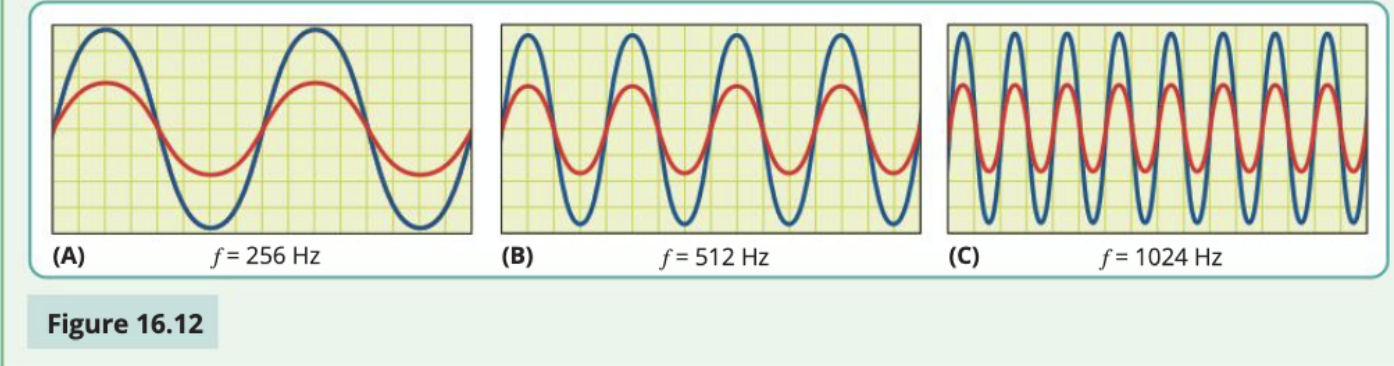
The diagram above shows how different frequencies appear as waveforms. Notice how more wave cycles fit into the same time period as frequency increases from to to .
Human hearing and frequency limits
The range of human audibility
For a sound wave to be audible to humans, its frequency must fall between 20 Hz and 20,000 Hz. These values are known as the frequency limits of audibility. However, this range isn't the same for everyone - the upper frequency limit decreases with age, and most adults cannot hear frequencies above 20,000 Hz.
Important
Human Frequency Limits of Audibility
The frequencies of audibility represent the highest and lowest frequencies that can be heard by a normal human ear. The range is 20 Hz - 20,000 Hz.
Remember: This range decreases with age, particularly the upper frequency limit.
Beyond human hearing: ultrasonic frequencies
Note
What are Ultrasonic Frequencies?
Frequencies above 20,000 Hz are called ultrasonic and are inaudible to humans. However, some animals like dogs and bats can hear sounds at frequencies up to about , and some dog whistles operate at frequencies above .
Applications of ultrasound in medicine and technology
Medical applications
Ultrasound serves as a vital tool in modern medicine because it can be used to diagnose issues or monitor conditions inside the human body without invasive procedures.
Note
Diagnostic Ultrasound
Diagnostic ultrasound can produce images of internal features of the human body, such as organs and other structures or foetuses during pregnancy. This technique works by sending ultrasonic waves into the body and detecting the echoes that bounce back from different tissues.

Doppler ultrasound represents a special application that can detect the movement of body parts or liquids, such as measuring the velocity of blood flow. This is particularly useful for examining circulation and heart function.
Ultrasound can also be used therapeutically for treating various medical issues such as pains, sprains and musculoskeletal conditions. Very high frequency ultrasound can be used to dissolve blood clots or heat up tissue and stop it performing problematic functions.
Important
Key Advantage of Medical Ultrasound
The major advantage of ultrasound in medicine is that it's non-invasive and non-ionising, unlike X-rays. This makes it safe for repeated use and suitable for monitoring pregnancy.
Industrial and technological applications
Note
Industrial Applications of Ultrasound
In manufacturing and industry, ultrasound has several practical uses:
- Non-contact sensors for measuring distances and detecting objects
- Motion sensors and flow measurement sensors for monitoring industrial processes
- Non-destructive testing to check for cracks and flaws in welded materials without damaging them
Cleaning applications
Ultrasonic cleaners can be used for cleaning objects such as jewellery, watches, and dental equipment. The ultrasound creates cavitation bubbles near dirty surfaces, and these tiny shockwaves help clean the surface effectively.

Summary
Key Relationships to Remember
Understanding sound requires grasping these fundamental relationships:
- Loudness increases when amplitude increases
- Pitch increases when frequency increases
- Human hearing range: to
- Ultrasonic frequencies: above
- Sound waves can be visualised using oscilloscopes to show their amplitude and frequency characteristics
Summary
Essential Points to Remember
- Loudness depends on the amplitude of the sound wave - bigger amplitude means louder sound
- Pitch depends on the frequency of the sound wave - higher frequency means higher pitch
- Human audible range is to , though this decreases with age
- Ultrasonic frequencies (above ) have important applications in medicine, industry, and cleaning
- Medical ultrasound is non-invasive and non-ionising, making it safe for imaging internal body structures and monitoring conditions like pregnancy