Production and Travel of Sound Waves (Leaving Cert Physics): Revision Notes
📚Revision Notes
Production and Travel of Sound Waves
Every source of sound is a vibrating object
Understanding sound begins with a fundamental principle: all sound originates from vibrating objects. When any object moves back and forth rapidly, it creates the disturbances in the surrounding air that we perceive as sound.
What makes objects vibrate and produce sound
A vibrating object moves in a repetitive pattern, oscillating back and forth around a rest position. Consider a ruler clamped to the edge of a desk - when you pull the free end down and release it, the ruler vibrates up and down. This motion creates sound waves that travel through the air to your ears.
The frequency of vibration determines how we perceive the sound. Frequency is measured in hertz (Hz), which represents the number of complete vibrations or cycles per second. For humans to hear a sound, the vibrating object must have a frequency between 20 Hz and 20,000 Hz. This range is called the audible frequency range.
Note
The human audible frequency range of 20 Hz to 20,000 Hz means we can hear everything from the deep rumble of a bass drum (around 20 Hz) to the high-pitched whistle of a tea kettle (around 20,000 Hz). Sounds below 20 Hz are called infrasound, while sounds above 20,000 Hz are called ultrasound.
Common examples of vibrating objects that produce sound include:
- Guitar strings vibrating when plucked
- Vocal cords vibrating when speaking or singing
- Tuning forks when struck
- Loudspeaker cones moving back and forth
- Any object that moves rhythmically
The connection between vibration and sound
Every time an object vibrates, it pushes against the air molecules around it. When the object moves in one direction, it compresses the nearby air molecules together. When it moves back, it creates a region where the air molecules are spread further apart. This alternating pattern of compression and expansion travels outward from the vibrating source as a sound wave.
Sound travels as a mechanical wave
Sound is classified as a mechanical wave because it requires matter (a medium) to travel through. Unlike light waves, which can travel through empty space, sound waves need physical substance to propagate.
Important
Sound is called a "mechanical" wave because it needs a physical medium (solid, liquid, or gas) to travel through. This is fundamentally different from electromagnetic waves like light, which can travel through empty space.
Evidence for sound's wave nature
Sound demonstrates all the classic properties of waves:
- Reflexion: Sound bounces off surfaces, creating echoes. When you shout near a large wall or cliff, the sound reflects back to you after a brief delay.
- Refraction: Sound waves change direction when they pass from one medium to another or when temperature conditions change. This explains why sounds can seem clearer on cold nights.
- Diffraction: Sound spreads around corners and obstacles. You can hear someone calling from around a corner because sound waves bend around the edge.
- Interference: When two sound waves meet, they can either reinforce each other (constructive interference) or cancel each other out (destructive interference).
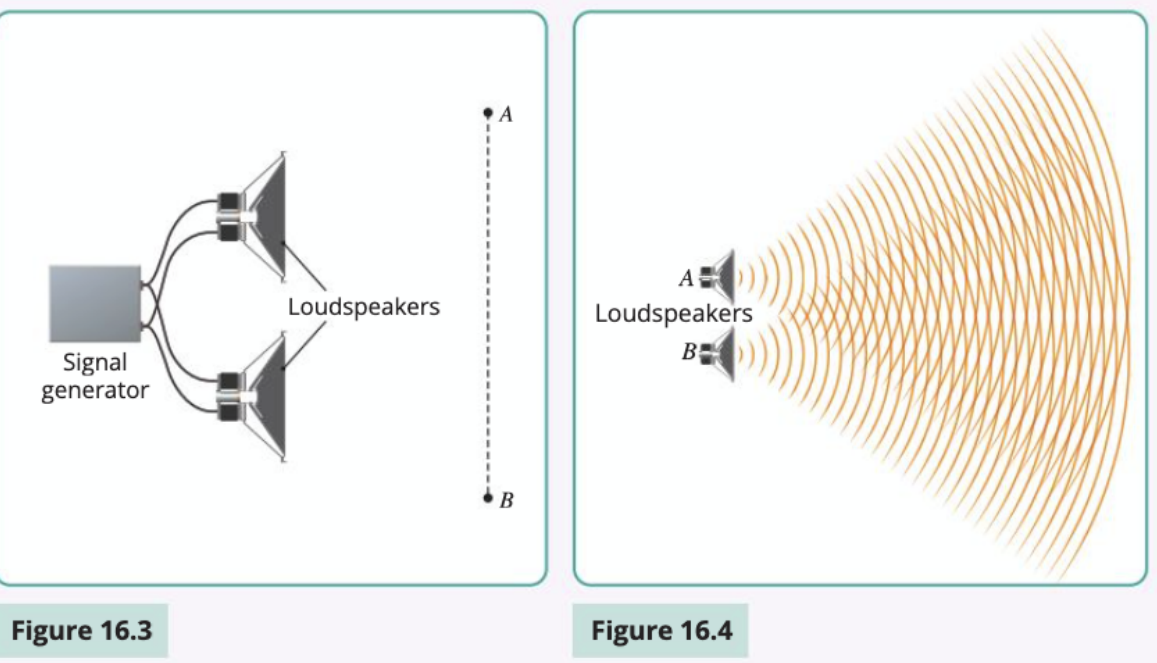
This interference pattern demonstrates how sound waves from multiple sources interact, creating regions of loud and quiet sound.
How vibrating objects produce sound waves
When an object vibrates, it creates a specific pattern of disturbances in the surrounding medium. Understanding this process helps explain how sound energy travels from source to listener.
The compression and rarefaction cycle
As a vibrating object moves, it creates two types of regions in the surrounding air:
Compressions: Areas where air molecules are pushed closer together than normal. These regions have higher pressure and density than the surrounding air.
Rarefactions: Areas where air molecules are pulled further apart than normal. These regions have lower pressure and density.
The vibrating object alternately creates compressions and rarefactions, sending these pressure variations outward in all directions. This creates the sound wave pattern that travels through the medium.
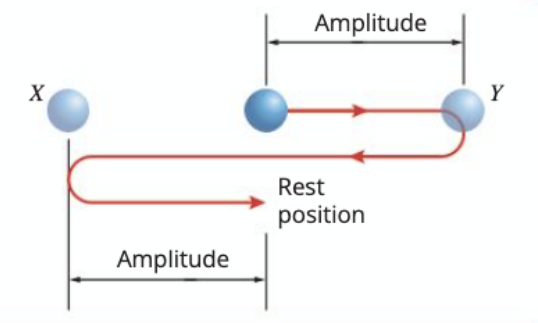
Sound as a longitudinal wave
Sound waves are longitudinal waves, meaning the particles of the medium vibrate parallel to the direction the wave travels. As the sound wave passes through air:
- Air molecules vibrate back and forth along the same line as the wave's movement
- Individual molecules don't travel with the wave - they oscillate around their rest positions
- The wave energy passes from molecule to molecule without the molecules themselves moving far from their original locations
Note
Think of a longitudinal wave like a "push-pull" motion. Imagine pushing a slinky back and forth - the compressions and expansions travel along the slinky, but each coil of the slinky only moves back and forth in its own small space.
The amplitude of a sound wave represents the maximum distance any molecule moves from its rest position during vibration. Greater amplitude corresponds to louder sounds, while smaller amplitude produces quieter sounds.
Frequency determines pitch
The frequency of the vibrating source equals the frequency of the sound wave it produces. This frequency determines the pitch we hear:
- Higher frequency vibrations create higher-pitched sounds
- Lower frequency vibrations create lower-pitched sounds
- The human ear can detect frequencies from 20 Hz to 20,000 Hz
Sound requires a medium to travel through
One of the most important characteristics of sound waves is their dependence on matter for transmission. Sound cannot travel through empty space because there are no particles to carry the wave energy.
The vacuum experiment
Example
Classic Experiment: Sound in a Vacuum
Setup: A bell jar contains an electric bell connected to a power source. A vacuum pump can remove air from the jar.
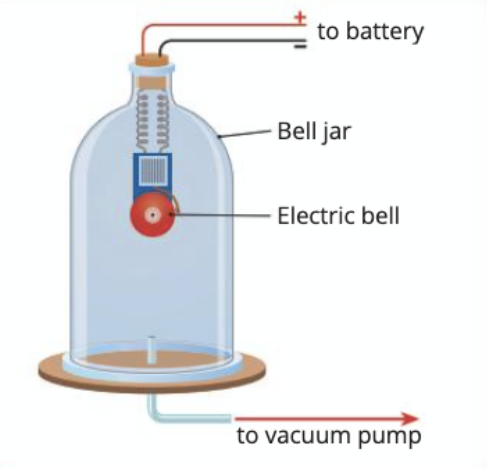
Procedure:
- Ring the bell inside the jar filled with normal air - you hear it clearly
- Gradually pump air out of the jar using the vacuum pump
- Observe what happens to the sound as air is removed
Results:
- As air is removed, the sound becomes fainter
- When most air is removed, the sound disappears completely
- You can still see the bell's hammer moving, but hear no sound
Conclusion: This proves that sound needs a material medium to travel - without air molecules, there's no way for the sound energy to reach your ears.
Why sound needs matter
Sound travels by passing energy from one particle to the next through a medium. In air, vibrating molecules bump into neighbouring molecules, transferring the wave energy. Without particles present, there's no mechanism for the sound energy to propagate.
This explains why:
- Sound travels through solids, liquids, and gases
- Sound cannot travel through vacuum
- Astronauts in space must use radio waves (not sound waves) to communicate
Speed of sound in different materials
The speed of sound varies dramatically depending on the medium through which it travels. This variation depends on the material's properties and environmental conditions.
Speed in different materials
| Material | Approximate Speed (m/s) | Density (kg/m³) |
|---|---|---|
| Dry air at 0°C | 331 | 1.28 |
| Water | 1500 | 1000 |
| Copper | 3400 | 8940 |
| Steel | 4800 | 7850 |
| Diamond | 12000 | 3500 |
Generally, sound travels:
- Slowest in gases (like air) because molecules are far apart
- Faster in liquids (like water) because molecules are closer together
- Fastest in solids (like steel) because molecules are tightly bound and can quickly transmit vibrations
Note
The relationship between density and sound speed isn't straightforward. Diamond, despite being less dense than steel, conducts sound much faster due to its extremely rigid crystal structure. It's not just about how heavy the material is, but how stiff and elastic it is.
Temperature effects on sound speed
In gases, temperature significantly affects sound speed. As temperature increases:
- Air molecules move faster and can transmit vibrations more quickly
- Sound speed increases by approximately for each degree Celsius rise in temperature
- At 20°C, sound travels through air at about 343 m/s compared to 331 m/s at 0°C
Important
Temperature has a major effect on sound speed in air. The formula for sound speed in air at temperature T (in Celsius) is approximately:
This is why the same sound can seem different on hot versus cold days!
Sound refraction due to temperature
Temperature differences can cause sound waves to bend or refract, similar to how light bends when passing through different materials.
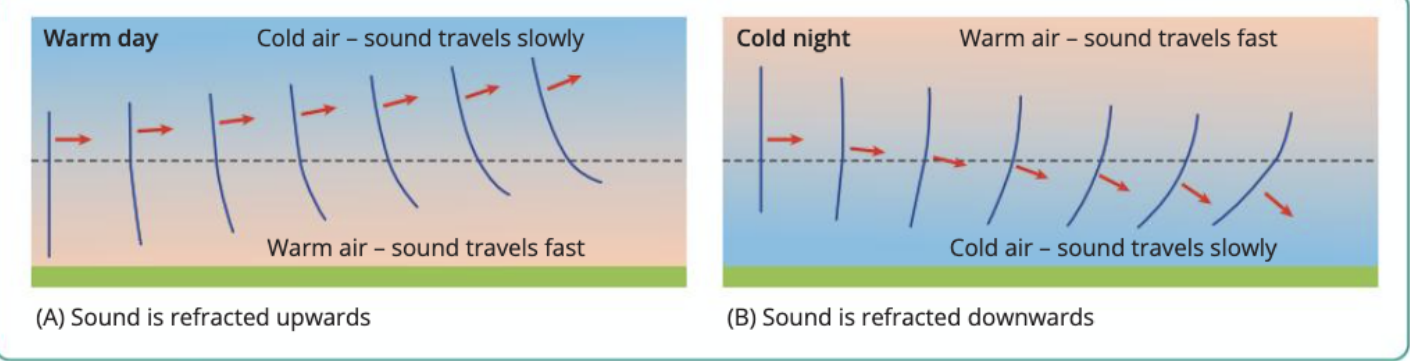
- On warm days with cold air above: Sound waves bend upward, making distant sounds harder to hear
- On cold nights with warm air above: Sound waves bend downward towards the ground, making sounds carry further and seem clearer
This explains why sounds often seem to carry better on calm, cool evenings compared to hot days.
Summary
Key Points to Remember:
• All sound originates from vibrating objects - without vibration, there is no sound production
• Sound is a mechanical longitudinal wave - it requires a medium to travel and particles vibrate parallel to the wave direction
• Sound exhibits all wave properties - reflexion (echoes), refraction (bending), diffraction (spreading around corners), and interference (wave interactions)
• Sound cannot travel through vacuum - it needs matter (solid, liquid, or gas) to propagate from source to receiver
• Sound speed varies with medium and temperature - generally fastest in solids, slowest in gases, and increases with temperature in air