Resonance and Standing Waves on Stretched Strings (Leaving Cert Physics): Revision Notes
📚Revision Notes
Resonance and Standing Waves on Stretched Strings
Understanding resonance
Natural frequency is the frequency at which an object naturally tends to vibrate when disturbed. Every object has its own natural frequency based on its physical properties like size, shape, and material.
Resonance occurs when a driving force matches the natural frequency of an object. When this happens, the object absorbs energy very efficiently and vibrates with much larger amplitudes than normal.
Note
Think of pushing someone on a swing - if you push at exactly the right moment (matching the swing's natural frequency), the person swings higher and higher with minimal effort from you.

Some important characteristics of resonance:
- Resonance only occurs when the driving frequency equals (or is very close to) the natural frequency
- At resonance, the amplitude of vibration becomes very large
- Energy is transferred most efficiently at the resonant frequency
- If the frequencies don't match, very little energy is transferred and amplitudes remain small
Standing waves on stretched strings
When a string is fixed at both ends and vibrated, standing waves are formed. These are wave patterns that appear to stand still rather than travel along the string. Standing waves result from the interference between waves travelling in opposite directions.

Nodes and antinodes
Standing wave patterns contain two key features:
Nodes are points along the string that remain completely stationary (zero displacement). These occur where destructive interference cancels out all wave motion. The ends of a fixed string are always nodes.
Antinodes are points where the string vibrates with maximum amplitude. These occur where constructive interference produces the largest wave displacement.
An important relationship to remember: the distance between two consecutive nodes equals half a wavelength ().
Formation of standing waves
When you pluck or bow a string, waves travel along its length. When these waves reach the fixed ends, they reflect back. The original waves and reflected waves interfere with each other, creating the standing wave pattern. The fixed ends act as nodes since they cannot move, while the pattern of nodes and antinodes depends on the frequency of vibration.
Harmonics and frequency relationships
A stretched string can vibrate at several different frequencies, producing different standing wave patterns called harmonics.
The fundamental frequency
The fundamental frequency (first harmonic) is the lowest frequency at which the string can vibrate. This produces the simplest standing wave pattern with just one antinode in the centre and nodes at both ends.
Higher harmonics
Higher harmonics occur at frequencies that are exact multiples of the fundamental frequency:
- Second harmonic: frequency = (twice the fundamental)
- Third harmonic: frequency = (three times the fundamental)
- Fourth harmonic: frequency = , and so on
Each harmonic has a different number of nodes and antinodes:
- First harmonic: 2 nodes, 1 antinode
- Second harmonic: 3 nodes, 2 antinodes
- Third harmonic: 4 nodes, 3 antinodes
The frequencies of harmonics that can exist are limited by the physical properties of the string and how it's fixed.
Factors affecting fundamental frequency
The fundamental frequency of a stretched string depends on three main factors:
Length of the string
Frequency is inversely proportional to length:
This means:
- Doubling the length halves the frequency
- Tripling the length makes the frequency three times smaller
- Halving the length doubles the frequency
Tension in the string
Frequency is proportional to the square root of tension:
This means:
- Increasing tension increases frequency (higher pitch)
- To double the frequency, you need to increase tension by a factor of 4
- Higher tension makes strings vibrate faster, producing higher notes
Mass per unit length
Frequency is inversely proportional to the square root of mass per unit length:
Where (mu) represents mass per unit length. This means:
- Heavier strings produce lower frequencies
- Thicker strings generally have more mass per unit length and produce lower notes
- To halve the frequency, you need to increase the mass per unit length by a factor of 4
The fundamental frequency formula
Combining all three factors gives us the complete formula for the fundamental frequency of a stretched string:
Important
The Fundamental Frequency Formula:
Where:
- = fundamental frequency (Hz)
- = length of string (m)
- = tension in string (N)
- = mass per unit length (kg/m)
| Quantity | Unit |
|---|---|
| Length (l) | metre (m) |
| Tension (T) | newton (N) |
| Mass per unit length (μ) | kilogramme per metre (kg m⁻¹) |
This formula shows that to increase the frequency (higher pitch), you can:
- Shorten the string
- Increase the tension
- Use a lighter string (smaller mass per unit length)
The sonometer
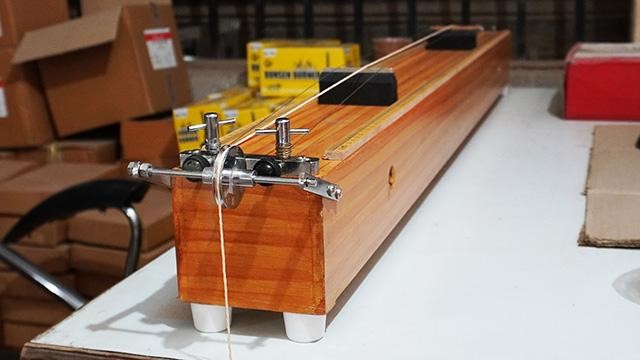
The sonometer is a laboratory instrument designed to study the vibrations of stretched strings and verify the relationships between frequency and string properties.
Construction and operation
A sonometer consists of:
- A wooden sounding board for amplification
- A wire stretched between two fixed bridges
- Moveable bridges to vary the length of the vibrating portion
- A method to adjust tension (usually hanging masses)
- A way to measure the vibrating length
Measuring frequency with a sonometer
Example
Worked Example: Finding String Frequency Using a Sonometer
To find the frequency of vibration:
Step 1: Set up the apparatus
Stretch the wire between the bridges and adjust the tension using hanging masses
Step 2: Use a tuning fork
Strike a tuning fork of known frequency and hold it near the wire
Step 3: Adjust for resonance
Vary the length of the wire (by moving the bridges) until resonance occurs
Step 4: Identify resonance
When the frequencies match, the wire vibrates with large amplitude, and a small paper rider placed on the wire will be thrown off
Step 5: Measure the vibrating length
The distance between the bridges when resonance occurs
Result: The frequency of the wire equals the frequency of the tuning fork when resonance is achieved.
Practical applications and examples
Musical instruments
String instruments like violins, guitars, and cellos use these principles:
- Changing pitch: Musicians press strings against frets to change the vibrating length
- Tuning: Adjusting tension using tuning pegs changes the fundamental frequency
- String selection: Different strings have different masses per unit length for different pitch ranges
Experimental verification
The relationships can be verified experimentally by:
- Plotting graphs of frequency vs (should give a straight line)
- Plotting frequency vs (should give a straight line)
- Plotting frequency vs (should give a straight line)
Note
These linear relationships confirm the mathematical formulas and help students understand how each factor influences string frequency.
Summary
Key Points to Remember:
- Resonance occurs when the driving frequency matches the natural frequency, causing large amplitude vibrations
- Nodes are stationary points in standing waves, while antinodes vibrate with maximum amplitude
- The fundamental frequency formula shows how length, tension, and mass per unit length affect frequency
- Harmonics occur at frequencies that are multiples of the fundamental frequency (, , , , etc.)
- The sonometer is a key experimental tool for studying string vibrations and verifying theoretical relationships