Stationary Waves (Leaving Cert Physics): Revision Notes
📚Revision Notes
Stationary Waves
When two waves with identical frequency and amplitude travel in opposite directions and meet, something fascinating happens - they create a stationary wave (also called a standing wave). This is a fundamental concept in wave physics that explains many phenomena we observe in musical instruments, radio antennas, and other wave systems.
What are stationary waves?
A stationary wave forms when two periodic travelling waves of the same frequency and amplitude move in opposite directions and interfere with each other. Unlike normal travelling waves that move along a medium, stationary waves appear to vibrate in fixed positions without travelling along the rope, string, or other medium.
Note
The key characteristic that makes these waves "stationary" is that the wave pattern doesn't move - instead, different points along the medium vibrate with different amplitudes, creating a fixed pattern of high and low vibration zones.
Key features of stationary waves
Nodes
Nodes are special points along a stationary wave where there is no vibration at all - the amplitude is always zero. These points remain completely still while the rest of the wave vibrates around them. Think of nodes as the "dead spots" in the wave pattern.
Antinodes
Antinodes are the points where vibration reaches its maximum amplitude. These are the most active parts of the wave, where particles move with the greatest displacement. Antinodes are positioned exactly halfway between consecutive nodes.
Note
Remember the simple mnemonic: "Nodes have No movement" (zero amplitude) while "Antinodes are At maximum" (maximum amplitude).
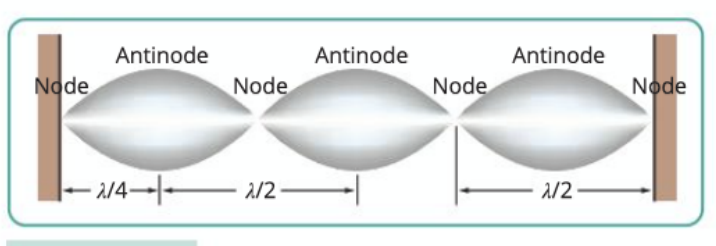
The diagram above shows the characteristic pattern of a stationary wave with clearly marked nodes and antinodes, along with the important wavelength relationships.
How stationary waves form
Stationary waves occur through a process called wave interference. Here's how it works:
- A vibrating source produces a travelling wave that moves along a medium (like a rope or string)
- This wave reaches a fixed end and gets reflected back
- The reflected wave travels back towards the source with the same frequency and amplitude
- The original (incident) wave and reflected wave meet and interfere with each other
- At some points, the waves reinforce each other (constructive interference) creating antinodes
- At other points, the waves cancel each other out (destructive interference) creating nodes
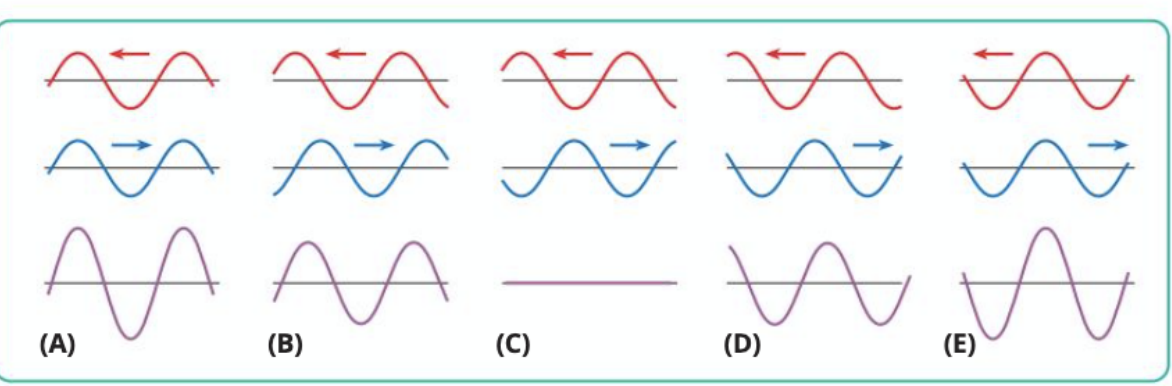
Note
This interference diagram demonstrates how waves travelling in opposite directions combine to create different patterns, including the complete cancellation seen in column C.
Frequency and wavelength relationships
Understanding the measurements in stationary waves is crucial for solving physics problems. The frequency of a stationary wave equals the frequency of the travelling waves that created it, and all points along the stationary wave (except nodes) vibrate at this same frequency.
Important
Critical Distance Relationships:
- Distance between two consecutive nodes = (half a wavelength)
- Distance between two consecutive antinodes = (half a wavelength)
- Distance between a node and the next antinode = (quarter wavelength)
These relationships are fundamental for calculating wavelengths and frequencies in stationary wave problems.
Worked example analysis
Example
Worked Example: Finding Frequency from Distance Measurements
Problem: Waves on a rope travel at 3 m s⁻¹. When a stationary wave forms, the distance between an antinode and the nearest node is 60 cm. Find the frequency.
Step 1: Identify the given information
- Wave speed:
- Distance from antinode to node:
Step 2: Apply the distance relationship
- We know this distance equals
- So:
- Therefore:
Step 3: Calculate frequency using the wave equation
- Using :
Answer: The frequency is 1.25 Hz
Practical applications
Stationary waves aren't just theoretical concepts - they appear in many real situations:
- Musical instruments: Stationary waves in guitar strings, organ pipes, and wind instruments create specific notes
- Microwave ovens: Standing waves ensure even heating patterns
- Radio antennas: Designed using stationary wave principles for optimal transmission
- Laboratory experiments: Rubber bands and ropes can easily demonstrate these wave patterns
Note
The understanding of stationary waves is essential in engineering and technology, particularly in the design of musical instruments and communication systems.
Summary
Key Points to Remember:
- Stationary waves form when identical waves travelling in opposite directions interfere with each other
- Nodes have zero amplitude (no vibration) while antinodes have maximum amplitude
- The distance between consecutive nodes or antinodes is always
- The distance from any node to the nearest antinode is
- The frequency of a stationary wave equals the frequency of the travelling waves that created it