Transverse and Longitudinal Waves (Leaving Cert Physics): Revision Notes
📚Revision Notes
Transverse and Longitudinal Waves
What are waves?
Waves are a way of transferring energy from one place to another without transferring matter. When a wave passes through a material, the particles vibrate around their rest positions, but they don't actually travel along with the wave itself.
There are two main types of waves based on how the particles vibrate compared to the direction the wave is travelling:
Transverse waves
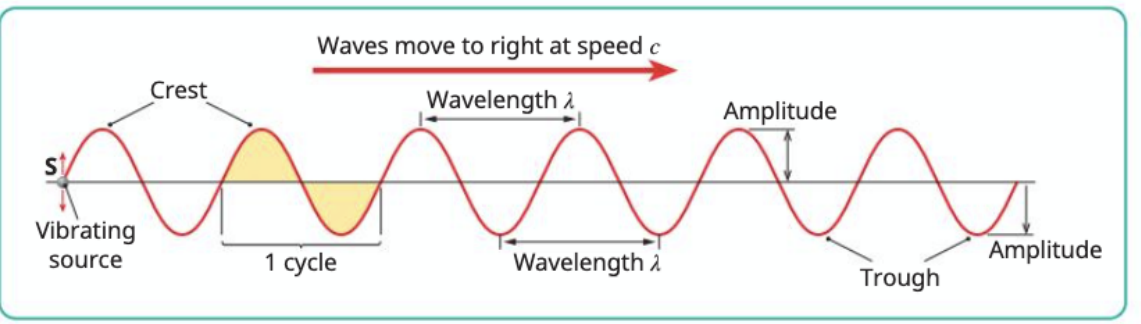
A transverse wave is one where the particles vibrate at right angles to the direction in which the wave is travelling. Think of it as the vibrations being "across" or perpendicular to the wave's path.
Note
Examples of transverse waves include:
- Waves on a rope when you flick one end
- Waves on a spring held horizontally
- Water waves on the surface of a pond
- All electromagnetic waves (light, radio waves, X-rays, etc.)
Key features of transverse waves
In a transverse wave, you can identify several important parts:
- Crest: the highest point of the wave above the rest position
- Trough: the lowest point of the wave below the rest position
- Amplitude: the maximum displacement of particles from their rest position
- Wavelength (λ): the distance from one point on the wave to the corresponding point on the next wave (e.g., crest to crest)
Longitudinal waves
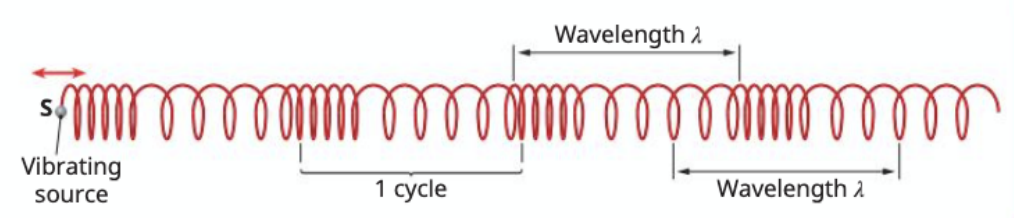
A longitudinal wave is one where the particles vibrate parallel to the direction in which the wave travels. The vibrations are along the same line as the wave's movement.
Note
Examples of longitudinal waves include:
- Compression waves on a spring (like a slinky)
- Sound waves in solids, liquids, or gases
- Ultrasonic waves used in medical scanning
Key features of longitudinal waves
In longitudinal waves, particles move back and forth creating:
- Compressions: regions where particles are pushed closer together
- Rarefactions: regions where particles are spread further apart
- One complete cycle consists of one compression followed by one rarefaction
The wavelength in a longitudinal wave is the distance from the centre of one compression to the centre of the next compression.
Important wave properties
Understanding waves requires knowing several key measurements and their relationships:
| Quantity | Symbol | SI Unit | Symbol |
|---|---|---|---|
| Wavelength | λ | metre | m |
| Frequency | f | Hertz (cycles per second) | Hz or s⁻¹ |
| Velocity | v | metre per second | m s⁻¹ |
Key relationships
The frequency (f) is the number of complete oscillations or cycles that pass a given point each second. It's measured in hertz (Hz).
The period (T) is the time taken for one complete oscillation to pass a point. It's measured in seconds.
These are related by:
Note
Important note about units:
- 1 kHz = 1000 Hz = 10³ Hz
- 1 MHz = 1 000 000 Hz = 10⁶ Hz
- 1 GHz = 1 000 000 000 Hz = 10⁹ Hz
Energy carried by waves
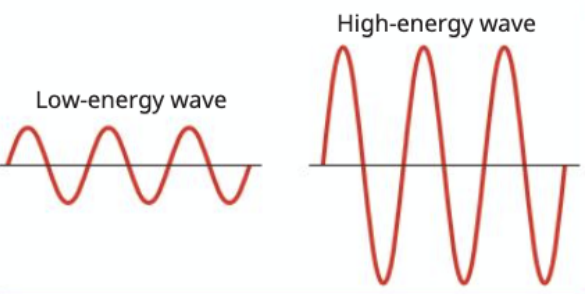
The amount of energy a wave carries is directly related to its amplitude. This is a crucial concept to understand:
Important
The energy carried by a wave is proportional to the square of its amplitude:
This relationship explains why large ocean waves can be so destructive - even a small increase in wave height results in a much larger increase in energy.
Example
Worked Example: Amplitude and Energy Relationship
If the amplitude is doubled, the energy becomes four times bigger:
- Original amplitude = A, Energy ∝ A²
- New amplitude = 2A, Energy ∝ (2A)² = 4A²
If the amplitude is tripled, the energy becomes nine times bigger:
- New amplitude = 3A, Energy ∝ (3A)² = 9A²
If the amplitude is halved, the energy becomes four times smaller:
- New amplitude = A/2, Energy ∝ (A/2)² = A²/4
Heinrich Rudolf Hertz
Heinrich Rudolf Hertz (1857-1894) was a German physicist who made significant contributions to our understanding of electromagnetic waves. He was the first person to definitively prove the existence of electromagnetic waves by engineering instruments to transmit and receive radio pulses. The unit of frequency, the hertz (Hz), is named in his honour.
Summary
Key Points to Remember:
- Transverse waves: particles vibrate at right angles to the wave direction (think of waves on a rope)
- Longitudinal waves: particles vibrate parallel to the wave direction (think of sound waves or a compressed spring)
- Key measurements: wavelength (λ), frequency (f), amplitude, and velocity (v) are all interconnected
- Energy relationship: the energy carried by a wave increases with the square of its amplitude - double the amplitude means four times the energy
- Frequency and period: are inversely related through , where frequency is cycles per second and period is seconds per cycle