Analysing a Cartoon (Grade 10 NSC Matric English HL): Revision Notes
📚Revision Notes
Analysing a Cartoon
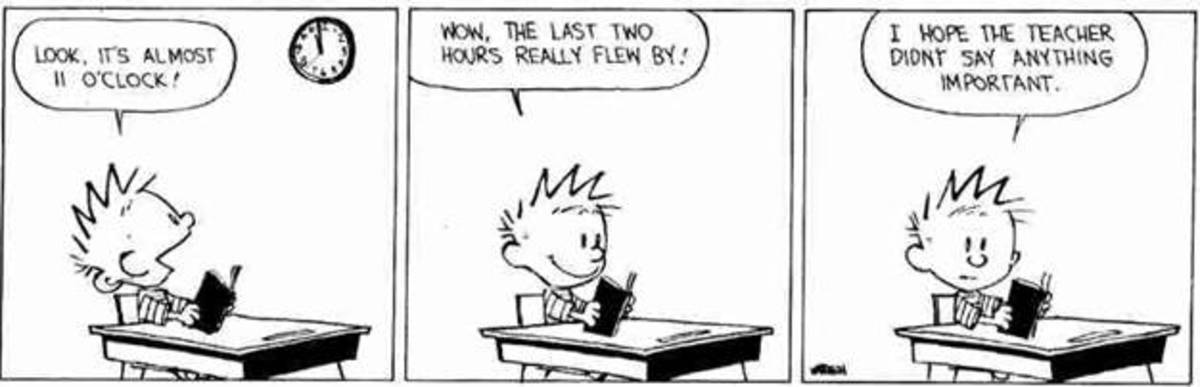
What is a cartoon?
A cartoon is an individual illustration that usually includes both drawings and words. Cartoons serve two main purposes:
- Entertainment - to make readers laugh through humour
- Social commentary - to highlight important issues and make people think about current events or social problems
Note
A comic strip differs from a single cartoon as it tells a story through multiple connected drawings. Each individual drawing in a comic strip is called a frame, and the story typically builds towards a punch line - the final amusing or clever twist that appears in the last few words.
Understanding cartoon elements
Speech representation in cartoons

Cartoons use different types of bubbles to show how characters are speaking or thinking. Understanding these visual cues is essential for cartoon analysis:
- Solid line bubble - normal speech at regular volume
- Dotted line bubble - whispering or quiet speech (when multiple characters are present) or shows focus/concentration (for single characters)
- Jagged line bubble - shouting or loud, angry speech
- Small circled bubble with tail - thoughts that characters are thinking but not saying aloud
Some cartoons connect words to speakers using simple lines instead of bubbles.
Visual storytelling techniques
Frames in comic strips work like scenes in a film, with each frame showing a different moment in the story. The sequence of frames guides readers through the narrative from beginning to punch line.
Important
Satire is commonly used in cartoons to criticise people, organisations, or governments through humour, sarcasm, ridicule, or irony. This technique is particularly effective when targeting public figures like politicians.
Five key areas for cartoon analysis
When analysing any cartoon, examine these essential characteristics:
1. Setting and scenario
Identify where and when the scene takes place. The setting often provides context that helps you understand character identities and the cartoon's message.
2. Characters
Consider whether characters represent real individuals or are stereotypes - generalised representations of particular groups. Examine facial expressions, body language, and relationships between characters, as these reveal important information about personalities and attitudes.
3. Actions
Look carefully at the lines and facial expressions that indicate movement and activity. These visual elements show what characters are doing and their emotional states.
4. Language
Analyse the structure of the text - does it use single words, phrases, or complete sentences? Pay attention to:
- Time indicators (words like "seldom", "always", "never")
- Place references (words indicating location)
- Qualifiers (descriptive words like "big", "fast", "often")
Remember that these are your adjectives and adverbs, which add important descriptive detail.
5. Objective
Determine the cartoonist's main purpose: is it to educate, inform, entertain, or satirise? Understanding the objective helps you grasp the deeper meaning behind the humour or imagery.
Communication in cartoons
Non-verbal communication
This includes all the visual elements that convey meaning without words:
- Facial expressions showing emotions
- Voice tone and pitch (suggested through bubble types)
- Body language and gestures
- Physical distance between characters
Note
These non-verbal signals often provide additional layers of meaning beyond the spoken words and can sometimes contradict what characters are actually saying.
Verbal communication
The actual words used in cartoons employ various techniques:
- Rhetorical questions - questions asked for effect rather than answers
- Repetition - repeating words or phrases for emphasis
- Imperative sentences - commands or instructions
- Minor sentences - incomplete sentences that still convey meaning
- Dialogue - conversations between characters
- Punctuation marks - which indicate tone and emotion
- Overall tone - the attitude or mood created by word choice
Analysis techniques
Understanding how to analyse cartoons requires examining both visual and verbal elements that work together to create meaning.
Visual clues
These are the graphic elements that provide meaning:
- Character positioning and body language
- Facial expressions and gestures
- Visual symbols or props
- Setting details and background elements
Verbal clues
These are the written elements that convey meaning:
- Word choice and vocabulary level
- Sentence structure and punctuation
- Dialogue content and style
- Typography (bold, italics, size) for emphasis
Important
Always consider both visual and verbal elements together - they work as a team to create meaning. Look for contradictions between what characters say and what their body language shows, as this often reveals the cartoon's deeper message.
Exam tips
Summary
Essential Exam Strategies:
- Always consider both visual and verbal elements together - they work as a team to create meaning
- Look for contradictions between what characters say and what their body language shows
- Pay attention to exaggerated features, as these often indicate the cartoon's main message
- Consider the historical or social context if the cartoon references current events
- Practice identifying different speech bubble types and their meanings
Remember!
Summary
Key Points to Remember:
- Cartoons combine visual art with written text to create meaning and impact
- Single cartoons focus on one moment, while comic strips tell stories through multiple frames
- Analysis requires examining five key areas: setting, characters, actions, language, and objective
- Both verbal and non-verbal communication elements contribute to the cartoon's overall message
- Satire is a common technique used to criticise people or situations through humour and irony