Landforms Associated With Different Rocks (Grade 10 NSC Matric Geography): Revision Notes
📚Revision Notes
Landforms Associated With Different Rocks
What are landforms?
Note
Definition: Landforms
Landforms are distinctive features that appear on the Earth's surface. They are created and shaped by various natural processes over long periods of time.
The type of rock present in an area plays a major role in determining what kinds of landforms will develop there.
Important
Key Concept: Differential Erosion
Many landforms exist because of differential erosion - this means that some rocks are harder and more resistant to weathering and erosion than others. When hard rocks and soft rocks exist together, the soft rocks wear away more quickly, leaving the hard rocks standing out as prominent landscape features.
Landforms associated with igneous rocks
Igneous rocks form from cooled magma or lava, and they create two main types of landforms depending on where they formed.
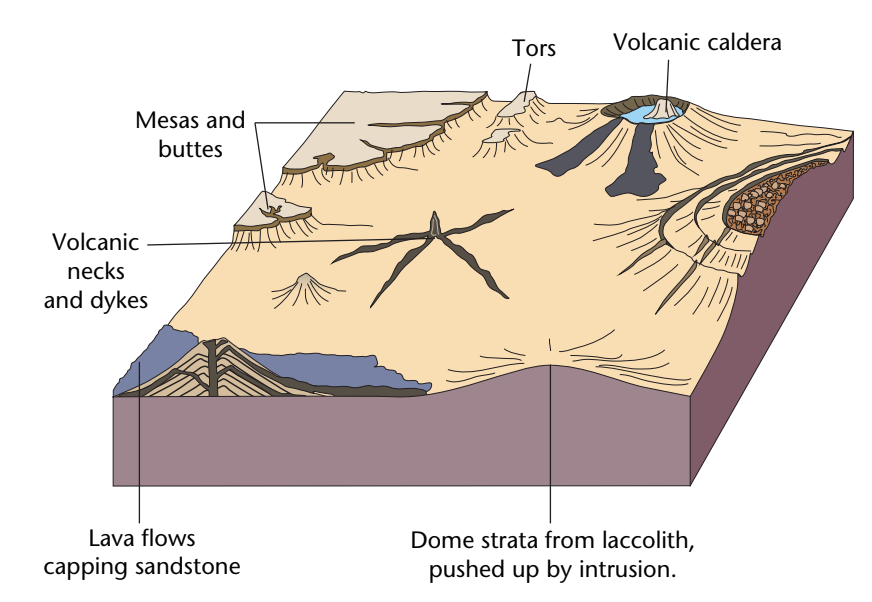
Extrusive igneous landforms
These landforms develop from volcanic activity that occurs on the Earth's surface:
- Lava flows: When thin lava pours out from volcanic vents, it spreads across large areas and hardens into rock layers. Over time, this creates stepped landscapes as different lava flows stack on top of each other.
- Volcanic calderas: These are large, collapsed volcanic craters that often contain lakes. They form when the underground magma chamber empties out, causing the volcano's peak to collapse inward.
Intrusive igneous landforms
These features form when magma cools underground and is later exposed by erosion:
- Tors: These appear as rounded columns of rock, usually about 20 metres tall. They are the weathered remains of large underground igneous intrusions that have been exposed as softer surrounding rocks eroded away.
- Volcanic necks: These stand out as tall columns of rock above the surrounding landscape. They formed inside old volcanic cones where magma cooled and hardened. After the rest of the volcano eroded away, only the hard core remains.
- Dykes: These are vertical sheets of hard igneous rock that cut through other rock layers. They appear as wall-like ridges in the landscape.
Landforms associated with sedimentary rocks
Sedimentary rocks form from layers of sediment deposited over time. The way these rock layers are positioned determines what landforms will develop.
Landforms from horizontal strata
When sedimentary rocks form in flat, horizontal layers, they create distinctive stepped landforms through erosion:
-
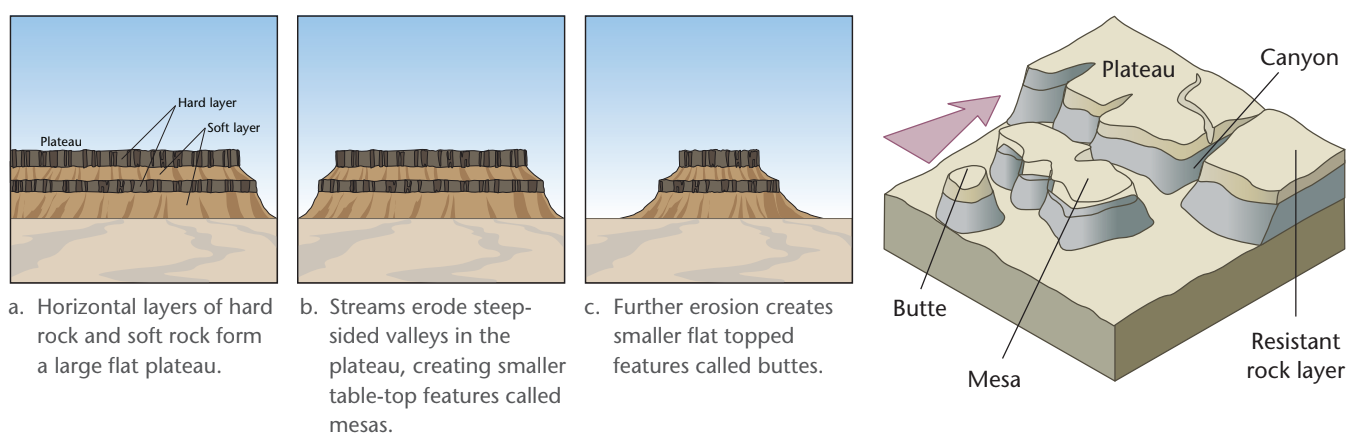
Plateaus: These are large, flat-topped areas of land elevated above the surrounding terrain. They form when horizontal layers of hard and soft rock resist erosion.
-
Mesas: These are smaller flat-topped hills with steep sides. They develop when streams cut into plateaus, creating isolated flat-topped features. The name comes from the Spanish word for "table."
-
Buttes: These are even smaller versions of mesas. As erosion continues, mesas become smaller until they form these tower-like landforms.
Example
Worked Example: Formation of Mesas and Buttes
Step 1: Plateau Formation Horizontal layers of alternating hard and soft rock create a flat plateau
Step 2: Stream Cutting Streams cut steep-sided valleys into the plateau, forming smaller table-top features (mesas)
Step 3: Continued Erosion Further erosion creates even smaller flat-topped features (buttes)
This process shows how larger landforms gradually become smaller through continued erosion.
Landforms from inclined strata
When sedimentary rock layers are tilted or folded, they create different types of landforms:
-
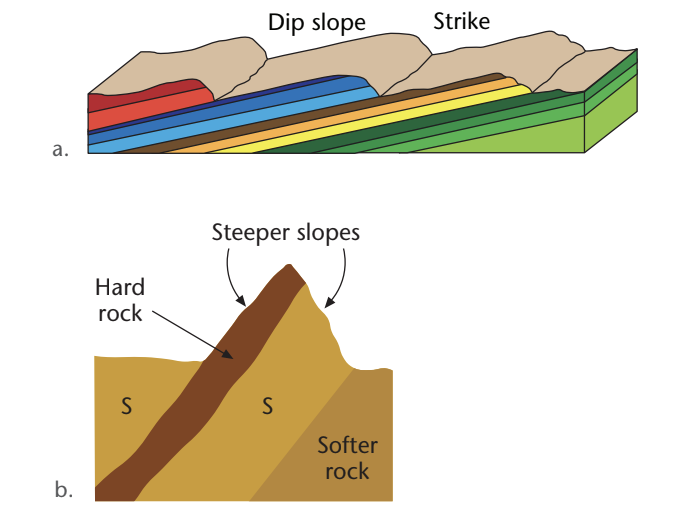
Cuestas: These are tilted ridges with one steep slope and one gentle slope. The steep side forms where hard rock layers are exposed, while the gentle side follows the slope of the tilted rock layers. See image a below.
-
Hog's backs: When rock layers are tilted at very steep angles, both sides of the ridge become steep, creating a narrow, sharp-topped ridge. See image b below.
Note
The world's largest mountain ranges often form from sedimentary rocks that have been uplifted and folded by Earth's crustal movements.
Landforms associated with metamorphic rocks
Metamorphic rocks often become harder than the original rocks they formed from. This increased hardness makes them more resistant to erosion, creating prominent landscape features.
Differential erosion and hard rock features
Quartzite is a common metamorphic rock formed from sandstone. It is much harder than the original sandstone and highly resistant to erosion. When quartzite occurs alongside softer rocks, differential erosion creates distinctive features:
- The harder quartzite remains as ridges or elevated areas
- Softer surrounding rocks erode away more quickly
- This creates a landscape of alternating high and low areas
Waterfalls
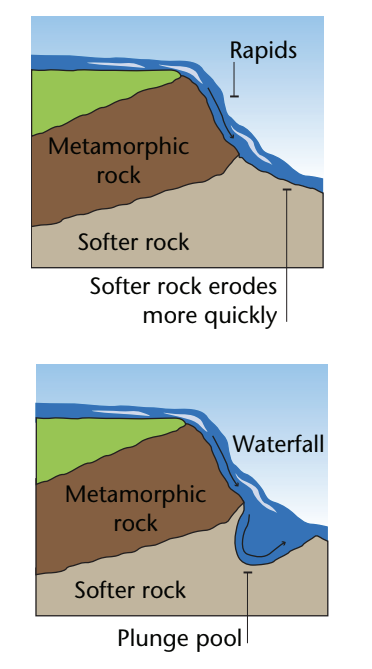
Waterfalls often form where hard metamorphic rocks occur in river valleys.
Example
Worked Example: Waterfall Formation Process
Step 1: Resistant Layer Formation Hard metamorphic rock forms a resistant layer across a river valley
Step 2: Differential Erosion Softer rock below erodes away more quickly
Step 3: Step Creation This creates a step in the river bed
Step 4: Waterfall Development Water cascades over the hard rock step, forming a waterfall
Step 5: Plunge Pool Formation The falling water creates a plunge pool at the base
Contour patterns
Different landforms create distinctive patterns when shown on topographic maps:
-
Steep slopes: Shown by contour lines that are close together
-
Gentle slopes: Shown by contour lines that are far apart
-
Hills and mountains: Shown by circular or oval contour patterns
-
Valleys: Shown by V-shaped contour patterns pointing uphill

South African examples
South Africa provides excellent examples of landforms associated with different rock types:
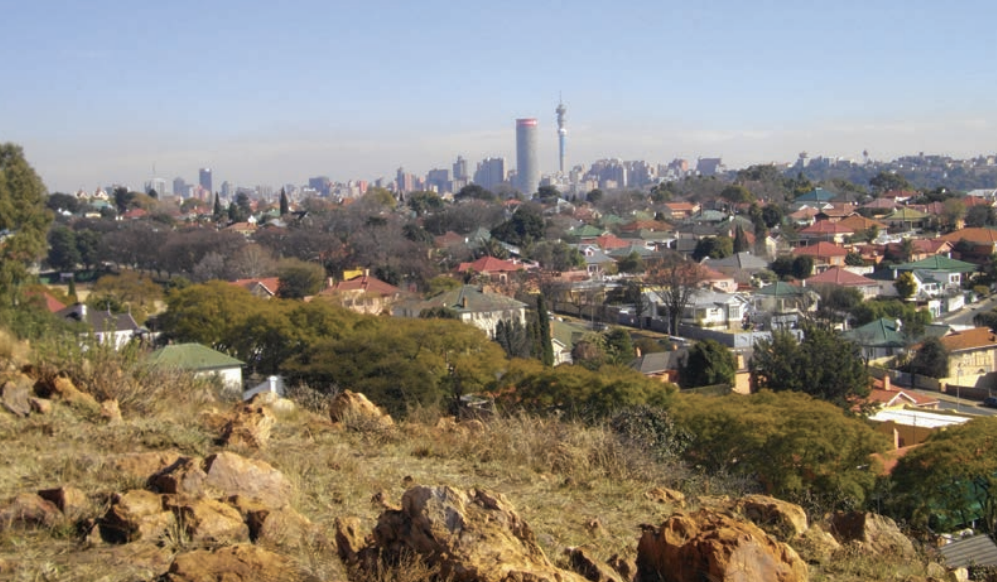
- Quartzite ridges in Johannesburg: These prominent ridges stand out in the urban landscape because quartzite is more resistant to erosion than surrounding softer rocks.
- Mesas and buttes in the Free State: These flat-topped landforms developed from horizontal sedimentary rock layers.
- Mountain ranges: Many South African mountains formed from sedimentary rocks that were folded and uplifted by tectonic forces.
Summary
Key Points to Remember:
- Rock type determines landform type: Different rocks create different landscape features through differential erosion
- Hard rocks stand out: Resistant rocks like quartzite and igneous rocks form ridges, hills, and prominent features
- Soft rocks wear away: Less resistant rocks erode more quickly, forming valleys and lowlands
- Layered rocks create stepped landscapes: Alternating hard and soft sedimentary layers produce mesas, buttes, and cuestas
- South Africa has excellent examples: From Johannesburg's quartzite ridges to the Free State's mesas, local landscapes demonstrate these principles clearly