The Hydrological Cycle (Grade 10 NSC Matric Geography): Revision Notes
📚Revision Notes
The Hydrological Cycle
What is the hydrological cycle?
The hydrological cycle is nature's way of recycling Earth's water supply. It's a collection of connected processes that work together continuously to move water around our planet. Think of it as a giant water recycling system that has been operating for millions of years!
The most important thing to understand is that the hydrological cycle is a closed system. This means that
no new water can be added to Earth, and no water can be removed from it
. The same amount of water that existed millions of years ago is still here today - it just keeps moving around in different forms.
Important
Critical Concept: Closed System
The hydrological cycle operates as a closed system - this is fundamental to understanding how water moves on our planet. The total amount of water remains constant; it simply changes form and location continuously.
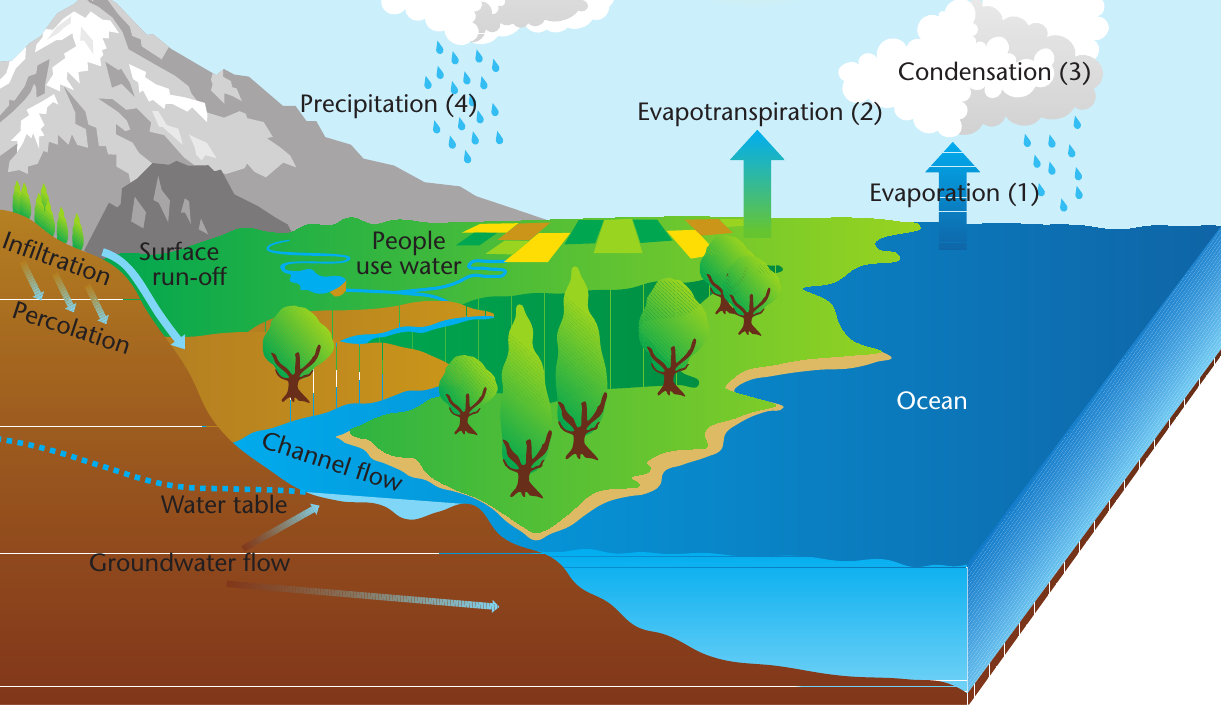
Processes that drive the hydrological cycle
The hydrological cycle is powered by several key processes that work together to move water between the atmosphere, land, and oceans:
Evaporation
This happens when the sun heats water in oceans, rivers, and lakes. The heat energy changes liquid water into invisible water vapour that rises into the atmosphere. You can see this process happening when you boil water - the steam is water vapour!
Transpiration
Plants play a crucial role in the water cycle through transpiration. Plants absorb water through their roots, transport it through their stems and branches, and then release water vapour into the atmosphere through tiny pores in their leaves called stomata. It's like plants are "sweating" water!
Example
Real-World Example: Observing Transpiration
Step 1: Place a clear plastic bag over a leafy branch of a tree or large plant
Step 2: Secure the bag tightly around the branch with a rubber band
Step 3: Leave it for several hours on a sunny day
Step 4: Observe - you'll see water droplets collecting inside the bag from the plant's transpiration!
Evapotranspiration
This is simply the combination of evaporation and transpiration happening together. When you see water vapour rising from areas with both water bodies and vegetation, you're witnessing evapotranspiration in action.
Condensation
As water vapour rises high into the atmosphere, it cools down. When it gets cold enough, the invisible water vapour turns back into tiny water droplets. These droplets cluster together to form clouds. You can observe condensation when you breathe on a cold window - the water vapour in your breath condenses into water droplets on the glass.
Precipitation
When water droplets in clouds become too heavy, they fall back to Earth as precipitation. This can be in liquid form (rain) or solid form (snow, sleet, or hail), depending on temperature conditions.
Note
Did You Know?
The sun provides all the energy that drives the hydrological cycle. Without solar energy, there would be no evaporation, and the water cycle would stop completely!
Processes that take place on land
Once water reaches the land surface through precipitation, several important processes determine what happens to it:
Surface flow
When rain falls heavily, the ground cannot absorb all the water quickly enough. The excess water flows over the land surface as surface run-off. You'll notice this clearly in urban areas where pavements and roads prevent water from soaking into the ground.
Surface water eventually flows into streams and rivers (channel flow), which may lead to dams and lakes where water is temporarily stored. Humans, plants, and animals all use this surface water, but eventually it returns to the system through evaporation, transpiration, and waste water processes.
Infiltration
This is the process where water soaks into the soil from the surface. The water fills spaces between soil particles and creates a saturated layer underground. Plant roots can access some of this groundwater, and it will eventually return to the atmosphere through transpiration.
Percolation
Water continues to move downward through the soil and loose rocks until it reaches solid rock layers. Some rocks have cracks and joints that allow water to penetrate deeper, while others are porous with spaces between rock grains.
The water keeps moving down until it reaches impermeable layers - solid rock layers that don't allow water to pass through them. This creates what we call the water table - the top level of the saturated soil and rock layer. Water can only percolate so far before it hits these impermeable barriers.
Example
Worked Example: Understanding Water Movement on Land
When 100mm of rain falls on a area:
Step 1: Some water flows immediately as surface run-off (maybe 30mm)
Step 2: Some water infiltrates into the soil (maybe 50mm)
Step 3: Some water is lost to evaporation (maybe 20mm)
Step 4: The infiltrated water gradually percolates downward until it reaches the water table
Note: These percentages vary greatly depending on soil type, vegetation, and terrain.
Key terminology you need to know
Note
Essential Definitions
- Transpiration: The process where plants absorb water through their roots and release water vapour through their leaves
- Evapotranspiration: The combined effect of evaporation from water surfaces and transpiration from plants
- Percolation: Water seeping downward through soil and rocks until it reaches solid rock layers
- Impermeable: Rock or soil layers that do not allow water to pass through them
- Closed system: A system where no matter (in this case, water) can be added or removed from the outside
Why understanding the hydrological cycle matters
The hydrological cycle is fundamental to all life on Earth. Understanding these processes helps us appreciate how our planet's water system works and why we need to protect it.
Note
The Hydrological Cycle's Impact on Life
The cycle affects every aspect of our environment and daily lives. From the water we drink to the weather we experience, everything connects back to these fundamental water movement processes.
The hydrological cycle:
- Provides fresh water for drinking, agriculture, and industry
- Distributes heat energy around the planet, affecting climate patterns
- Shapes landforms through erosion and deposition
- Supports all ecosystems and biodiversity
- Influences weather patterns and seasonal changes
Summary
Key Points to Remember:
- The hydrological cycle is a closed system - no water is added or lost, just recycled continuously
- The sun provides the energy that drives evaporation and powers the entire cycle
- Plants are active participants through transpiration, not just passive recipients of water
- Water on land follows predictable paths: surface flow, infiltration, and percolation
- Understanding these processes helps explain weather patterns, water availability, and environmental challenges