Challenges of Providing Free Basic Water (Grade 10 NSC Matric Geography): Revision Notes
📚Revision Notes
Challenges of Providing Free Basic Water
Introduction to water access in South Africa
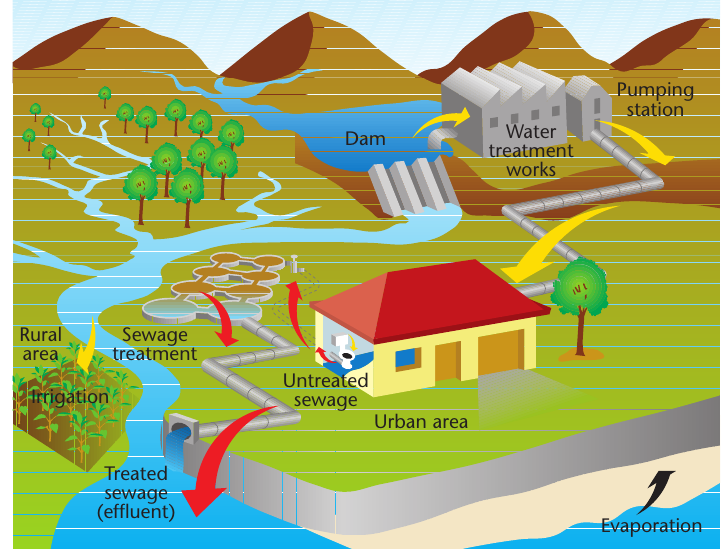
Most South Africans (about 90%) get their water from taps, but the journey water takes to reach these taps is much more complex than water from natural sources. This complexity is part of what we call the human water cycle - the natural water cycle that includes the effects of human activities on water circulation.
Understanding how people access water helps us see the challenges government faces in providing water to everyone. The majority of people have access to tap water either in their homes or yards (70%) or from public taps (20%). However, some communities still depend on rivers (5%), boreholes (3.5%), water tankers (1.3%), or other sources like desalination (0.2%).
Note
The percentages show that while most South Africans have improved access to water, there are still communities relying on less reliable and potentially unsafe water sources that require government attention.
The human water cycle and infrastructure
The human water cycle shows how water moves through our built environment before reaching people's homes. This system involves dams, water treatment works, pumping stations, pipelines, and sewage treatment facilities. Each stage requires significant infrastructure, skilled workers, and ongoing maintenance.
Note
This complex infrastructure network explains why simply having natural water sources isn't enough - water must be collected, treated, and safely distributed through an interconnected system of facilities and equipment.
This complex system explains why providing water to everyone is challenging - it's not just about having water available in nature, but about building and maintaining the infrastructure to collect, treat, and distribute it safely to millions of people.
Free basic water policy
The South African government introduced the Free Basic Water Policy in 1999 to guarantee water access for all citizens. This policy provides 25 litres of water per person per day at no cost. This amount is called "basic" because it represents the minimum water needed for essential daily activities like drinking, cooking, washing, and basic sanitation.
Important
The policy recognises that access to clean water is a basic human right. This fundamental principle drives South Africa's commitment to ensuring every citizen has access to safe water regardless of their economic circumstances.
Since 1994, at least 15 million additional South Africans have gained access to free basic water, showing the policy's positive impact. The Department of Water Affairs (DWA) is responsible for implementing South Africa's water policy and ensuring quality standards are met.
Challenges in rural areas
Providing water to rural communities presents several unique difficulties that make it expensive and time-consuming to ensure everyone has access:
Geographic challenges:
- People live spread out across vast areas, making it expensive to build infrastructure
- Long distances between water supply centres and communities increase costs
- Remote locations are harder to reach for construction and maintenance
Infrastructure challenges:
- Historical lack of water services means starting from scratch in many areas
- Building tap water systems requires laying pipes, constructing pumping stations, and installing taps
- Water provision requires complex systems for collection, storage, purification, and distribution
Economic challenges:
- High costs of building infrastructure over long distances
- Time-consuming process to plan and build water systems
- Limited budget must cover many scattered communities
Note
Rural water provision is particularly challenging because infrastructure costs increase dramatically when serving scattered populations across large geographical areas, unlike urban areas where high population density makes infrastructure more cost-effective.
Despite these challenges, rural areas have seen remarkable progress. In 1994, only 44.4% of rural residents had access to water meeting DWA standards. By 2010, this figure had risen to 79.1%, even as the rural population grew from 16.7 million to 20.1 million people.
Challenges in urban areas
Urban areas face different but equally complex water provision challenges, particularly as cities grow rapidly:
Population pressure:
- Rapid increase in urban population puts strain on existing systems
- Growing numbers of people living in informal settlements without proper water infrastructure
- Higher population density means greater demand for water services
Infrastructure challenges:
- Old and ageing infrastructure including pipes, dams, and purification systems needs replacement
- Existing systems weren't designed for current population sizes
- Maintaining water quality becomes more difficult with increased demand
Technical challenges:
- Shortage of skilled water engineers and system managers
- Complex systems require specialised knowledge to operate and maintain
- Lack of qualified personnel to manage water services effectively
Note
Urban water challenges are often hidden from residents who simply turn on taps, but behind the scenes, cities struggle with aging infrastructure that wasn't built for current population levels and the technical expertise needed to maintain complex systems.
Urban areas have achieved better progress than rural areas, with access to adequate water rising from 70.3% in 1994 to 95.6% in 2010. The urban population also grew significantly, from 22.1 million to 30.1 million people during this period.
Progress and achievements (1994-2010)
The data shows remarkable progress in both rural and urban water access over 16 years:
Rural achievements:
- Water access improved from 44.4% to 79.1%
- This happened despite rural population growing by 3.4 million people
- Shows government commitment to reaching remote communities
Urban achievements:
- Water access improved from 70.3% to 95.6%
- Urban areas achieved better overall access rates
- Progress occurred alongside rapid urban population growth of 8 million people
Overall impact:
- Millions more South Africans gained access to safe water
- Both rural and urban areas showed consistent improvement
- Demonstrates that focused policy and investment can overcome water access challenges
Example
Progress Calculation Example:
Rural water access improvement:
- 1994: 44.4% of 16.7 million = 7.4 million people with access
- 2010: 79.1% of 20.1 million = 15.9 million people with access
- Net improvement: 8.5 million additional rural people gained water access despite population growth
The most significant improvements occurred between 2002-2007, showing how sustained effort can accelerate progress in water provision.
Remember!
Summary
Key Points to Remember:
- Free Basic Water Policy provides 25 litres per person per day at no cost since 1999
- Rural challenges include scattered populations, long distances, and high infrastructure costs
- Urban challenges include rapid population growth, old infrastructure, and skills shortages
- 90% of South Africans get their water from taps (70% household taps + 20% public taps)
- Significant progress was made from 1994-2010, with rural access rising from 44% to 79% and urban access from 70% to 96%