The Role of the Government and Other Water Providers (Grade 10 NSC Matric Geography): Revision Notes
📚Revision Notes
The Role of the Government and Other Water Providers
Water management in South Africa involves several different organisations working together to ensure everyone has access to clean water. Understanding who does what and how they work together is essential for managing our country's precious water resources effectively.
The structure of water providers in South Africa
The National Water Act of 1998 created the legal framework that governs how South Africa manages its water resources. This act established a clear system of water providers, each with specific roles and responsibilities.
Note
Understanding the hierarchical structure of water providers is crucial for comprehending how water reaches your tap and who is responsible at each stage of the process.
At the top of this system is the Department of Water Affairs, which is responsible for building dams and transferring water between different river basins. Think of a river basin as the area drained by one main river and all its tributaries - it's like a giant catchment area that collects rainwater.
Below the Department of Water Affairs are water boards. These organisations buy water from the Department of Water Affairs, purify it to make it safe to drink, and then sell it to municipalities. Water boards act as the middle layer in our water supply system.
At the bottom of this structure are municipalities - your local government authorities. Municipalities buy purified water from water boards and deliver it directly to consumers like you and your family. They charge people for the water they use, but there's an important policy you should know about.
Important
Free Water Policy
The South African government has made a commitment to supply every home in the country with 6,000 litres of free water each month. This policy recognises that water is a basic human right and ensures that even the poorest families have access to clean water.
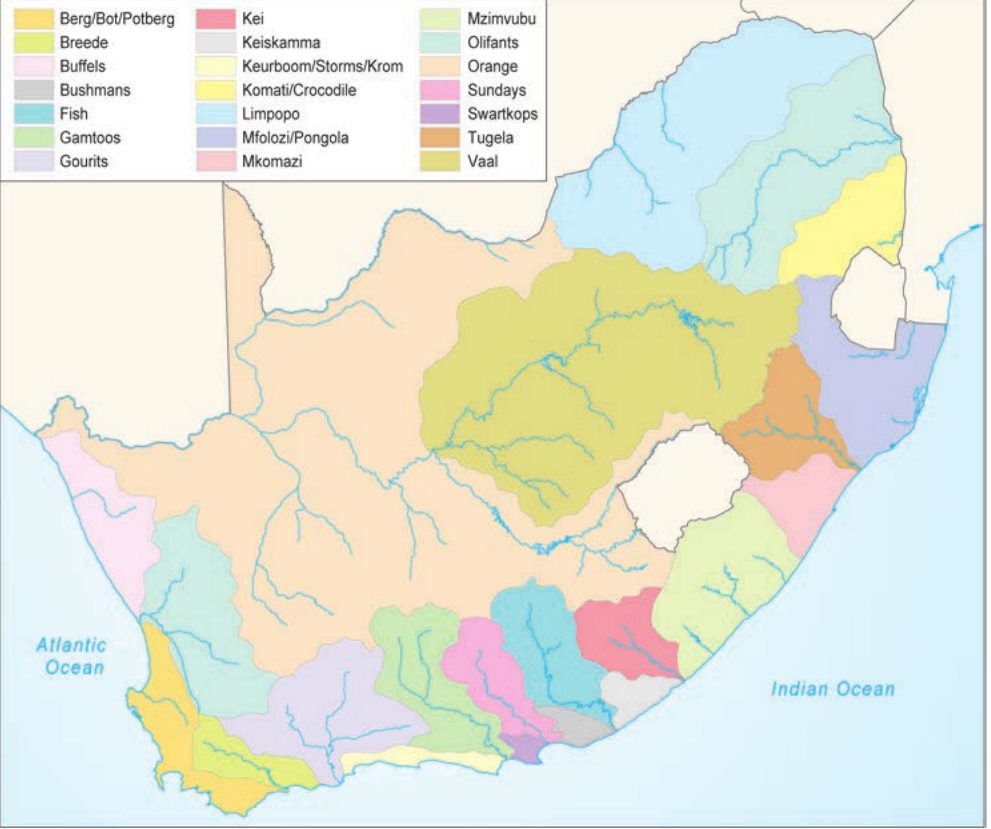
South Africa's water resources are divided into many different river basins and catchment areas. Each coloured region on this map represents a different water management area, showing how complex our water system really is.
Inter-basin water transfers
One of the biggest challenges facing South Africa's water managers is the uneven distribution of rainfall across the country. Some areas receive plenty of rain and have abundant water resources, while others are much drier and struggle to meet their water needs.
Inter-basin water transfer is the solution to this problem. This means moving water from one river basin (where there's plenty of water) to another river basin (where water is scarce). It's like borrowing water from your water-rich neighbour to help your water-poor friend.
Note
Inter-basin water transfers require sophisticated engineering solutions including canals, pipelines, tunnels, and pumping stations to move water across vast distances and different terrains.
The government has developed numerous inter-basin water transfer schemes to address these imbalances. These projects involve building complex systems of canals, pipelines, tunnels, and pumping stations to move water across the landscape.
| Source Basin | Receiving Basin | Annual Water Transfer (Million Cubic Metres) | Use |
|---|---|---|---|
| Gariep-Orange | Fish | 643 | Irrigation, domestic, industrial |
| Fish | Sundays | 200 | Irrigation, domestic |
| Orange | Riet | 189 | Irrigation |
| Thukela | Vaal | 630 | Industrial, domestic |
| Assegai | Vaal | 81 | Industrial, domestic |
| Vaal | Crocodile | 615 | Industrial, domestic |
| Vaal | Olifants | 150 | Electricity generation |
| Komati | Olifants | 111 | Electricity generation |
| Mooi | Mgeni | 69 | Domestic, industrial |
| Lesotho Highlands Water Project (Senqu) | Vaal | 935 (when completed) | Industrial, domestic |
These transfer schemes serve different purposes. Some provide water for irrigation to help farmers grow crops, others supply domestic water for households, and some provide water for industrial uses or electricity generation.
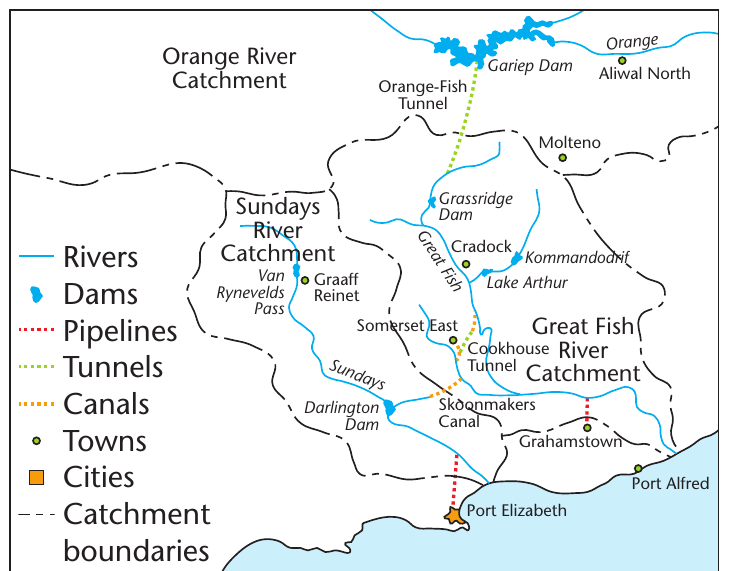
The Gariep-Orange to Fish transfer system is one of South Africa's major inter-basin water transfer projects. Water travels through tunnels, canals, and pipelines to reach areas that need it most.
Building dams
South Africa relies heavily on its system of dams to store and supply water. The country already obtains water from neighbouring countries, particularly Lesotho, and the Department of Water Affairs is also considering sourcing water from Mozambique and Zimbabwe in the future.
Case study: Lesotho highlands water project
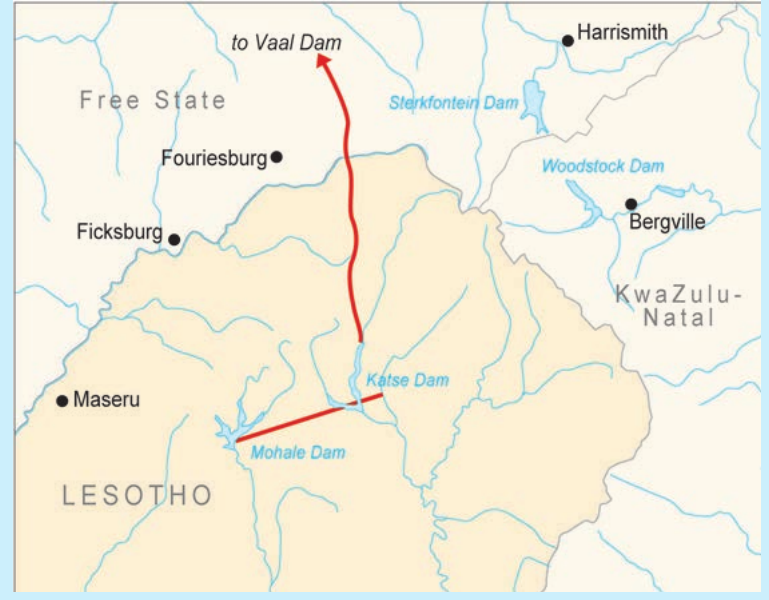
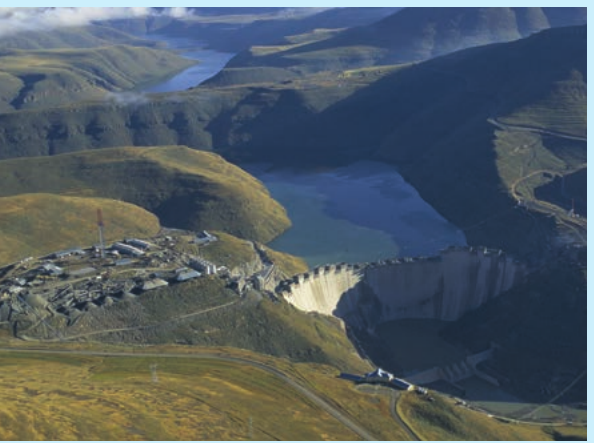
The Lesotho Highlands Water Project represents one of Africa's most ambitious water-transfer schemes. This long-term project was designed to supply the growing demand for water in Gauteng's densely populated industrial centres.
Example
Case Study Analysis: The Lesotho Highlands Water Project
Project Scope:
- Five dams to be constructed
- 200 kilometres of tunnels
- One hydroelectric power station
- Water transferred from Senqu River and other Lesotho basins
- Destination: Vaal Dam in South Africa
Project Phases:
- Phase 1: Already completed
- Phases 2 and 3: Planned for future implementation
Expected Output: 935 million cubic metres of water transferred annually when fully completed
When fully completed, this project will transfer 935 million cubic metres of water annually from Lesotho to South Africa - making it the largest water transfer scheme shown in our table.
However, dam-building projects like this face significant criticism. Critics argue that these projects are too expensive and cause serious environmental and social problems. Some believe that South Africa could have delayed or avoided projects like the Lesotho Highlands Water Project by using existing water supplies more efficiently.
Important
Major Criticisms of Large Dam Projects
The main criticisms of building large dams include:
- High cost of construction - these projects require enormous financial investment
- Great loss of water through evaporation - large surface areas mean lots of water evaporates
- Loss of valuable farmland - when valleys are flooded to create reservoirs
- Loss of biodiversity and damage to natural environments - ecosystems get disrupted
- Increase in flood risk - if dams fail or overflow
Critics suggest that South Africa could save up to 30% of its water costs by focusing on maintaining existing dams, repairing leaking pipes, and improving inefficient billing systems instead of building new mega-projects.
Water purification and the role of municipalities
Once water has been collected and transferred to river basins or dams, it must be purified before being distributed to consumers. Water boards take responsibility for this purification process.
Example
The Water Purification Process: Five Essential Stages
Stage 1: Screening Large solid objects like leaves and branches are trapped and removed from the raw water as it enters the treatment plant.
Stage 2: Coagulation Chemicals are added to make tiny particles of silt and sand cluster together into larger clumps that are easier to remove.
Stage 3: Settling The clustered particles sink to the bottom of large settling tanks, where they are removed as sludge.
Stage 4: Filtering The water passes through sand filters that remove very small solid particles that escaped the earlier stages.
Stage 5: Chlorination Chlorine is added to kill any remaining germs and make the water safe to drink.
Memory aid: "Some Can See Filtered Chlorine"
After purification, water boards sell this clean water to municipalities. Large water users like mines and factories can buy water directly from water boards, but most people receive their water through their local municipality.
Municipalities face several challenges in delivering water services to their communities. These challenges became particularly serious during the period of rapid expansion after 1994, when many municipalities expanded their water-delivery networks quickly but neglected proper maintenance of existing infrastructure.
Important
Critical Challenges Facing Municipalities
The main challenges facing municipalities in water provision include:
- Non-payment of water bills - When people don't pay for water services, municipalities struggle to maintain and improve their systems
- Lack of maintenance of infrastructure - Pipes, pumps, and treatment facilities need regular upkeep to work properly
- Shortage of skilled water technicians - Technical expertise is needed to operate complex water systems effectively
- Rapid urbanisation - Cities growing quickly puts enormous pressure on existing water infrastructure
- The need for sound management planning - Coordinating all these challenges requires good leadership and planning
The price each municipality charges for water depends partly on its running costs. Municipalities with high running costs often don't have enough money to provide effective services, which means their services are in danger of getting worse rather than better.
Summary
Key Points to Remember:
- Water provider hierarchy: The Department of Water Affairs builds dams and transfers water → Water boards purify water → Municipalities distribute water to consumers
- Inter-basin water transfers: Moving water from areas with plenty of water to areas that need more water, using tunnels, canals, and pipelines
- Free water policy: Every South African home is entitled to 6,000 litres of free water each month
- Water purification process: Screening → Coagulation → Settling → Filtering → Chlorination (remember: "Some Can See Filtered Chlorine")
- Municipal challenges: Include non-payment of bills, poor infrastructure maintenance, staff shortages, rapid urbanisation, and inadequate planning