The Leaf as an Organ (Grade 10 NSC Matric Life Sciences): Revision Notes
📚Revision Notes
The Leaf as an Organ
What makes a leaf an organ?
Understanding how plant parts work together starts with recognising what an organ actually is. An organ is a collection of different tissues that work together as one unit to carry out specific jobs for the organism. Think of it like a well-organised team where each member has a special role, but they all work towards the same goal.
Leaves are brilliant examples of plant organs because they perfectly demonstrate how different tissues combine to perform essential life functions. These remarkable structures have evolved to be flat and thin, which gives them the best possible surface area for capturing sunlight and exchanging gases with the atmosphere. The way a leaf is organised internally shows us exactly how form follows function in nature.
Note
Most leaves you'll encounter belong to vascular plants - these are plants that have developed specialised tissues for transporting water and nutrients throughout their structure. The shape and internal arrangement of leaves can vary dramatically depending on the plant's environment.
Some leaves look different on their upper and lower surfaces (called dorsiventral leaves), while others appear identical on both sides (called isobilateral leaves). Many leaves also serve additional purposes beyond photosynthesis, such as storing food and water.
The three main tissue types in leaves
Every leaf is built from three fundamental tissue types, each with specific roles that contribute to the leaf's overall function. Understanding these tissues helps us appreciate how leaves accomplish their complex tasks.
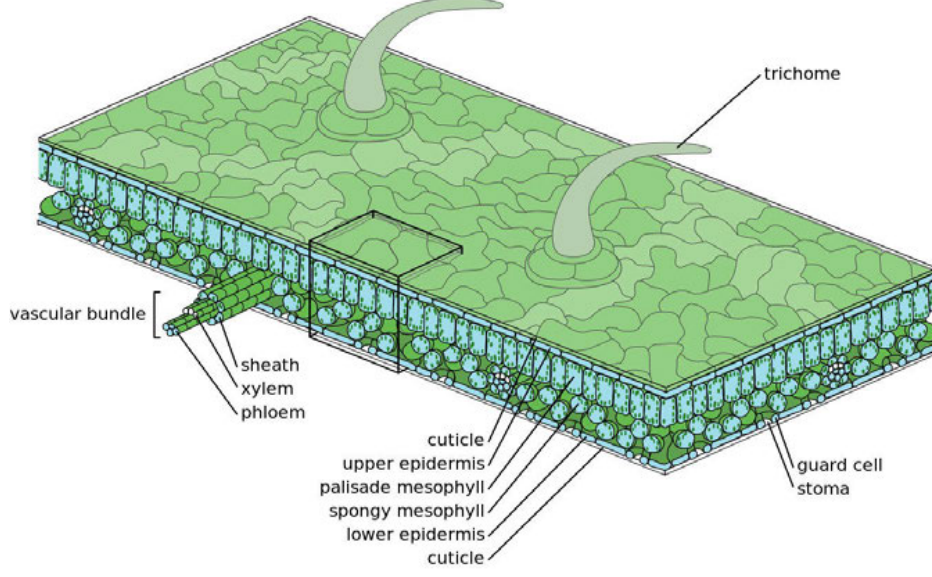
The epidermis forms the protective outer covering on both the upper and lower leaf surfaces. The mesophyll makes up the internal bulk of the leaf and contains most of the chloroplasts needed for photosynthesis. The vascular tissue creates a network of transport vessels that move water, minerals, and sugars throughout the leaf structure.
Epidermis - the protective boundary
The epidermis acts as the leaf's first line of defence against the outside world. These specialised cells create a barrier that separates the leaf's internal environment from the external atmosphere, much like how your skin protects your body.
Note
Key Functions of Epidermis: Epidermal tissue performs several crucial functions that keep the leaf healthy and functioning properly:
- Provides protection against excessive water loss through transpiration
- Regulates the exchange of gases like oxygen and carbon dioxide
- Can secrete various metabolic compounds
- Absorbs water when needed
The epidermis often features specialised structures called trichomes - these are tiny hair-like projections that can help reduce water loss, reflect excess light, or even provide protection from herbivores.
Mesophyll - the photosynthetic powerhouse
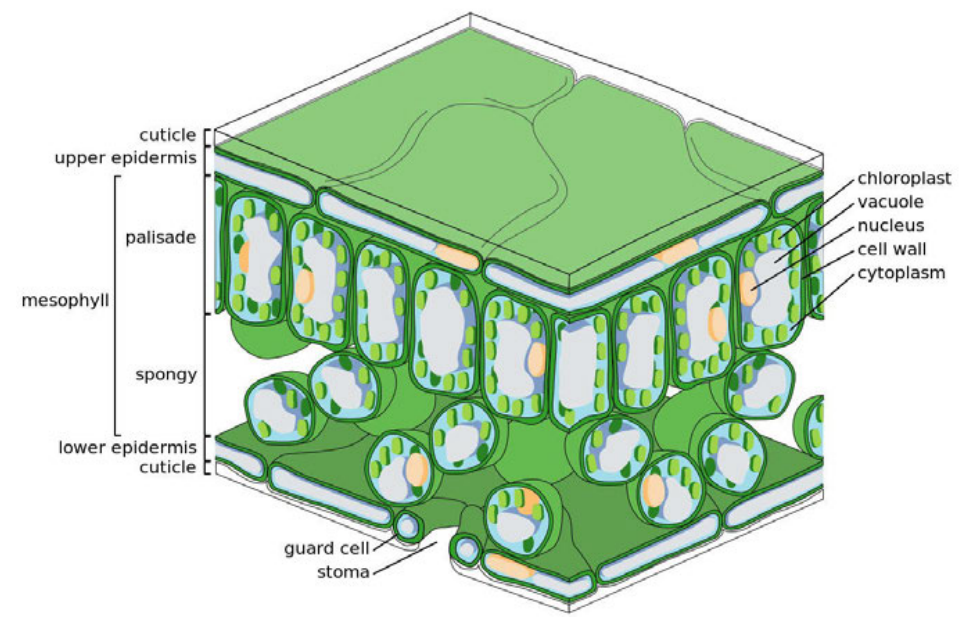
The mesophyll represents the leaf's main photosynthetic factory, positioned strategically between the upper and lower epidermis layers. This tissue consists primarily of parenchyma (ground tissue) or chlorenchyma tissue, both of which are packed with chloroplasts - the tiny green organelles that capture light energy and convert it into chemical energy.
The mesophyll is cleverly divided into two distinct layers, each optimised for different aspects of photosynthesis. The upper palisade layer sits just beneath the upper epidermis and consists of tall, column-like cells arranged vertically. These cells are tightly packed together to maximise the number of cells that can be exposed to incoming sunlight. Because they need to capture as much light as possible, palisade cells contain numerous chloroplasts, giving them their characteristic deep green colour.
Important
Environmental Adaptation: The thickness of the palisade layer varies depending on the leaf's light exposure. Leaves that develop in bright, sunny conditions typically have thicker palisade layers than those growing in shadier environments. This adaptation helps plants make the most of their available light resources.
Below the palisade layer lies the spongy mesophyll, where cells are rounder and more loosely arranged. This layer contains air spaces that facilitate the movement of gases throughout the leaf interior. These air spaces are essential for efficient gas exchange during photosynthesis and respiration.
Vascular tissue - the transport network
The vascular tissue forms the leaf's internal highway system, consisting of xylem and phloem vessels that you've learned about in previous sections. The xylem specialises in transporting water and dissolved minerals from the roots up to the leaf tissues. Meanwhile, the phloem carries dissolved sugars produced during photosynthesis away from the leaf to other parts of the plant that need energy.
Transport of substances in leaves
Leaves are designed as highly efficient transport hubs, constantly moving water, sugars, carbon dioxide, and oxygen across their surfaces. Each of these substances follows different pathways and involves distinct cellular processes.
Movement of oxygen and carbon dioxide
Stomata serve as the primary gateways for gas exchange in leaves. These microscopic pores allow carbon dioxide to enter the leaf from the atmosphere, providing the raw material needed for photosynthesis. At the same time, oxygen produced as a waste product of photosynthesis exits through the stomata.
The direction of gas movement follows concentration gradients - substances naturally move from areas of high concentration to areas of low concentration. Oxygen moves out of the leaf because photosynthesis creates higher oxygen concentrations inside the leaf than outside. Carbon dioxide moves into the leaf because the atmosphere generally contains higher concentrations of this gas than the leaf interior.
Movement of water into the leaf
Water transport in leaves involves a fascinating process driven by transpiration. As water continuously evaporates from the mesophyll cell surfaces and exits through the stomata, it creates a lower water concentration in the mesophyll tissues compared to the vascular bundles. This concentration difference causes water to move from the xylem vessels into the living mesophyll cells and eventually to the cell wall surfaces.
Note
This movement is maintained by what scientists call transpirational pull - the continuous evaporation of water molecules creates a pulling force that draws more water up from the stem through the xylem vessels. The process works because water molecules stick together, creating an unbroken column from the roots to the leaves.
Movement of sugars
Sugar transport represents the leaf's export business. Chloroplasts in the palisade layer capture solar energy and use it to manufacture glucose through photosynthesis. Some of this glucose gets converted into starch for temporary storage within the leaf. However, most of the sugar production gets transported through the phloem vessels to other parts of the plant that need energy for growth, maintenance, or storage.
Stomatal regulation
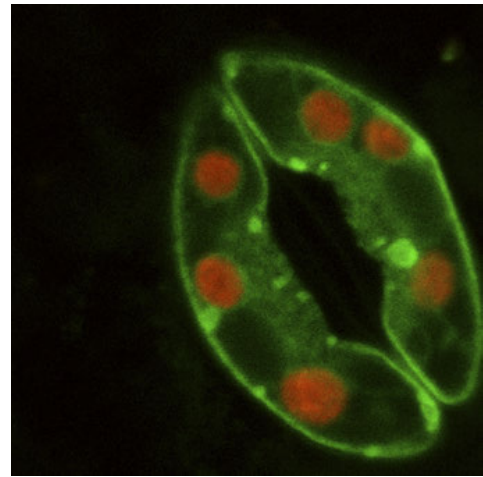
The opening and closing of stomata plays a critical role in controlling gas exchange, water loss, and sugar movement. Guard cells surrounding each stomatal pore can change shape to open or close the opening, depending on environmental conditions and the plant's needs.
Stomata typically open when light levels are high and humidity is adequate, allowing maximum gas exchange for photosynthesis. However, when soil water levels drop and the plant begins to experience water stress, chemical signals trigger the guard cells to close the stomata. This protective response helps prevent excessive water loss that could damage or kill the plant.
Practical investigation insights
Understanding leaf structure becomes much clearer when you observe real tissue samples under a microscope. When examining cross-sections of leaves, you can identify the distinct layers and cell types that make each tissue unique.
Example
Microscope Observation: Identifying Leaf Tissues
When viewing leaf cross-sections under the microscope, look for these key features:
Step 1: Identify the palisade cells - they appear as tall, narrow structures packed with green chloroplasts
Step 2: Locate the spongy mesophyll - shows rounder cells with obvious air spaces between them
Step 3: Observe the epidermis - forms the clear boundary layers at the top and bottom of the section
Different plants show variations in their leaf structure that reflect their environmental adaptations. Plants from sunny, dry environments often have thicker cuticles and more compact tissue arrangements, while plants from shady, moist environments may have thinner tissues and larger air spaces.
Summary
Key Points to Remember:
-
Leaves are organs because they contain multiple tissue types working together to perform photosynthesis, gas exchange, and transport functions
-
Three main tissues make up every leaf: epidermis for protection and gas regulation, mesophyll for photosynthesis, and vascular tissue for transport
-
Mesophyll has two layers - the upper palisade layer maximises light capture, while the lower spongy layer facilitates gas movement
-
Stomata act as controllable gates that open in bright, humid conditions and close when the plant needs to conserve water
-
Transport processes work in different directions - water moves up from roots, gases move in and out through stomata, and sugars move from leaves to other plant parts