Tissues (Grade 10 NSC Matric Life Sciences): Revision Notes
📚Revision Notes
Tissues
What are tissues?
A tissue is a group of similar cells that work together to perform a specific function. Think of it as a team of cells that have specialised to do a particular job in the body. These cells become adapted for their specific function through a process called cell differentiation.
Understanding tissues is crucial because they represent an important level of organisation in living organisms. Tissues sit between individual cells and complete organs in the biological hierarchy. When multiple tissues work together, they form organs, which then work together in organ systems.
Note
The concept of tissues helps us understand how complex organisms are built from simpler components. Just like how a sports team is made up of players with different positions and skills, tissues are made up of specialised cells that each contribute to the overall function.
Important
The relationship between structure and function is fundamental in biology. As Francis Crick once said, "If you want to understand function, study structure." This principle is especially important when studying tissues, as each tissue type has a specific structure that allows it to carry out its particular function effectively.
The organisation of life
Living organisms are organised in a hierarchical manner, from the smallest components to the largest:
atom → molecule → cell → tissue → organ → system → organism → ecosystem
Tissues occupy a crucial position in this hierarchy. They bridge the gap between individual cells and complex organs.
Example
Worked Example: From Cells to Organs
Consider the heart:
- Cells: Individual heart muscle cells contract rhythmically
- Tissue: Heart muscle cells group together to form heart tissue
- Organ: Different types of heart tissues (muscle, connective, nerve) combine to create the complete heart organ
- System: The heart works with blood vessels to form the cardiovascular system
Plant tissue classification
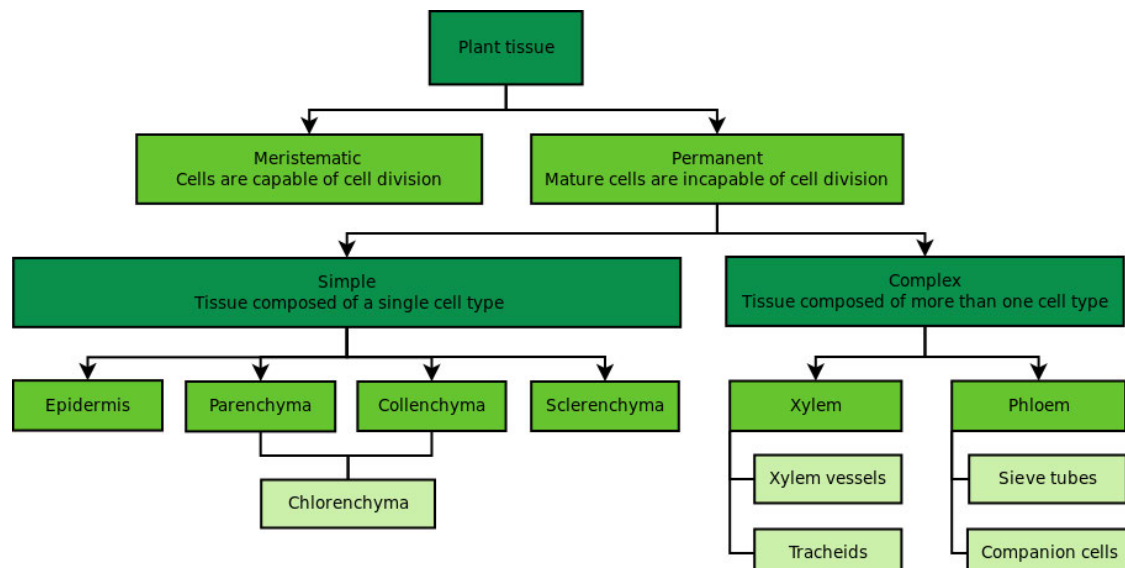
Plants are typically made up of three main parts: roots, stems, and leaves. Plant tissues can be broadly categorised into two main types based on their ability to divide:
Meristematic tissues
Meristematic tissues are composed of cells that are capable of cell division. These are the growth tissues of plants, found in areas where the plant is actively growing, such as:
- Root tips
- Shoot tips
- Cambium (tissue responsible for increasing stem thickness)
These tissues are responsible for the plant's ability to grow throughout its lifetime.
Note
Unlike animal tissues, plant meristematic tissues allow plants to continue growing throughout their entire lives. This is why plants can live for hundreds or even thousands of years, continuously adding new growth.
Permanent tissues
Permanent tissues are made up of mature cells that are incapable of cell division. These tissues have completed their development and now perform specialised functions. Permanent tissues are further divided into two categories:
Simple tissues
Simple tissues are composed of only one type of cell. There are four main types of simple tissues:
- Epidermis: The protective outer layer of the plant that helps prevent water loss and provides protection against damage
- Parenchyma: The most common plant tissue, involved in storage, photosynthesis, and support
- Collenchyma: Provides flexible support to growing parts of the plant
- Sclerenchyma: Provides rigid structural support with thick, strong cell walls
Note
Chlorenchyma is a specialised type of parenchyma tissue that contains chloroplasts and is specifically adapted for photosynthesis. This tissue is what gives leaves their green colour and enables plants to make their own food.
Complex tissues
Complex tissues are composed of more than one type of cell working together. There are two main types of complex tissues:
Xylem - the water transport system:
- Xylem vessels: Large tubes that transport water and minerals from roots to leaves
- Tracheids: Smaller water-conducting cells that also provide structural support
Phloem - the food transport system:
- Sieve tubes: Transport dissolved food substances (mainly sugars) throughout the plant
- Companion cells: Support the sieve tubes and help control the movement of substances
Important
Remember the key difference: Xylem moves water and minerals UP from the roots to the leaves, while Phloem moves food DOWN from the leaves (where it's made) to other parts of the plant that need energy.
Example
Worked Example: Tissue Function in a Tree
When you look at a tree:
- Epidermis on leaves prevents water loss while allowing gas exchange
- Chlorenchyma in leaves captures sunlight and produces glucose through photosynthesis
- Phloem transports this glucose down to the roots and growing parts
- Xylem transports water and nutrients from the soil up through the roots, stem, and to the leaves
- Sclerenchyma in the trunk provides the rigid support needed to hold the tree upright
Summary
Key Points to Remember:
- Tissues are groups of similar cells that work together to perform specific functions through cell differentiation
- Plant tissues are classified into meristematic (dividing) and permanent (non-dividing) tissues
- Simple tissues contain one cell type (epidermis, parenchyma, collenchyma, sclerenchyma) while complex tissues contain multiple cell types (xylem and phloem)
- Xylem transports water and minerals upward from roots, while phloem transports food throughout the plant
- Structure and function are closely related - each tissue type has a specific structure that enables it to perform its particular function effectively