Molecules for Life and Inorganic Compounds (Grade 10 NSC Matric Life Sciences): Revision Notes
📚Revision Notes
Molecules for Life and Inorganic Compounds
Introduction to biological molecules
Life exists at many different levels, from tiny atoms that join together to form molecules, all the way up to complex ecosystems. Understanding this hierarchy helps us see how chemistry forms the foundation of all living things.
Elements and atoms are the building blocks of everything around us. An atom is the smallest unit of matter that still has the properties of an element. Common elements you'll encounter in Life Sciences include carbon, oxygen, hydrogen, nitrogen, sulphur, calcium, sodium, and iron.
When atoms bond together, they form molecules. A molecule can contain identical atoms (like O₂ or H₂) or different atoms (like H₂O). When atoms from different elements combine, they create compounds.
Note
The progression from atoms → molecules → compounds → living organisms represents one of the most fundamental concepts in biology. Each level builds upon the previous one to create the complexity we see in living systems.
Organic vs inorganic compounds
All compounds can be divided into two main categories:
- Organic compounds nearly always contain carbon atoms bonded to hydrogen atoms. The main organic compounds in living things are carbohydrates, fats, proteins, and nucleic acids.
- Inorganic compounds include everything else. Even though carbon dioxide (CO₂) contains carbon, it's classified as inorganic because the carbon isn't bonded to hydrogen.
Important
This distinction between organic and inorganic compounds is crucial in biology. Remember: organic = carbon bonded to hydrogen, even though there are rare exceptions like CO₂.
What makes up the human body?
Our bodies are remarkable chemical factories. Here's what we're made of:
| Substance | Percentage |
|---|---|
| Inorganic compounds | |
| Water | 65% |
| Mineral salts | 1% |
| Organic compounds | |
| Protein | 18% |
| Carbohydrate | 5% |
| Other organic macromolecules | 1% |
As you can see, water makes up nearly two-thirds of your body weight, making it absolutely essential for life!
The role of water in biological systems
Water (H₂O) is truly amazing. It consists of two hydrogen atoms bonded to one oxygen atom, but its simple structure allows it to perform many vital functions in living organisms.
Key functions of water
Temperature regulation: When you get hot, your sweat glands produce sweat that evaporates from your skin surface. This process, called perspiration, cools your body down. Plants have a similar cooling system called transpiration, where water evaporates from their leaves.
Structure and support: Many animals use water pressure to maintain their body shape. Jellyfish and worms use a hydrostatic skeleton - special water-filled chambers that provide support and enable movement. Plants stay upright because of turgor pressure - water pressure inside their cells that keeps them rigid and firm.
Transport medium: Water serves as the body's delivery system. Blood, which is mostly water, carries hormones, dissolved gases, nutrients, and waste products throughout your body.
Note
Think of water as your body's highway system - it's constantly moving essential materials to where they need to go and removing waste products from where they shouldn't be.
Lubrication: Water is the main ingredient in saliva, which helps you chew and swallow food easily. It also keeps your eyes moist through tears and allows food to move smoothly through your digestive system.
Universal solvent: More substances dissolve in water than in any other liquid, which is why water is called the "universal solvent". This property makes water perfect for transporting dissolved nutrients and waste products.
Chemical reactions: All the chemical reactions that keep you alive happen in water. Water also participates directly in many reactions. During hydrolysis, water breaks apart large molecules into smaller ones. Water can even be split into hydrogen and oxygen atoms to provide energy for complex processes like photosynthesis.
Example
Worked Example: Hydrolysis Reaction
When you digest starch, water molecules break the bonds between sugar units:
Starch + H₂O → Individual glucose molecules
This is why digestive enzymes need a watery environment to function properly!
Essential minerals for life
Dietary minerals are chemical elements that living things need to stay healthy. Your body requires different minerals in different amounts.
Macro-elements and micro-elements
Macro-elements (also called macro-nutrients) are minerals needed in large quantities. These include carbon, hydrogen, oxygen, nitrogen, potassium, sodium, calcium, chloride, magnesium, phosphorus, and sulphur.
Micro-elements (micro-nutrients) are needed in very small amounts but are still essential. Examples include iron, cobalt, chromium, copper, iodine, manganese, selenium, zinc, and molybdenum.
Important
Don't let the term "micro-elements" fool you - these minerals may be needed in tiny amounts, but they're absolutely critical for health. A deficiency in any micro-element can cause serious health problems.
Important minerals for humans
Here are some key minerals and what they do in your body:
Calcium: Essential for strong bones and teeth, muscle contraction, blood clotting, and nerve function. Found in dairy products, leafy vegetables, and meat. Deficiency causes rickets and osteoporosis.
Iron: Vital component of haemoglobin (the protein that carries oxygen in your blood) and many enzymes. Found in meat and legumes. Deficiency leads to anaemia.
Iodine: Needed for thyroid hormone production, which controls growth and metabolism. Found in seafood and iodated salt. Deficiency causes goitre and stunted growth.
Potassium: Important for heart function, muscle contraction, and water balance. Found in bananas, meat, and dairy. Deficiency can cause heart problems and muscle cramps.
Plant nutrition
Plants also need specific minerals to grow properly. Like humans, they require both macro-nutrients and micro-nutrients.
Key plant nutrients include:
- Nitrogen: Essential for chlorophyll production and protein synthesis
- Phosphorus: Important for photosynthesis and root growth
- Potassium: Needed for protein synthesis and enzyme activation
- Magnesium: A key component of chlorophyll
- Iron: Required for chlorophyll production
When plants don't get enough of these minerals, they develop deficiency symptoms like chlorosis (yellowing of leaves), stunted growth, or poor fruit quality.
Note
Plant mineral deficiencies often show up as visible symptoms on leaves - yellowing, browning, or stunted growth. This makes it relatively easy for farmers and gardeners to diagnose nutritional problems.
Fertilisers and environmental impact
Why use fertilisers?
When farmers grow crops repeatedly on the same land, the soil becomes depleted of essential nutrients. Fertilisers are mixtures of chemical substances that replenish these nutrients, improve soil quality, and promote plant growth. They typically contain inorganic nutrients like nitrates and phosphates.
Environmental concerns
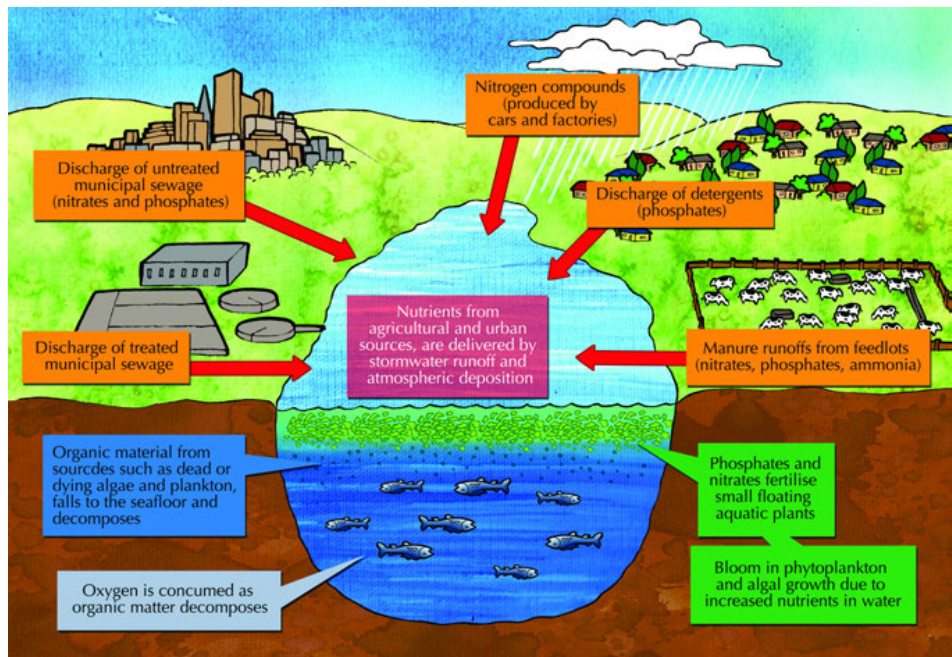
However, using large amounts of fertilisers can harm the environment. When excess fertilisers wash into rivers and lakes, they cause a serious problem called eutrophication.
Here's how eutrophication happens:
- Excess nutrients (nitrates and phosphates) from fertilisers run off into water bodies
- These nutrients cause rapid growth of water plants and algae
- The plants use up large amounts of oxygen during photosynthesis
- When the plants die, bacteria decompose them, using even more oxygen
- Other organisms in the water suffocate and die from lack of oxygen
- The ecosystem becomes severely damaged
Important
Environmental Warning: Eutrophication is one of the most serious threats to freshwater ecosystems. It creates "dead zones" where nothing can survive due to oxygen depletion. This process can take decades to reverse, making prevention crucial.
Natural alternatives
To reduce environmental damage, farmers can use natural fertilisers made from organic materials like manure, compost, worm castings, peat, and seaweed. These release nutrients slowly through natural decomposition processes, reducing the risk of nutrient runoff and eutrophication. While more labour-intensive, organic fertilisers are much better for the environment.
Example
Worked Example: Comparing Fertiliser Types
Synthetic fertiliser: Releases nutrients immediately → Plants absorb some → Excess washes away → Causes water pollution
Organic fertiliser: Decomposes slowly → Releases nutrients gradually → Plants absorb most → Minimal runoff → Protects environment
Summary
Key Points to Remember:
-
Water makes up 65% of the human body and performs many vital functions including temperature regulation, transport, and chemical reactions
-
Minerals are divided into macro-elements (needed in large amounts) and micro-elements (needed in small amounts), both essential for health
-
Plants require specific nutrients like nitrogen, phosphorus, and potassium for proper growth and development
-
Fertilisers help crops grow but excessive use can cause eutrophication, which damages aquatic ecosystems
-
Natural fertilisers provide a more environmentally friendly alternative to synthetic chemicals, releasing nutrients slowly and reducing environmental impact