Organic Compounds: Proteins and Nucleic Acids (Grade 10 NSC Matric Life Sciences): Revision Notes
📚Revision Notes
Organic Compounds: Proteins and Nucleic Acids
Understanding proteins
Proteins are incredibly important molecules found throughout your body. Think of them as the builders and workers of life - they help construct your body and keep it running smoothly.
Note
Proteins are essential macromolecules that perform countless vital functions in living organisms. Without proteins, life as we know it would be impossible.
What are proteins made of?
Proteins contain several key elements that you need to remember:
- Carbon (C)
- Hydrogen (H)
- Oxygen (O)
- Nitrogen (N)
- Sometimes other elements like iron (Fe), phosphorus (P), and sulphur (S)
The building blocks of proteins are called amino acids. There are 20 different amino acids that your body uses to make proteins. Nine of these are called essential amino acids because your body cannot make them - you must get them from food.
Important
Essential amino acids must be obtained from your diet because your body cannot synthesise them. This is why eating a balanced diet with complete proteins is crucial for health.
These amino acids link together using peptide bonds to form long chains called peptides. When many amino acids join together, they create a protein with a very specific three-dimensional shape.
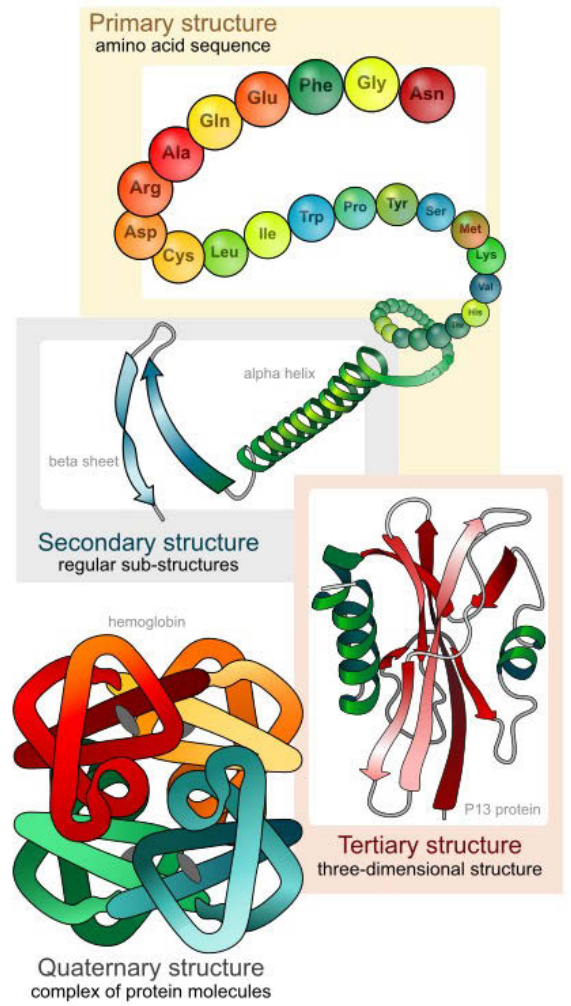
The four levels of protein structure
Understanding protein structure is like understanding how a building is constructed - there are different levels of organisation:
Primary structure: This is simply the order of amino acids in the chain, like beads on a string. The sequence determines everything else about the protein.
Secondary structure: The chain starts to fold and twist due to hydrogen bonds between different parts. This creates patterns like spirals (alpha helices) and flat sheets (beta sheets).
Tertiary structure: The protein folds into its final three-dimensional shape. This happens because different parts of the protein are attracted to or repelled by water and each other.
Quaternary structure: Some complex proteins are made of multiple protein chains working together, like a team of builders constructing something large.
Example
Structural Organisation Example: Building a House
Think of protein structure like constructing a house:
- Primary structure = The individual bricks (amino acids) in order
- Secondary structure = Organising bricks into walls (helices and sheets)
- Tertiary structure = Arranging walls to form rooms (final 3D shape)
- Quaternary structure = Multiple buildings working together as a complex
Important
This specific shape is crucial - if the shape changes, the protein cannot do its job properly. This is why maintaining proper conditions for proteins is essential.
Why are proteins important?
Proteins have many vital roles in your body:
- Structural support: Found in hair, skin, bones, muscles, and tendons
- Communication: Help cells talk to each other
- Immune defence: Antibodies that fight diseases
- Energy source: Can be broken down for energy when needed
- Catalysis: Special proteins called enzymes speed up chemical reactions
Protein deficiency diseases
Without enough protein, serious health problems develop:
Important
Protein Deficiency Diseases:
- Kwashiorkor: Caused specifically by lack of protein
- Marasmus: Caused by general starvation and lack of all nutrients
These conditions highlight why adequate protein intake is essential for proper growth and development.

Testing for proteins
Scientists use chemical tests to detect proteins in foods and samples:
Example
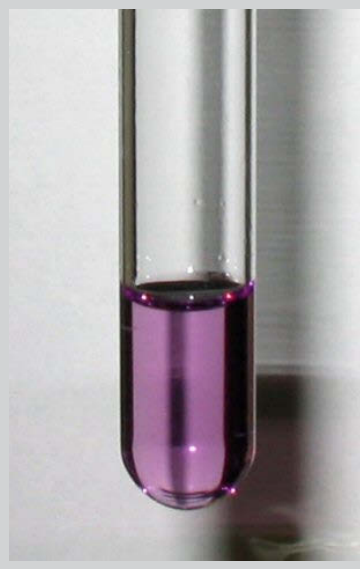
Biuret Test Procedure
- Uses a copper-based reagent
- Positive result: Purple or violet colour (protein present)
- Negative result: Blue colour (no protein)
Example
Millon's Reagent Test Procedure
- Uses mercury-based reagent (very toxic - avoid breathing fumes!)
- Positive result: Red-brown colour (protein present)
- Negative result: White colour (no protein)
| Test reagent | Positive result | Negative result |
|---|---|---|
| Biuret reagent | Violet/purple colour | Blue colour |
| Millon's reagent | Red-brown colour | White colour |
Enzymes - the body's catalysts
Enzymes are special proteins that act as biological catalysts. This means they speed up chemical reactions in your body without being used up in the process.
What makes enzymes special?
Important
Key Definition: An enzyme is a biological catalyst that speeds up the rate of a chemical reaction without being used up in the chemical reaction itself.
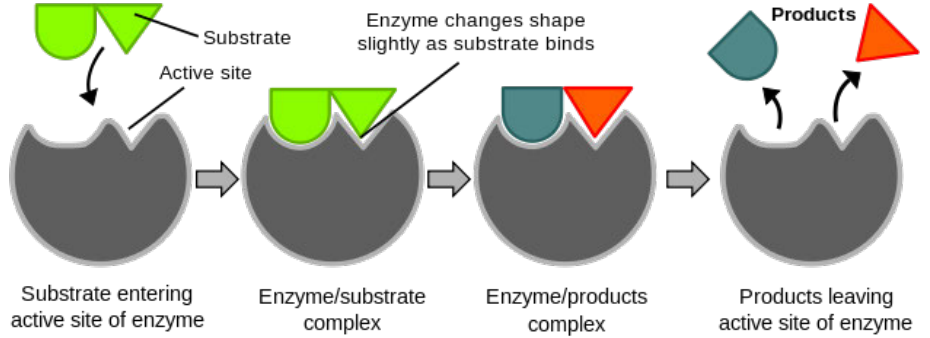
Every enzyme has an active site - a specially shaped region where chemical reactions take place. Think of it like a very specific keyhole that only fits certain keys (called substrates).
How enzymes work - the lock and key model
Enzymes work through a process that scientists compare to a lock and key:
Example
Lock and Key Mechanism Steps
- The substrate (key) approaches the enzyme's active site (lock)
- They fit together perfectly to form an enzyme-substrate complex
- The reaction happens, creating new products
- The products leave the active site, and the enzyme is ready to work again
Note
The enzyme changes shape slightly when the substrate binds - this is called the induced fit model, which is more accurate than thinking of a rigid lock and key.
Energy and enzymes
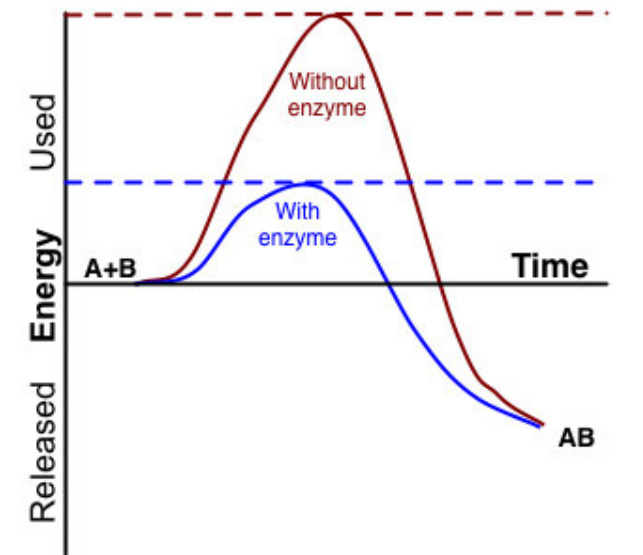
All chemical reactions need energy to get started - this is called activation energy. Enzymes are amazing because they lower this energy barrier, making reactions happen much faster at body temperature.
Important
Without enzymes, the reactions needed for life would be too slow to keep you alive! Enzymes make life possible by dramatically reducing the activation energy required for biochemical reactions.
Factors affecting enzyme activity
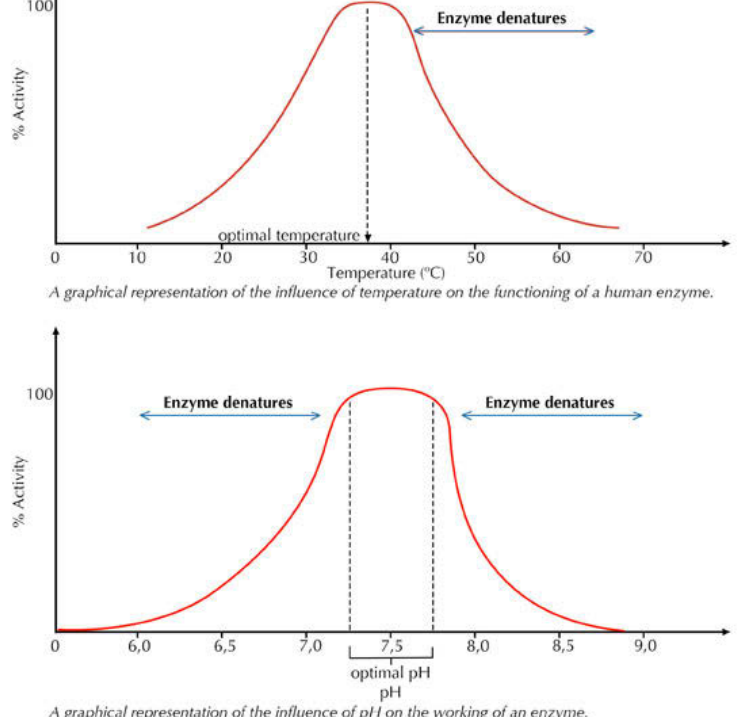
Enzymes are sensitive to their environment. Two key factors affect how well they work:
Temperature
Note
Temperature Effects on Enzymes:
- Optimal temperature: For human enzymes, this is around 37°C (body temperature)
- Too cold: Enzymes work very slowly
- Too hot: Enzymes denature (lose their shape) and stop working completely
pH levels
Note
pH Effects on Enzymes:
- Each enzyme has an optimal pH range
- Outside optimal range: The enzyme's shape changes and it cannot function properly
- Extreme pH: Causes denaturation
Important
Denaturation is usually irreversible - once an enzyme loses its shape due to extreme temperature or pH, it cannot regain its function. This is why maintaining proper body conditions is crucial.
Enzymes in everyday life
Note
Practical Applications of Enzymes: Enzymes are used in many products you encounter:
- Biological washing powders: Contain enzymes that break down protein and fat stains
- Meat tenderisers: Use enzymes from fruits like papaya to soften meat
- Lactose-free milk: Has the enzyme lactase added to break down milk sugar
Nucleic acids - the information molecules
Nucleic acids are large, complex molecules that store and transfer genetic information in all living things. They are like the instruction manuals for life.
Note
Nucleic acids are the molecular basis of heredity and are responsible for storing, transmitting, and expressing genetic information in all living organisms.
Structure of nucleic acids
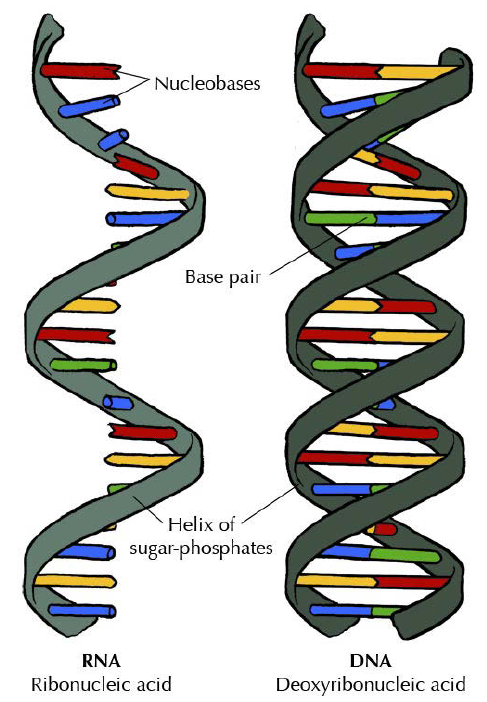
Nucleic acids are polymers made up of smaller units called nucleotides. Each nucleotide contains:
- A sugar molecule
- A phosphate group
- A nitrogenous base
These nucleotides link together through phosphodiester bonds, connecting the phosphate of one nucleotide to the sugar of the next.
Types of nucleic acids
There are two main types you need to know:
Example
Comparing DNA and RNA
DNA (Deoxyribonucleic acid):
- Contains the genetic instructions for making proteins
- Found in the nucleus of every cell
- Has a double-stranded helical structure
- Stores information in the form of genes
RNA (Ribonucleic acid):
- Helps transfer genetic information from DNA to make proteins
- Found in ribosomes, cytoplasm, and nucleus
- Usually single-stranded
- Has several different types with different functions
Key difference: DNA stores long-term genetic information, while RNA helps carry out the instructions stored in DNA.
Summary
Summary
Key Points to Remember:
-
Proteins are made of amino acids linked by peptide bonds and have four levels of structural organisation (primary, secondary, tertiary, quaternary)
-
Enzymes are biological catalysts that speed up reactions by lowering activation energy, and they work through a lock-and-key mechanism with their active sites
-
Temperature and pH significantly affect enzyme activity - each enzyme has optimal conditions and will denature under extreme conditions
-
Nucleic acids (DNA and RNA) are information storage molecules made of nucleotides that carry the instructions for making proteins and controlling cellular processes
-
Chemical tests like the Biuret test can identify the presence of proteins by producing characteristic colour changes