Uptake of Water and Minerals in the Roots (Grade 10 NSC Matric Life Sciences): Revision Notes
📚Revision Notes
Uptake of Water and Minerals in the Roots
Plants need a constant supply of water and minerals from the soil to survive and grow. The root system is specially adapted to absorb these essential substances efficiently and transport them to other parts of the plant. Understanding how this uptake process works is crucial for grasping how plants maintain their life processes.
Note
The root system acts as the plant's lifeline, working continuously to extract water and dissolved minerals from the soil. This process is so efficient that a single plant can absorb hundreds of litres of water during its growing season.
Root hair cells - the absorption specialists
The uptake of water and minerals begins at tiny structures called root hair cells. These are remarkable adaptations that make plants incredibly efficient at absorbing what they need from soil.
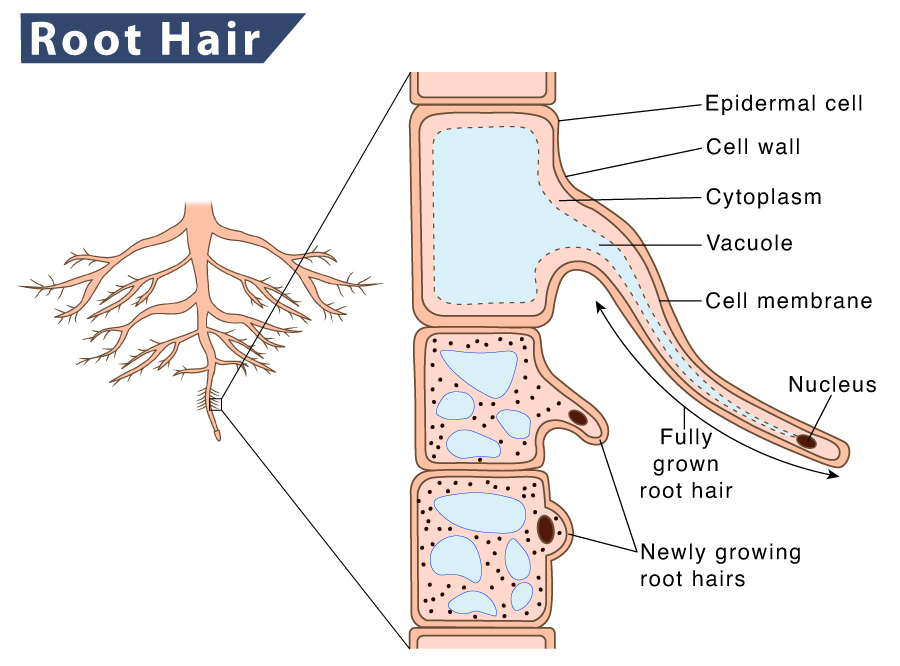
Root hair cells are outgrowths found at the tips of plant roots. They have several key features that make them perfect for absorption:
- Large surface area: Their small diameter ( micrometres) and greater length ( micrometres) create a massive surface area for absorption
- Large vacuoles: These allow storage of water and mineral salts once absorbed
- No chloroplasts: Since they're underground and receive no sunlight, they don't photosynthesize
- Thin cell walls: This makes it easier for substances to pass through
Important
The surface area created by root hair cells can increase the absorptive capacity of roots by up to 40 times compared to roots without these specialised structures.
Water is found in the spaces between soil particles. Both water and dissolved mineral salts first enter the root hair cell through osmosis - the movement of water from an area of high water concentration to low water concentration across a semi-permeable membrane.
Movement across the root cortex
Once water enters the root hair cells, it needs to travel across the root cortex (the middle layer of the root) to reach the transport system. This journey happens in two main ways:
Through the cells (symplastic pathway)
Some water passes directly through the parenchyma cells of the cortex by osmosis. Water moves from cell to cell through their cytoplasm and connecting channels.
Around the cells (apoplastic pathway)
Most water actually travels in or between the cell walls of the parenchyma cells by simple diffusion. This is often the faster route as there are fewer barriers to cross.
Note
The apoplastic pathway is typically the dominant route for water transport across the root cortex because it encounters less resistance than moving through multiple cell membranes.
Both pathways work together to ensure water moves efficiently across the root cortex towards the centre of the root.
Entry into the xylem tissue
Before water can enter the plant's main transport system (the xylem), it must pass through a special layer called the endodermis. This acts like a checkpoint, controlling what enters the xylem vessels.
Once water successfully passes through the endodermis, it enters the xylem in the root. From here, it will travel up through the xylem vessels in the stem to reach all parts of the plant where it's needed.
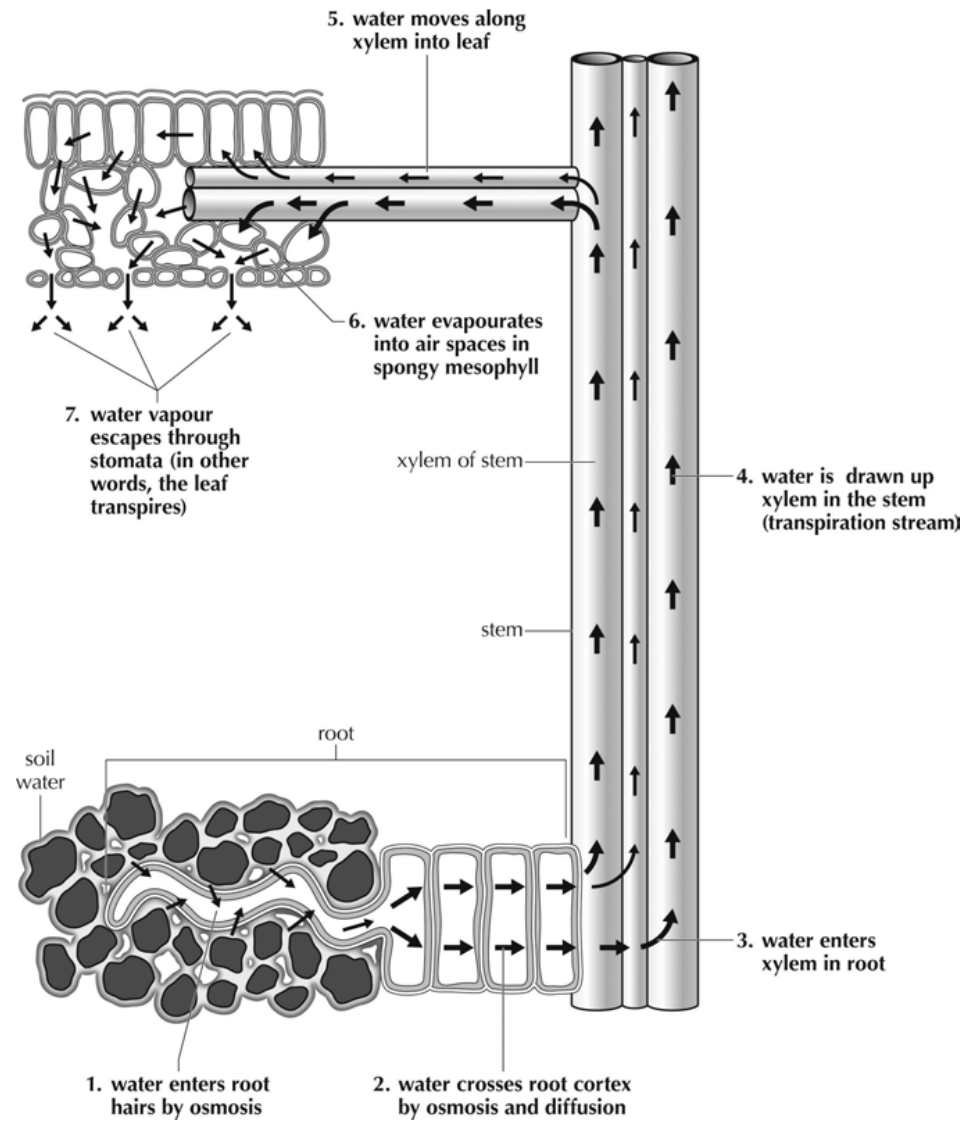
This diagram shows the complete journey of water from the soil through the root system and up to the leaves, illustrating each step of the uptake and transport process.
Investigation: measuring water uptake by roots
Scientists can measure how much water plants absorb using a simple but effective experiment:
Example
Practical Investigation: Measuring Water Uptake
Aim: To measure the uptake of water by roots and track this over time.
Method:
- Remove a plant cutting and place it in a container with soil
- Cut drainage holes in the bottom and weigh the entire setup
- Water the plant until water runs out of the drainage holes
- Weigh again to calculate the exact amount of water added
- Place by a window and monitor weight loss over several weeks
- The decrease in weight shows how much water the plant has absorbed and used
Key Findings:
- Plants continuously absorb water from soil through their roots
- The rate of water uptake can be measured and tracked over time
- Water uptake is linked to plant growth and metabolic processes
- Environmental conditions (like sunlight and temperature) affect uptake rates
Investigation: examining water uptake by stems
Another useful investigation demonstrates how water moves through plant stems:
Example
Practical Investigation: Tracking Water Movement in Stems
Method:
- Take a white flower on a stem (like carnations or chrysanthemums)
- Cut the stem and place half in plain water, half in coloured water
- Observe how the dye travels up through the stem to the flower
- The coloured sections show the pathway of water transport
Key Observations:
- Water moves upward through specific pathways in the stem
- The xylem vessels act like tiny tubes carrying water upward
- This transport can happen quite quickly - visible within hours
The three key processes working together
For effective water uptake and transport, plants rely on three main processes:
1. Root pressure
When soil moisture is very high, water enters the root system creating pressure that can push water upward. This is most effective when transpiration rates are low (like at night).
2. Capillarity
Capillarity refers to the ability of liquids to flow through narrow spaces. The xylem vessels act like tiny tubes, and water can move up through them due to capillary action - just like how water moves up a thin straw.
Note
Capillarity alone can lift water several metres in plants, but it's most effective in smaller plants. Taller trees rely more heavily on transpiration pull for water transport.
3. Transpiration pull
As water evaporates from leaves during transpiration, it creates a "pulling" effect that draws more water up from the roots. This is usually the strongest force moving water through plants during the day.
Important
Transpiration pull is the dominant mechanism for water transport in most plants, especially during daylight hours when stomata are open and evaporation rates are high.
Connection to transpiration
It's important to understand that water uptake in roots is closely connected to water loss in leaves. During the day, when stomata are open for gas exchange, water evaporates from leaf surfaces. This creates a continuous demand for more water, which must be supplied by the root system.
The plant maintains a constant flow: water in through the roots → up through the xylem → out through the leaves. This system ensures all parts of the plant receive the water they need while also enabling essential processes like photosynthesis and temperature regulation.
Summary
Key Points to Remember:
- Root hair cells are specially adapted for maximum water and mineral absorption with their large surface area and thin walls
- Water moves across the root cortex through two pathways - through cells (osmosis) and around cells (diffusion)
- Three processes drive water transport: root pressure, capillarity, and transpiration pull working together
- Water uptake is continuous - plants constantly absorb water to replace what they lose through transpiration
- The journey from soil to leaf involves osmosis, diffusion, and active transport processes that ensure efficient distribution throughout the plant