Measuring Area (Grade 10 NSC Matric Mathematical Literacy): Revision Notes
📚Revision Notes
Measuring Area
What is area?
Area is the size of a surface or the amount of space inside the boundary of a flat (2-dimensional) object such as a square, triangle, or circle. Area is always measured in square units like mm², cm², m², or km².
Note
Think of area as "how much space something covers" - like how much paint you would need to cover a wall, or how much carpet you need for a floor.
Estimating area using grids
Sometimes we need to estimate area when we don't have exact measurements or when dealing with irregular shapes. The grid method is a practical way to do this.
How the grid method works
When using a grid to estimate area, you follow these key steps:
- Place a square grid over the shape you want to measure
- Count how many complete squares fit inside the shape
- Each square represents a specific area (like 1 cm²)
- Add up all the squares to get your estimated area
Example
Worked Example 1: Rectangular patio using a grid
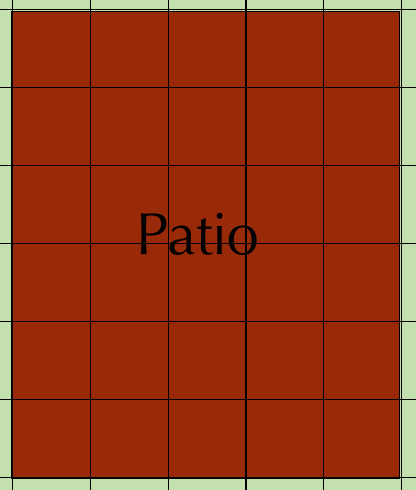
Let's estimate the area of Mr and Mrs Dlamini's rectangular patio where each grid square represents 1 cm².
Solution:
- Count each square systematically and mark it as you go
- The patio is 5 blocks wide and 6 blocks high
- Total blocks = blocks
- Since each block = 1 cm², the area = 30 cm²
Example
Worked Example 2: Triangular garden using a grid
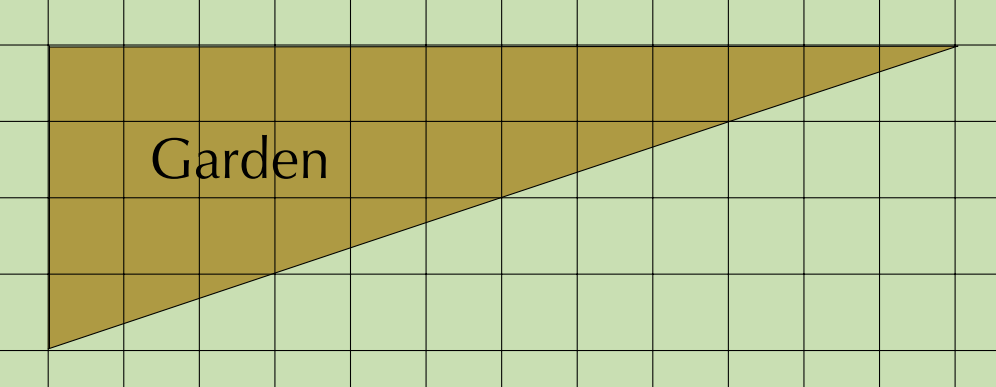
Now let's estimate the area of a triangular garden using the same grid method.
Solution: When estimating a triangle's area with a grid:
- First, count all the complete blocks inside the triangle = 18 blocks
- Next, count the half-blocks that fit inside = 4 half-blocks = 2 whole blocks
- Count remaining partial blocks and estimate = approximately 4½ whole blocks
- Total estimated area = 24.5 cm²
Example
Worked Example 3: Circular pond using a grid
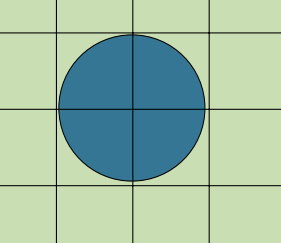
For a circular fish pond, the grid method becomes an estimation tool since circles don't fit neatly into square grids.
Solution:
- Each piece of the circle takes up approximately three-quarters of a square
- There are 4 such squares, so: whole blocks
- Estimated area = 3 cm²
Using formulae to calculate area
While grid estimation is useful, formulae give us exact answers and are much faster for regular shapes. Here are the essential area formulas you need to know:
Essential area formulae
| Shape | Formula | Key Points |
|---|---|---|
| Rectangle | Multiply the two different sides | |
| Square | or | All sides are equal |
| Triangle | Height must be perpendicular to base | |
| Circle | Remember: radius = diameter ÷ 2 |
Important
Important: You will always be given these formulae in your NSC exam, but you must know how to use them correctly.
What does "perpendicular" mean?
Perpendicular means a straight line that lies at an angle of 90° to another line, plane, or surface. In triangles, the height must always be measured perpendicular (at right angles) to the base.
Example
Worked Example 4: Using formulae for basic shapes
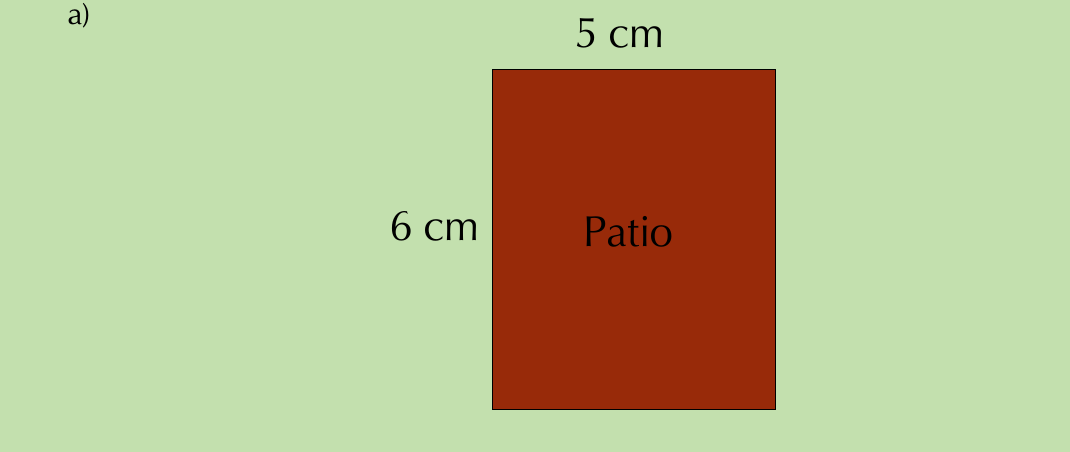
Calculate the area of these three shapes:
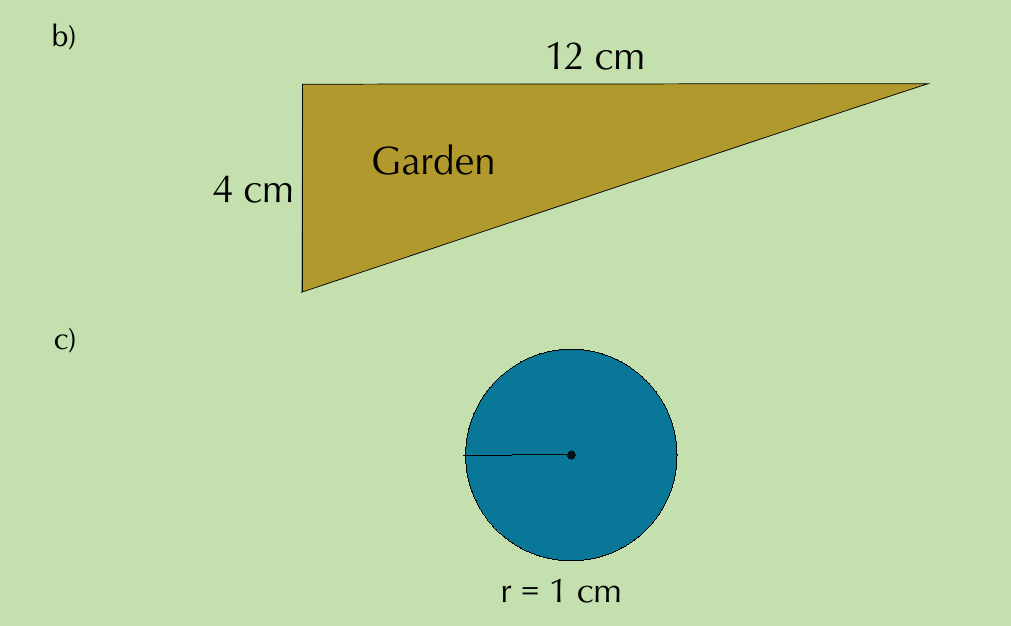
Solutions:
a) Rectangle (Patio):
- Area =
- Area = 30 cm²
b) Triangle (Garden):
- Area =
- Area = 24 cm²
c) Circle (Pond):
- Area =
- Area =
- Area = 3.142 cm²
Comparing grid estimation vs formulae
When we compare our grid estimates with formula calculations:
- Rectangle: Grid = 30 cm², Formula = 30 cm² (Same! The rectangle fits perfectly into the grid)
- Triangle: Grid = 24.5 cm², Formula = 24 cm² (Close, but grid estimation is less accurate)
- Circle: Grid = 3 cm², Formula = 3.142 cm² (Grid estimation is less accurate for curved shapes)
Note
Key insight: Using formulae is more accurate than grid estimation, especially for triangles and circles. Grid estimation is most useful for irregular shapes that don't have standard formulae.
Example
Worked Example 5: Complex shapes
Sometimes you'll encounter complex shapes that need to be broken down into simpler parts.
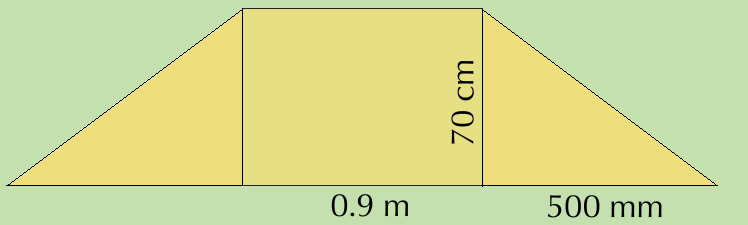
For a trapezoidal table shape with dimensions 70 cm height, 0.9 m and 500 mm widths:
Solution approach:
- Convert all units to the same measurement (e.g., all in cm)
- Break the complex shape into simpler shapes (rectangles and triangles)
- Calculate each area separately
- Add all areas together
Example
Worked Example 6: Real-world application
A coin has a circular shape with a square cut out from the middle.
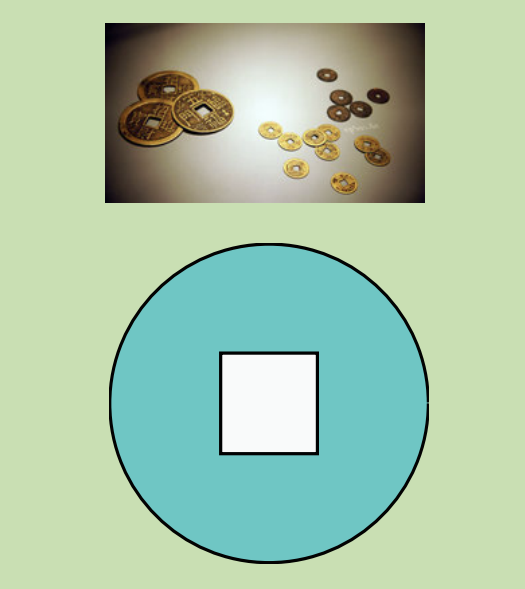
Problem: If the circle diameter is 3 cm and the square side is 0.9 cm, find the remaining area.
Solution:
- Calculate circle area:
- Radius = cm
- Circle area = cm²
- Calculate square area:
- Square area = cm²
- Find remaining area:
- Remaining area = 6.3 cm²
Exam tips and common mistakes
Important
Key exam strategies:
- Always check your units - make sure all measurements are in the same units
- Show all working steps - you get marks for method, not just the final answer
- Use the correct formula - identify the shape first, then choose the right formula
- Round only at the end - keep full decimal values during calculations
Important
Common mistakes to avoid:
- Confusing radius with diameter in circle problems
- Using the wrong height in triangle calculations (it must be perpendicular)
- Forgetting to convert units before calculating
- Mixing up length and width in rectangles (though it doesn't matter for area calculations)
Summary
Key Points to Remember:
-
Area measures the space inside a 2D shape and is always in square units (mm², cm², m², km²)
-
Grid estimation is useful for irregular shapes but less accurate than formulae for regular shapes
-
Essential formulae: Rectangle = , Square = , Triangle = , Circle =
-
Always convert to the same units before calculating and show all working steps
-
Complex shapes can be broken down into simpler shapes, then add or subtract areas as needed