Summary (Grade 10 NSC Matric Mathematics): Revision Notes
📚Revision Notes
Summary
Number systems
Understanding different types of numbers forms the foundation of algebraic expressions. Numbers can be classified into several important categories.
Natural numbers (N) are the counting numbers we use in everyday life: {1, 2, 3, 4, ...}. These numbers start from 1 and continue infinitely.
Whole numbers (N₀) include all natural numbers plus zero: {0, 1, 2, 3, 4, ...}. The subscript ₀ reminds us that zero is included in this set.
Integers (Z) extend further to include all positive and negative whole numbers: {..., -3, -2, -1, 0, 1, 2, 3, ...}. The symbol Z comes from the German word "Zahlen" meaning numbers.
Note
The relationship between these number sets follows a nested pattern: Natural numbers are contained within whole numbers, which are contained within integers. Think of them as expanding circles, with each set including all the numbers from the previous set plus additional ones.
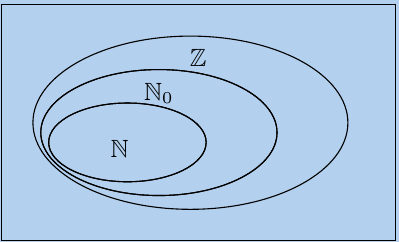
This Venn diagram shows how these number sets relate to each other, with natural numbers contained within whole numbers, which are contained within integers.
Rational and irrational numbers
Rational numbers are any numbers that can be expressed as a fraction where both and are integers and . This large category includes:
- All fractions where both the numerator and denominator are integers
- All integers (since any integer can be written as )
- All decimal numbers that terminate (like 0.25 = )
- All decimal numbers that recur or repeat (like 0.333... = )
Irrational numbers are numbers that cannot be written as a fraction with integer numerator and denominator. These numbers have decimal representations that neither terminate nor repeat in a pattern.
Important
Key Distinction: A rational number is any number that can be written as where and are integers and . If a number cannot be expressed this way, it is irrational.
Surds are a special type of irrational number. When the root of a number cannot be simplified to give a rational result, we call it a surd. For example, and are surds because they cannot be expressed as exact fractions.
An important property of surds is that if and are positive whole numbers with , then .
Binomials and polynomial expressions
A binomial is any algebraic expression that contains exactly two terms. Examples include , , and .
When we multiply two identical binomials, we get the square of the binomial. This creates important patterns that are useful for both expanding and factorising expressions.
For more complex expressions, when we multiply a binomial by a trinomial (three terms), we use the distributive property:
Note
This means each term in the first bracket multiplies every term in the second bracket. This distributive principle is fundamental to all polynomial multiplication.
Factorisation techniques
Factorisation is the reverse process of expanding brackets. Instead of multiplying out expressions, we break them down into their component factors.
The most basic method is taking out a common factor. This involves identifying the largest factor that divides all terms in the expression and factoring it out.
For more complex expressions, we often use grouping to factorise polynomials. This technique involves rearranging and grouping terms strategically to reveal common factors.
Quadratic factorisation requires us to find the two binomials that, when multiplied together, produce the original quadratic expression.
Two important special cases are the sum and difference of cubes:
Sum of two cubes:
Difference of two cubes:
Note
These cube formulas are particularly useful for factorising expressions involving cubic terms. Notice the pattern in the signs and terms - this can help you remember the formulas.
Simplifying algebraic fractions
Working with algebraic fractions requires understanding several key principles. We can simplify fractions by using the factorisation methods we have learned to break down complex expressions.
Important
Critical Rule: Only factors can be cancelled out in fractions, never individual terms. This means you must first factorise both the numerator and denominator before attempting to simplify. This is one of the most common mistakes students make with algebraic fractions.
When adding or subtracting algebraic fractions, the denominators of all fractions must be the same. If they are different, we need to find a common denominator first, just as we do with numerical fractions.
The same principles of fraction operations that apply to numbers also apply to algebraic expressions, but we must be more careful with the algebraic manipulation required.
Summary
Key Points to Remember:
- Number classification: Natural numbers ⊂ Whole numbers ⊂ Integers ⊂ Rational numbers, while irrational numbers are separate from rationals
- Rational vs irrational: Rational numbers can be written as fractions with integer numerator and denominator; irrational numbers cannot
- Factorisation is the opposite of expansion: Use common factors, grouping, and special formulas like sum/difference of cubes
- Only factors cancel in fractions: Never cancel individual terms - always factorise first
- Binomials have two terms: Remember the special formulas for products and factorisation involving binomials