Solving Simultaneous Equations (Grade 10 NSC Matric Mathematics): Revision Notes
📚Revision Notes
Solving Simultaneous Equations
What are simultaneous equations?
Simultaneous equations are a set of two or more equations that must be solved together to find the values of unknown variables. When you need to find two unknown variables, you need two independent equations that provide different information about those variables.
The key idea is that the solution consists of values for the unknown variables that satisfy both equations at the same time. For example, if we have variables and , we need to find specific values that work in both equations simultaneously.
Note
The word "simultaneous" means "at the same time" - this reminds us that our solution must work for all equations in the system together, not just one at a time.
A typical system of simultaneous equations looks like this:
In this case, we have two equations with two unknowns ( and ), and we need to find the specific values that make both equations true.
Method 1: Solving by substitution
The substitution method works by expressing one variable in terms of the other, then replacing it in the second equation. This transforms the problem into a single equation with one unknown.
Steps for substitution method:
- Choose the simpler equation and rearrange it to express one variable in terms of the other
- Replace this variable in the second equation
- Solve the resulting equation (which now has only one unknown)
- Substitute your answer back into the first equation to find the other variable
- Check your solution by substituting both values into both original equations
Note
The substitution method is particularly useful when one of the equations is already solved for a variable, or can be easily rearranged to isolate a variable.
Example
Worked Example 1: Using substitution
Question: Solve for and :
Solution:
Step 1: Use equation (1) to express in terms of
Step 2: Substitute this expression into equation (2)
Step 3: Substitute back into equation (1)
Step 4: Check by substituting into both original equations
- Equation (1): ✓
- Equation (2): ✓
Final answer: ,
Example
Worked Example 2: Another substitution problem
Question: Solve the system:
Solution:
Step 1: Express in terms of using equation (1)
Step 2: Substitute into equation (2)
Multiply through by 3:
Step 3: Find by substituting back
Final answer: ,
Method 2: Solving by elimination
The elimination method involves making the coefficients of one variable the same in both equations, then adding or subtracting the equations to eliminate that variable.
Steps for elimination method:
- Look at the coefficients of both variables in each equation
- Choose which variable to eliminate (often the one with simpler coefficients)
- Multiply one or both equations to make the coefficients of the chosen variable equal
- Add or subtract the equations to eliminate that variable
- Solve for the remaining variable
- Substitute back to find the other variable
Important
When using elimination, pay careful attention to the signs. If the coefficients of the variable you want to eliminate have the same sign, you subtract the equations. If they have opposite signs, you add the equations.
Example
Worked Example 3: Using elimination
Question: Solve the system:
Solution:
Step 1: Notice that the coefficients of are already and . We can eliminate by adding the equations:
Step 2: Solve for
Step 3: Substitute back into equation (1)
Final answer: ,
Example
Worked Example 4: Elimination with multiplication
Question: Solve the system:
Solution:
Step 1: Make the coefficients of equal by multiplying equation (1) by 3 and equation (2) by 2:
Step 2: Subtract the first from the second to eliminate :
Step 3: Substitute back into original equation (1)
Final answer: ,
Method 3: Solving graphically
Graphical solution involves plotting both equations as straight lines on the same coordinate system. The solution is the coordinates of the intersection point where the two lines meet.
Steps for graphical method:
- Rearrange both equations into the form
- Plot both lines on the same set of axes
- Find the coordinates where the lines intersect
- This intersection point gives you the solution
Understanding the graphical approach
When you have two linear equations, each represents a straight line. The solution to the simultaneous equations is the point that lies on both lines - this is where they intersect.
Note
The graphical method gives you a visual understanding of simultaneous equations. If the lines are parallel (same gradient), there's no solution. If they're the same line, there are infinitely many solutions.
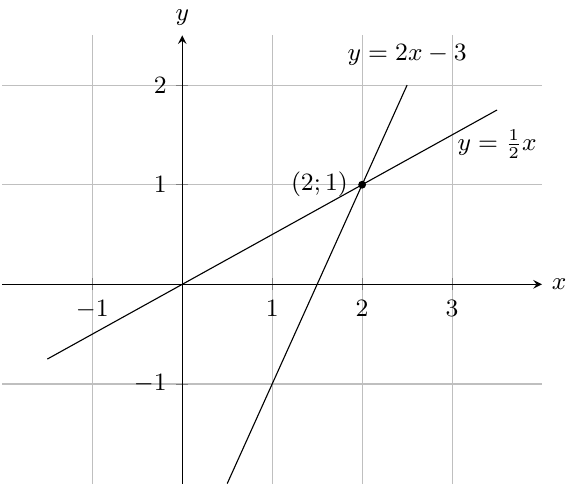
The graph shows two lines: and intersecting at the point . This means and is the solution.
Example
Worked Example 5: Graphical solution
Question: Solve graphically:
Solution:
Step 1: Convert to form
From equation (1): , so
From equation (2): , so
Step 2: Plot both lines on the same axes
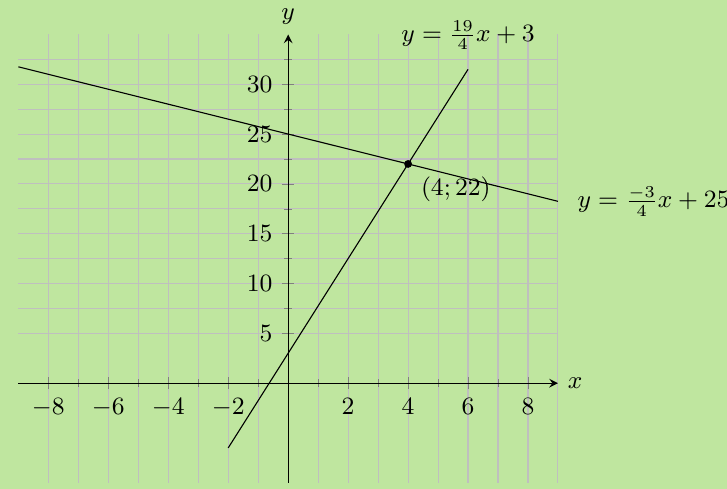
Step 3: The intersection point occurs at
Final answer: ,
You can verify this algebraically by substitution if needed. Both methods should give the same result!
Choosing the best method
Understanding when to use each method will help you work more efficiently:
- Substitution works well when one equation can be easily rearranged to express one variable in terms of the other
- Elimination is often faster when the coefficients are already similar or can be made equal with simple multiplication
- Graphical method is useful for visualising the solution and checking your algebraic work
Note
In exams, you might be told which method to use. If not, choose the method that seems easiest based on the coefficients and structure of your equations.
Exam tips
Important
Essential exam strategies:
- Always check your solution by substituting back into both original equations
- Show your working clearly - marks are awarded for method even if the final answer is incorrect
- When using elimination, be careful with signs when adding or subtracting equations
- For graphical solutions, ensure your scales are appropriate and you can read the intersection point accurately
Summary
Key Points to Remember:
-
Simultaneous equations require two equations to solve for two unknowns, and the solution must satisfy both equations at the same time
-
Substitution method: Express one variable in terms of the other, substitute, solve, then find the second variable
-
Elimination method: Make coefficients equal for one variable, then add or subtract equations to eliminate that variable
-
Graphical method: Plot both lines and find their intersection point - this gives you the solution coordinates
-
Always verify your answer by substituting back into both original equations to ensure both are satisfied